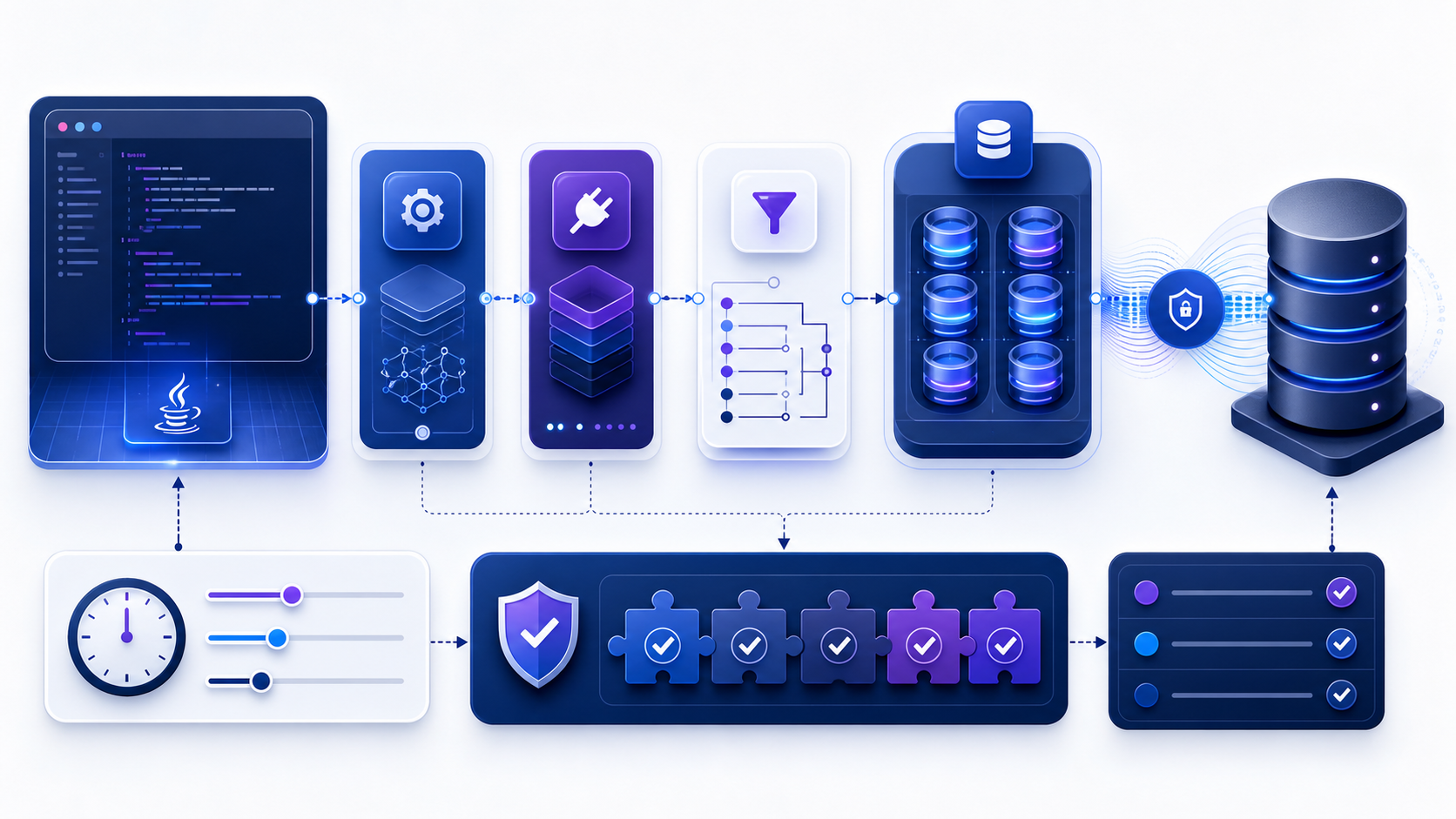
What does JDBC connection mean?
JDBC connection identifies a specific part of the path applications use to reach JDBC. A successful low-level test proves only that one stage responded. A usable database session also requires correct name resolution, route, the database-specific listener port, the database vendor protocol implemented by the JDBC driver, compatible client software, TLS trust, authentication, database selection and permission for the intended operation.
Troubleshoot from the client context that actually fails. Record time, source network, endpoint, driver and version, sanitized effective configuration, exact error, first failing stage and recent changes. Do not paste passwords, tokens, private keys or complete production connection strings into tickets or public tools.
Trace a JDBC connection from JVM to database
JDBC defines Java interfaces for database access; the selected driver implements those interfaces and the database wire protocol. A connection therefore depends on the JVM, application class path or module path, driver artifact and version, JDBC URL, properties, DNS and network path, TLS trust material, authentication method and database target. A generic “connection failed” message can originate before any network packet is sent or after a fully established database session.
Capture evidence from the deployed Java process. A command-line test can use a different JDK, trust store, DNS configuration and driver JAR than the application server. Record the Java runtime vendor/version, effective class path, loaded driver class and artifact version, sanitized URL, non-secret properties, pool implementation and the complete chained SQLException. When a framework wraps the exception, retain the root cause and every next exception before changing configuration.
| JDBC layer | Typical signal | Next evidence |
|---|---|---|
| Driver discovery | No suitable driver or class-loading failure. | Runtime class path, module configuration, driver service registration and artifact version. |
| URL parsing | Driver rejects the URL or silently applies an unexpected default. | Vendor URL grammar, property precedence and resolved database target. |
| Transport and TLS | Timeout, refused socket or certificate-path error. | Resolved address, connect timeout, active trust store and certificate identity. |
| Database session | SQLState, vendor code, login rejection or wrong database context. | Chained exception, authentication mode, selected schema/catalog and server log. |
Treat the JDBC URL as vendor-specific configuration
All JDBC URLs begin with jdbc:, but the remaining syntax belongs to the driver vendor. Host lists, instance or service names, database selection, encryption, failover and property delimiters differ across PostgreSQL, MySQL, SQL Server and Oracle drivers. Copying a URL pattern from another driver can produce an immediate parse error—or a more dangerous connection to an unintended default database. Validate the URL against documentation for the exact driver version.
Define property precedence so operators know whether a value in the URL, a Properties object, framework configuration or environment variable wins. Avoid declaring the same security property in multiple places. At startup, log a redacted configuration summary that includes driver, endpoint class, database, TLS policy and timeout values but omits usernames when sensitive, passwords, tokens and private-key locations. This makes configuration drift observable without exposing secrets.
Compatibility rule: an accepted URL proves only that this driver parsed it. Verify the connected product/version and database identity with a bounded read-only query before running migrations or writes.
Design JDBC pool and timeout behavior together
A production JDBC call may wait in several different places: DNS resolution, socket connection, TLS handshake, authentication, pool acquisition, statement execution and network read. One large application-level timeout hides which budget was consumed. Configure bounded timeouts at the layers supported by the driver and pool, then report them separately. The pool acquisition timeout should reflect how long a request may wait for a reusable connection; it is not a substitute for a network connect timeout.
Size pools from workload concurrency and database capacity rather than multiplying a default by the number of application instances. A pool of 20 across 50 pods can create 1,000 possible sessions before operational or failover demand is counted. Define maximum pool size, minimum idle behavior, connection lifetime, idle timeout, leak detection and validation strategy as one capacity model. Add jitter to retirement so every instance does not replace connections simultaneously.
| Test | What it reveals | Required observation |
|---|---|---|
| Pool saturation | Whether callers fail within budget instead of waiting indefinitely. | Acquisition latency, waiting threads and timeout class. |
| Database restart | How stale pooled connections are detected and replaced. | Retry volume, recovery time and absence of a reconnect storm. |
| Certificate rotation | Whether new handshakes use the updated trust material. | Fresh and reused connection behavior before and after rotation. |
Preserve the complete SQLException chain
SQLException exposes a SQLState, vendor error code, cause and optional chain of next exceptions. The SQLState class can distinguish connection exceptions from authorization, syntax and transaction conditions, while the vendor code supplies product-specific precision. Log the ordered diagnostic chain with a correlation ID and operation phase. Do not flatten everything into HTTP 500 or “JDBC error,” and never include a URL containing a password.
Retry only when the error class and operation semantics permit it. A transient connection interruption before a read may be retryable; an authentication rejection, malformed URL or missing driver is deterministic until configuration changes. A transaction whose commit outcome is unknown requires reconciliation before replay, especially for non-idempotent writes. Define retry count, backoff, jitter and total deadline centrally so driver, pool and framework retries do not multiply one another.
- ClassifyUse SQLState class, vendor code and operation phase.
- Preserve contextRecord runtime, driver, sanitized target, pool state and elapsed time.
- Choose a safe actionRetry, fail fast, refresh configuration or reconcile the transaction according to evidence.
Accept a JDBC driver upgrade with behavior tests
A driver upgrade should be evaluated as an application dependency change, not a file replacement. Review release notes between the deployed and target versions for minimum Java level, removed properties, TLS defaults, authentication support, failover behavior and type-mapping changes. Build the target artifact through the normal dependency process so the test includes shading, module rules and transitive conflicts. At runtime, confirm which driver class and implementation version the JVM actually loaded.
The canary suite should open fresh and pooled connections, validate server identity, bind representative parameter types, read metadata, commit and roll back controlled transactions, cancel a bounded query and recover after a planned database interruption. Compare latency and error classification with the baseline rather than requiring byte-for-byte log equality. Record unsupported scenarios and an explicit rollback trigger. Remove the old driver only after every deployment unit has restarted and runtime evidence confirms the target version is loaded.
A repeatable JDBC connection diagnostic workflow
Move from observed runtime context to the first failing stage, then validate the smallest safe correction.
- Capture the exact contextRecord time, runtime identity, source network, driver/version, sanitized configuration, endpoint, database and error.
- Resolve the effective destinationVerify DNS answers, route, proxy and the exact the database-specific listener port used by the process.
- Test transport and TLSMeasure socket and handshake stages separately; verify trust chain and server identity.
- Test identity and target scopeValidate driver-supported credentials, integrated identity, Kerberos, certificates, IAM or tokens, database or service selection and effective permissions.
- Run a minimal safe operationUse a deterministic, bounded, read-only operation before representative workload testing.
- Correct, retest and monitorChange one controlled variable, preserve rollback, retest from the failing context and watch recurrence.
Prepare JDBC connection evidence for compatibility review
Prepare sanitized engine and version, client runtime, driver and version, source environment, endpoint, the database-specific listener port, database or service, TLS mode, authentication method, effective non-secret properties, exact error, first failing stage and recent changes. Never include passwords, tokens, private keys or unredacted production strings.
Review JDBC connection compatibility
Use the InfiniSynapse DB Compatibility Checker to organize engine, driver, endpoint, protocol and TLS questions from sanitized evidence. Treat the output as guidance, then validate the real workload path, permissions, performance and failure behavior in an approved environment.
Open DB Compatibility CheckerJDBC connection FAQ
What is JDBC connection?
JDBC connection identifies a defined component of the connection path used to reach JDBC; it does not by itself prove authentication, authorization or query success.
How do I test JDBC connection?
Test from the failing runtime in stages: configuration, DNS, route, transport, TLS, protocol, authentication, database selection and a minimal safe operation.
Why does JDBC connection connect but login fail?
Transport success reaches the listener, while login depends on identity, secret, authentication method, source rule, account state and target database context.
Should JDBC connection be open to the internet?
Normally no. Prefer private connectivity and narrowly scoped allowlists. If public exposure is unavoidable, require verified TLS, strong identity, monitoring and explicit risk approval.
What information is safe to share when troubleshooting JDBC connection?
Share sanitized versions, endpoint class, port, driver, TLS mode, authentication type, exact error and stage timing. Never share passwords, tokens, private keys or full production strings.
How can I avoid JDBC connection outages during change?
Inventory consumers, test compatibility, canary the change, keep overlap and rollback, monitor new and old paths, and remove temporary access only after traffic proves completion.