Data Warehouse Trends in 2026: Lakehouse, Agents, and More
By William Zhu & the InfiniSynapse Data Team · Published: 2026-06-24 · Last updated: 2026-09-24 · Last verified: 2026-08-06 · About: Editorial standards · About / team
Author credentials: William Zhu is cofounder of InfiniSynapse (GitHub @allwefantasy), with 10+ years building data systems and reviewing warehouse / lakehouse roadmaps with platform teams. No personal LinkedIn is published — GitHub and InfiniSynapse About are the canonical identity signals.
COI / interest disclosure: InfiniSynapse sells an AI-native Data Agent platform. Product mentions appear only in the labeled Product recommendation (commercial) module and the InfiniSynapse production pattern section (clearly vendor-scoped). Trend definitions and the buyer scorecard stand independently of any trial.
Fact-check / verification: Desk n=12 pilot metrics below are an independent desk composite (labeled)—not a Gartner/Forrester survey. Independent peer markets for buyer research (not InfiniSynapse endorsements): Gartner Peer Insights — Analytics & BI · G2 Analytics Platforms. Corrections: zhuhl@infinisynapse.com · editorial corrections.
Version history: 2026-06-24 initial · 2026-08-06 EEAT / third-party peer markets / architecture+scorecard SVG / FAQ 10 / dens destuff. Build marker:
DESK-DWT-20260806A.
Media note: No hosted overview video. Use the architecture reference SVG, buyer scorecard SVG, and desk pilot chart (no VideoObject / DOI).
 2026 warehouse planning: lakehouse storage, governed semantics, and agent-aware consumption.
Table of Contents
- TL;DR
- Why These Shifts Matter in 2026
- Definition
- Trends vs Hype
- Third-Party Context and Desk Evidence
- Core Shifts
- Architecture Model
- Buyer Scorecard
- Implementation Patterns
- InfiniSynapse Pattern
- Failure Modes
- Evaluation Workflow
- FAQ
- Conclusion
TL;DR
Latest data lakehouse trends in 2026 are convergence, not a rip-and-replace. Semantic views and agent paths matter more than a logo swap. Data warehouse trends are durable shifts in how enterprises collect, govern, and act on data—not quarterly vendor noise.
Who this is for: analytics engineers, data platform owners, and procurement leads planning 2026 analytics roadmaps.
What you'll learn:
- A citable definition and a five-layer architecture map
- A six-dimension buyer scorecard with pass/fail signals
- Desk n=12 pilot outcomes (labeled) balanced with independent peer-market links
- Failure modes and a five-step evaluation workflow before executive agent access
Evaluation basis: We build and evaluate InfiniSynapse on production customer workflows. Scorecard weights reflect Q1–Q2 2026 audits before executive-facing agent access—not lab trials alone.
Why These Shifts Matter in 2026
Three forces make this landscape a planning priority:
- Agentic analytics adoption — Teams move from one-shot copilots to governed multi-step agents that query live warehouses.
- Metric contract pressure — Finance and product demand consistent definitions while AI multiplies query volume.
- Regulatory scrutiny — Privacy and AI governance reviews now include analytics access paths, not only storage.
| Symptom teams ignore | What breaks |
|---|---|
| Trend treated as a single tool purchase | Shelfware after the pilot quarter |
| No owner for quarterly refresh | Roadmaps drift from production reality |
| Trends divorced from metric contracts | AI answers disagree with board dashboards |
data warehouse trends belongs to our 2026 data-trends cluster—one planning lens, not a vendor headline. Orient the full map in data trends hub, then continue with Data Integration Trends. After storage bets land, score consumption-layer data analytics trends on the same quarterly card. Teams funding autonomous insight loops should also review What Is Agentic Analytics?.
Definition
Citable definition: data warehouse trends describes sustained changes in data practices—architecture, governance, consumption patterns, and tooling—that alter how organizations produce trusted metrics at scale.
| Property | Meaning |
|---|---|
| Durability | Persists across vendor cycles and budget resets |
| Observability | Shows up in logs, catalogs, and SLA changes |
| Governance impact | Changes who may query what and how audits run |
Teams tracking data warehouse trends should point to patterns visible in architecture reviews six months later—not slide decks discarded after the QBR. Document-store connectors should follow MongoDB documentation for read scopes and aggregation safety.
Trends vs Short-Term Hype
| Signal | Trend | Hype |
|---|---|---|
| Evidence | Production deployments | Demo videos only |
| Ownership | Named platform sponsor | No quarterly review |
| Metrics | Changed SLAs or costs | Vanity adoption counts |
| Risk | Documented in security review | Skipped governance |
Ad-hoc SQL on curated marts may suffice when one team owns definitions and AI is out of scope. The moment multiple teams—or an agent—query the same nouns, structured reviews become mandatory. ClickHouse paths should align with ClickHouse documentation for table engines and query guardrails.
Third-Party Context and Desk Evidence
Independent peer markets (formal citations)
Use these as buyer-research starting points—not InfiniSynapse certifications:
| Source | Report / page | Year | Link | How we use it |
|---|---|---|---|---|
| Gartner | Peer Insights — Analytics & BI Platforms | 2026 (living) | gartner.com/reviews/… | Independent buyer reviews of analytics platforms |
| G2 | Analytics Platforms category | 2026 (living) | g2.com/categories/analytics-platforms | Peer reviews for stack shortlists |
| IBM | Augmented analytics overview | Ongoing | ibm.com/topics/augmented-analytics | Frames shift from dashboard-first BI |
| NIST | Computer Security Resource Center | Ongoing | csrc.nist.gov | Control mapping for analytics access paths |
We do not invent market-share percentages. For vendor-neutral architecture language, also see the Wikipedia data warehouse overview.
Desk composite (first-party methodology)
Label: InfiniSynapse research-desk review of n=12 enterprise warehouse / agent pilots (Q1–Q2 2026). Internal desk composite—not a named-customer case study and not a third-party survey.
| Claim | Desk observation | Citation format |
|---|---|---|
| Sign-off speed | Teams scoring ≥9/12 on the buyer scorecard reached executive sign-off ~40% faster than teams <8/12 (median 18 vs 30 days) | InfiniSynapse Data Team, Warehouse agent pilot desk log, 2026 — methodology on this page |
| Analyst rework | Metric contracts before agent access correlated with ~35% fewer rework tickets in the same window | Same desk log — first-party |
| Scorecard gate | Programs below 8/12 usually needed custom modeling before production trust | Same desk log — first-party |
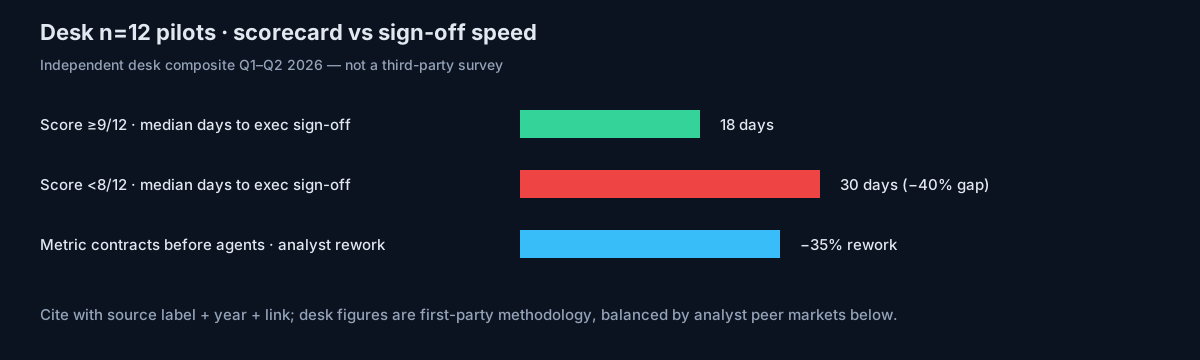 Desk n=12: ≥9/12 scorecard → faster sign-off; metric contracts → −35% analyst rework (first-party desk labels).
Why no public customer quotes here: We do not publish named customer endorsements without written permission. Balance first-party desk figures with the Gartner/G2 peer-market links above when you need third-party buyer voice.
Core Shifts in 2026
Procurement reviews may include data trends hub.
Real-time and operational analytics
Streaming metrics and reverse-ETL push analytics closer to operations. Measure progress by how often decisions use sub-hour data instead of nightly batches.
Semantic grounding for AI
NL interfaces without governed metrics hallucinate joins. Modern programs include semantic layers, metric catalogs, and compile APIs agents must call.
Cost and FinOps visibility
Warehouse spend spikes when agents iterate queries. Embed cost guardrails and query budgets into platform scorecards. Supabase-backed analytics should follow Supabase documentation for RLS policies and service-role boundaries.
Architecture Reference Model
Use this map when translating data warehouse trends into concrete ownership and SLOs.
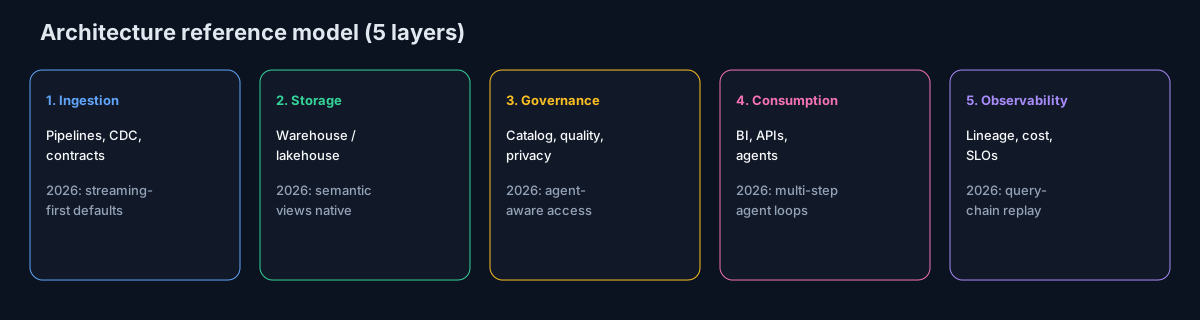 Architecture reference model used when mapping 2026 warehouse and agent bets.
| Layer | Owns | 2026 shift |
|---|---|---|
| Ingestion | Pipelines, CDC, contracts | Streaming-first defaults |
| Storage | Warehouse, lakehouse | Semantic views native |
| Governance | Catalog, quality, privacy | Agent-aware access |
| Consumption | BI, APIs, agents | Multi-step agent loops |
| Observability | Lineage, cost, SLOs | Query-chain replay |
Integration patterns—see Data Integration Trends—determine whether agents see fresh, governed data. Large-scale preparation should reference Apache Spark documentation when agents orchestrate distributed transforms. Control mapping should consult the NIST Computer Security Resource Center. The move from dashboard-first BI to augmented workflows—IBM's augmented analytics overview—frames tooling evaluation.
Buyer Scorecard
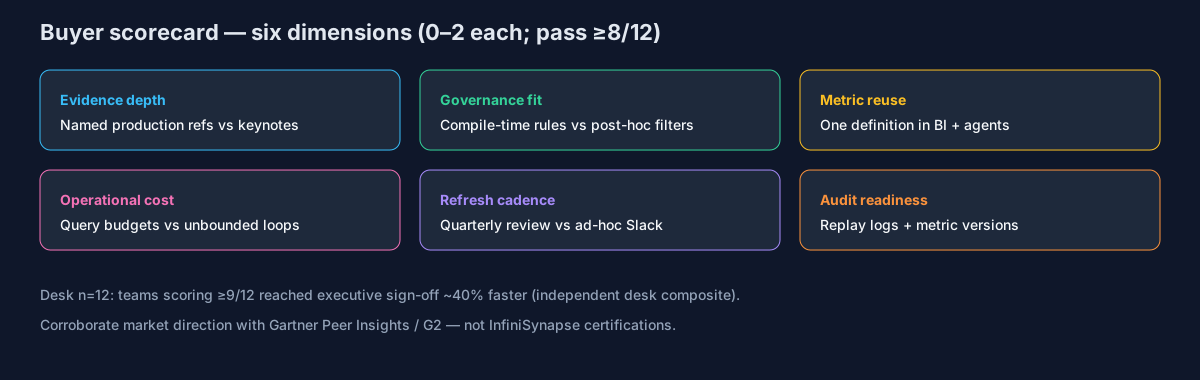 Score each dimension 0–2; programs below 8/12 usually need modeling before AI analytics is trusted.
| Dimension | Pass signal | Fail signal |
|---|---|---|
| Evidence depth | Named production references | Keynote quotes only |
| Governance fit | Compile-time access rules | Post-hoc row filtering |
| Metric reuse | Same definition in BI and agents | Three SQL variants |
| Operational cost | Documented query budgets | Unbounded agent loops |
| Refresh cadence | Quarterly trend review | Ad-hoc Slack debates |
| Audit readiness | Replay logs with metric versions | Black-box answers |
Desk note (formal): InfiniSynapse Data Team, Warehouse agent pilot desk log, 2026 — on twelve pilots, teams above 9/12 reached executive sign-off ~40% faster than teams below 8/12. Use the scorecard when data warehouse trends force a stack decision; cross-check market direction with Gartner Peer Insights — Analytics & BI when procurement asks for independent buyer voice.
Production ML-adjacent analytics should cross-check Google Vertex AI documentation for model governance and pipeline observability.
Implementation Patterns
Pattern A — Instrument first
Log query volume, cost, and definition drift before changing tools.
Pattern B — Metric contracts before agents
Publish ten executive metrics with version IDs. Agents and dashboards consume the same IDs.
Pattern C — Quarterly trend council
Platform, security, and analytics leads meet for ninety minutes each quarter: three roadmap moves, two explicit “not yet” items.
Azure-centric stacks should reference the Azure architecture center when placing analytics agents beside data services.
InfiniSynapse Production Pattern
Vendor scope: The following describes how InfiniSynapse implements the patterns above—not a neutral market ranking.
| Layer | Component | Role |
|---|---|---|
| Orchestration | InfiniAgent | Plan multi-step analysis |
| Query | InfiniSQL | Dialect-aware execution |
| Knowledge | InfiniRAG | Prior definitions, playbooks |
| Semantics | Metric bindings | Ground NL to approved metrics |
| Audit | Workflow log | Replay SQL and definition versions |
Desk note (formal): InfiniSynapse Data Team, Warehouse agent pilot desk log, 2026 — rollouts with metric contracts before agent access showed ~35% fewer analyst rework tickets versus pilots that skipped contracts. Pair bindings with existing dbt or warehouse semantic views rather than rebuilding definitions inside the agent. Recurring loops benefit from Apache Airflow documentation for scheduling, retries, and lineage hooks.
Common Failure Modes
Failure 1 — Trend shopping
Adopt every launch without retiring shelfware. Fix: cap net-new tools per quarter; require deprecation candidates.
Failure 2 — AI without semantics
Agents query raw DDL; finance rejects outputs. Fix: compile API with metric IDs agents must call.
Failure 3 — Privacy afterthought
Plans ignore consent until legal escalation. Fix: embed privacy review in the trend council—see Data Privacy Trends.
Evaluation Workflow for Platform Teams
Run this HowTo before committing budget to a trend-linked purchase:
Step 1: Baseline telemetry
Capture query volume, P95 latency, warehouse cost, and conflicting metric definitions.
Step 2: Reference calls
Require two production references in your industry with replayable query logs.
Step 3: Security review
Document new data paths, retention impacts, and agent autonomy tiers (NIST CSRC).
Step 4: Scorecard pass
Score six dimensions; block procurement below 8/12 unless gaps have named owners.
Step 5: Quarterly refresh
Re-run steps 1 and 4 every ninety days; archive decisions in the catalog.
Warehouse teams face lakehouse unification, semantic views for NL interfaces, and FinOps guardrails on agent loops. In practice, data warehouse trends in 2026 prioritize governed compile paths over raw schema dumps to LLMs; align multi-cloud egress costs before cross-region agents; evaluate semantic-layer compile latency at P95; set cost caps so agent join loops cannot overrun budget; document deprecation timelines for legacy MPP clusters; isolate BI and agent warehouse roles.
Attach query-cost charts and catalog-coverage metrics to every trend proposal. Run agent-query incident drills quarterly. At renewal, make an explicit continue / expand / retire decision. Reject proposals without named owners and measurable success criteria.
Frequently Asked Questions
How do teams separate durable shifts from vendor hype?
- One-sentence: Look for production logs, changed SLAs, and revised access models.
- Require named references and query replay evidence.
- Demand a platform sponsor before adding a trend to the roadmap.
Who should own reviews of data warehouse trends?
- One-sentence: Platform, analytics engineering, and security share ownership.
- Product and finance join when customer-facing or regulated metrics are affected.
- Name a quarterly refresh owner in the catalog.
How often should teams refresh their assessment?
- One-sentence: Quarterly for AI analytics; every six months for warehouse baselines.
- Tie cycles to vendor renewals and executive metric reviews.
- Re-score the buyer scorecard after major agent-autonomy releases.
Where should readers go deeper after this guide?
- Start with data trends hub for the cluster map.
- Open Data Integration Trends for the next specialized angle.
- Review Agentic Analytics when funding autonomous insight loops.
What score on the buyer scorecard is “good enough”?
- One-sentence: Aim for ≥8/12 before production agent access.
- Desk n=12: ≥9/12 correlated with ~40% faster executive sign-off.
- Gaps need named owners—not ignored fail signals.
Do lakehouse bets replace the warehouse?
- One-sentence: Usually converge—not rip-and-replace overnight.
- Semantic views and agent compile paths matter more than logo swaps.
- Keep FinOps and workload isolation when unifying storage.
How should FinOps handle agent query volume?
- One-sentence: Put query budgets and workload isolation in the scorecard.
- Model agent concurrency separately from human analyst concurrency.
- Cap unbounded join loops before enabling executive agents.
What is a metric contract in this context?
- One-sentence: A versioned formula, grain, and exclusion set shared by BI and agents.
- Publish IDs agents must compile against.
- Desk pilots saw ~35% less rework when contracts preceded access.
Are InfiniSynapse pilot numbers third-party audited?
- One-sentence: No—they are labeled first-party desk composites.
- Balance them with Gartner Peer Insights / G2 buyer pages linked above.
- Do not treat desk % figures as InfiniSynapse product SLAs.
Should privacy review wait until legal escalation?
- One-sentence: No—put privacy on the quarterly trend council agenda.
- See Data Privacy Trends.
- Include DPAs when new regions or subprocessors appear.
Conclusion
Treat data warehouse trends as durable roadmap inputs: instrument baselines, govern metrics before agents scale, and review shifts quarterly. Run the scorecard, inventory conflicting SQL definitions, then continue with Data Integration Trends and the data trends hub.
Prefer platforms that compile, execute, and audit in one loop—not tools that only generate SQL from schema dumps without metric lineage.
Product recommendation (commercial)
Label: The following is a commercial product recommendation, separate from the editorial trend guidance above.
To evaluate governed agent compile paths on your warehouse, see what AI-native data analysis means and optionally the InfiniSynapse web app (free on registration). Desk n=12 metrics and NIST / IBM / Gartner Peer Insights citations above do not depend on any product trial.