
What customer retention software actually does客户留存软件究竟做什么
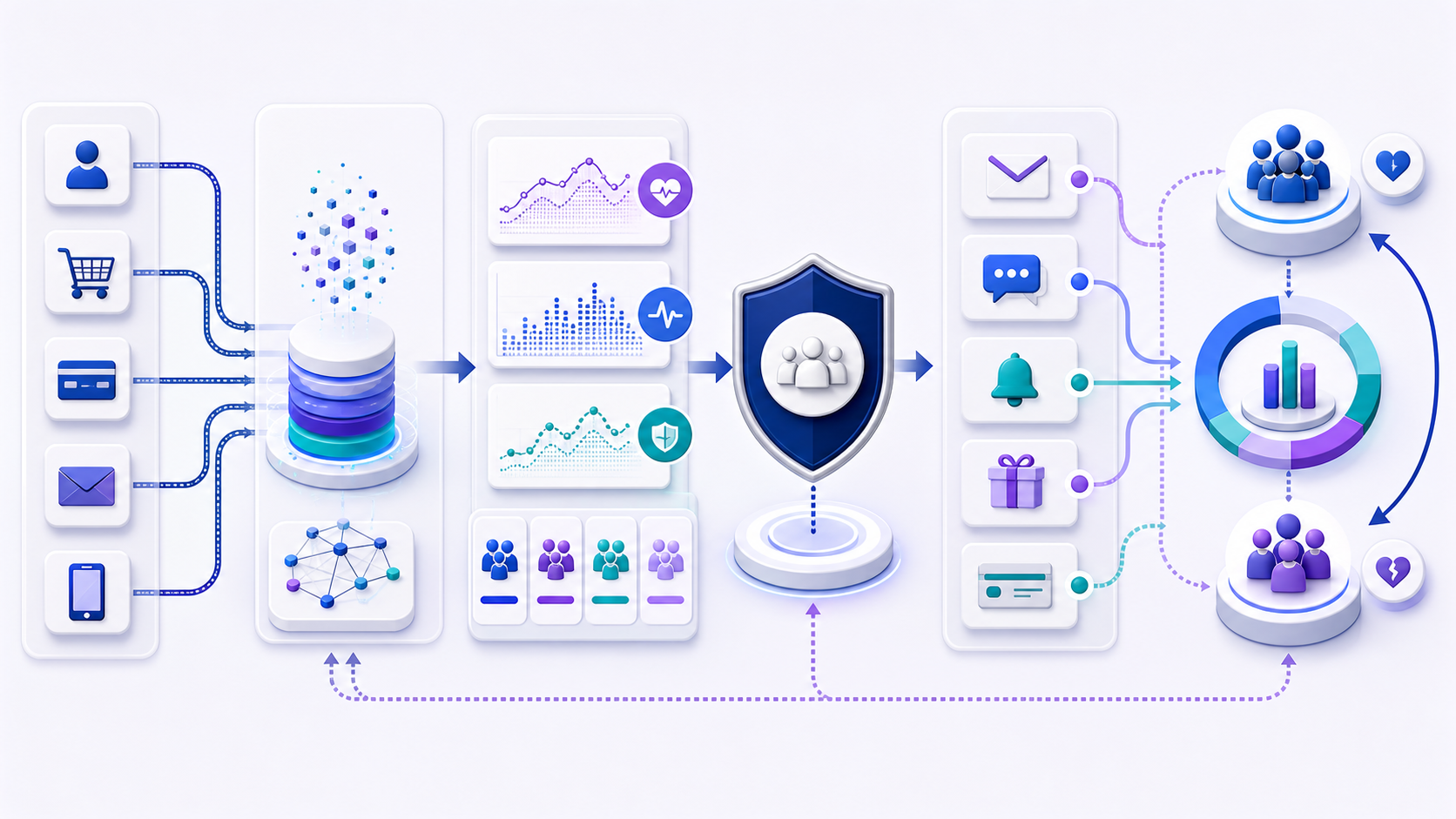
Customer retention software is a category of tools that helps a team measure continued customer activity, identify risks or opportunities, coordinate a proportionate response, and verify whether the response improved retention. It is not one universal product type: analytics, customer success, CRM, support, messaging, feedback, subscription recovery, and loyalty platforms cover different parts of that loop.
客户留存软件是一类帮助团队衡量客户持续活跃度、识别风险或机会、协调适度响应,并验证响应是否改善留存的工具。它并非单一统一的产品类别;分析、客户成功、CRM、支持、消息、反馈、订阅挽回和忠诚度平台分别覆盖闭环中的不同环节。
The best fit is therefore the smallest dependable stack that closes your specific gap. A subscription business may need account health, renewal workflow, and product-usage data. An ecommerce team may need repeat-purchase cohorts, lifecycle messaging, and loyalty operations. A high-touch service business may need a CRM, support history, task ownership, and renewal forecasting. Buying a broad platform before defining the decision often produces another dashboard with unclear ownership.
因此,最佳选择通常是能够补齐具体缺口的最小可靠工具组合。订阅业务可能需要账户健康度、续约流程和产品使用数据;电商团队可能需要复购群组、生命周期消息和忠诚度运营;高接触服务业务则可能需要 CRM、支持历史、任务归属和续约预测。在尚未定义决策之前购买庞大平台,往往只会增加一个归属不清的仪表盘。
When customer retention software is—and is not—the right answer客户留存软件何时适用,何时不适用
Teams repeatedly decide which accounts need review, which onboarding step failed, or which cohort needs a measured intervention.
团队需要反复决定哪些账户应被审阅、哪个引导步骤失败,或哪个群组需要可衡量的干预。
Customer identity, product or purchase events, billing, support, consent, and outcomes can be joined at a documented grain.
客户身份、产品或购买事件、账单、支持、同意与结果可以按明确粒度连接。
Software cannot compensate for weak product-market fit, unreliable service, unresolved defects, or a price-value mismatch.
软件无法弥补产品市场匹配不足、服务不可靠、缺陷未解决或价格与价值不匹配。
A risk score has little value when nobody can review it, contact the customer, fix the root problem, or measure the result.
如果无人审阅风险、联系客户、修复根因或衡量结果,风险评分本身几乎没有价值。
Start with the operating constraint, not the feature list. If the main issue is failed card payments, subscription recovery may matter more than predictive scoring. If new users never reach a key activation event, product analytics and guided onboarding may matter more than a loyalty program. If high-value accounts leave after unresolved cases, support quality and ownership may be the controlling layer.
应从运营约束而不是功能清单开始。如果主要问题是银行卡扣款失败,订阅挽回可能比预测评分更重要;如果新用户从未完成关键激活事件,产品分析和引导式入门可能比忠诚度计划更重要;如果高价值账户因未解决工单而离开,支持质量和归属机制可能才是决定性环节。
Choose a customer retention platform by the job it must perform按要完成的任务选择客户留存平台
| Category类别 | Best for最适合 | Required evidence所需证据 | Common limitation常见局限 |
|---|---|---|---|
| Retention analytics留存分析 | Cohorts, churn diagnosis, segment comparison, experiment readouts群组、流失诊断、分群比较、实验复盘 | Stable identities, dated events, eligibility and outcome rules稳定身份、带日期事件、资格与结果规则 | May not execute outreach or own cases可能不执行触达,也不负责任务 |
| Customer success software客户成功软件 | B2B account health, renewals, playbooks, ownershipB2B 账户健康、续约、行动手册与归属 | Account hierarchy, contracts, usage, support, relationship data账户层级、合同、使用、支持与关系数据 | Health scores can hide weak definitions健康评分可能掩盖薄弱定义 |
| CRM and serviceCRM 与服务 | Account history, tasks, communications, case resolution账户历史、任务、沟通与工单解决 | Clean contacts, ownership, activity and case states干净联系人、归属、活动和工单状态 | Often lacks detailed product behavior通常缺少详细产品行为 |
| Lifecycle engagement生命周期互动 | Email, in-app, push, education, and journey orchestration邮件、应用内、推送、教育与旅程编排 | Consent, channel reachability, triggers, suppression rules同意、渠道可达性、触发与抑制规则 | Automation can amplify wrong targeting自动化可能放大错误定向 |
| Feedback and experience反馈与体验 | Surveys, interviews, sentiment, themes, service recovery调查、访谈、情感、主题与服务补救 | Representative invitations, response context, linkage permission有代表性的邀请、回答背景与连接权限 | Respondents may not represent silent churners回答者可能无法代表静默流失者 |
| Loyalty or subscription recovery忠诚度或订阅挽回 | Rewards, repeat purchase, failed-payment recovery奖励、复购与失败付款挽回 | Transaction economics, eligibility, fraud and margin controls交易经济性、资格、欺诈和毛利控制 | Incentives can subsidize behavior that would occur anyway激励可能补贴原本就会发生的行为 |
A suite can span several categories, but breadth is not proof of fit. Check the depth of each needed workflow, the source of every field, the handoff between teams, and the export path. A capable analytics layer plus an existing CRM may outperform an all-in-one platform if the latter cannot reproduce your definitions or integrate with the systems that hold the truth.
一个套件可以跨越多个类别,但广度并不能证明适配性。应检查每个必要工作流的深度、每个字段的来源、团队间的交接以及导出路径。如果一体化平台无法复现你的定义或连接权威系统,那么可靠的分析层加现有 CRM 可能反而更合适。
Prepare the decision, data, and operating contract before demos演示前先准备决策、数据与运营约定
A vendor demo is easy to impress with polished dashboards. A defensible evaluation starts with a written packet that every vendor must use. Prepare:
供应商演示很容易用精美仪表盘制造好印象。可辩护的评估应从所有供应商都必须遵循的书面材料开始。请准备:
- One decision: for example, “Which first-90-day business accounts should receive a human onboarding review each week?”
- A retention contract: eligible population, retained event, churn event, observation window, grace period, reactivation, and exclusions.
- A source map: systems of record, entity keys, timestamps, refresh frequency, owners, permissions, and known quality failures.
- An action map: who reviews a signal, permitted interventions, service-level expectations, escalation, suppression, and opt-out handling.
- Success and guardrails: incremental retention or renewal, adoption, time saved, false-positive workload, contact fatigue, complaints, margin, and group-level effects.
- 一个决策:例如“每周哪些进入前 90 天的企业账户应接受人工引导审查?”
- 留存口径:合格总体、留存事件、流失事件、观察窗口、宽限期、重新激活与排除规则。
- 来源地图:权威系统、实体键、时间戳、刷新频率、负责人、权限与已知质量故障。
- 行动地图:谁审阅信号、允许的干预、服务时限、升级、抑制与退订处理。
- 成功指标与护栏:增量留存或续约、采用、节省时间、误报工作量、联系疲劳、投诉、毛利与群体影响。
Minimum-data warning: if customer identities cannot be reconciled or the churn event is not observable, do not begin with AI scoring. Fix measurement first. A sophisticated model trained on unstable labels produces precise-looking noise.
最低数据警告:如果客户身份无法对账,或流失事件不可观察,不要从 AI 评分开始。应先修复衡量口径。用不稳定标签训练复杂模型,只会产生看似精确的噪声。
How to choose customer retention software in seven steps分七步选择客户留存软件
Diagnose the gap. Decide whether the missing capability is measurement, insight, ownership, execution, or validation. Do not buy messaging automation to solve an identity problem.
诊断缺口。判断缺失的是衡量、洞察、归属、执行还是验证能力。不要用消息自动化解决身份问题。
Set mandatory scenarios. Write three to five realistic tasks with inputs, expected decisions, edge cases, and evidence. Include one failure scenario and one deletion or opt-out request.
设定强制场景。编写三到五个真实任务,注明输入、预期决策、边界情况和证据,并包含一个失败场景及一次删除或退订请求。
Separate must-have from optional. Identity, access, exports, auditability, and the core workflow are usually mandatory. Generative summaries, advanced prediction, and extra channels may be optional.
区分必需与可选。身份、访问、导出、可审计性和核心流程通常必需;生成式摘要、高级预测和额外渠道可能只是可选。
Verify integrations with evidence. Ask whether a connection is native, partner-built, API-only, batch, or custom. Confirm direction, supported objects, history, refresh, rate limits, retries, and error visibility.
用证据验证集成。确认连接是原生、合作伙伴构建、仅 API、批处理还是定制,并核实方向、支持对象、历史、刷新、速率限制、重试与错误可见性。
Run scripted demonstrations. Use the same scenarios and scorecard for every finalist. Require the vendor to show setup, exceptions, permissions, audit history, export, and correction—not only the happy path.
执行脚本化演示。对所有候选使用同一场景与评分表,要求展示设置、异常、权限、审计历史、导出与纠错,而不只是理想路径。
Pilot with representative users and data. Limit scope, document baseline, reconcile data, train actual operators, and measure adoption and workload as well as customer outcomes.
用代表性用户与数据试点。限制范围、记录基线、对账数据、培训真实操作者,并同时衡量采用、工作量与客户结果。
Decide with total evidence. Review security, privacy, accessibility, support, exit terms, implementation risk, total cost, and measured pilot value. Record assumptions and reasons for rejection.
依据完整证据决策。审查安全、隐私、无障碍、支持、退出条款、实施风险、总成本与试点价值,并记录假设和淘汰理由。
Score retention software on evidence, not feature count依据证据而不是功能数量评分
| Criterion标准 | Evidence to request应索取的证据 | Failure signal失败信号 |
|---|---|---|
| Data fidelity数据保真 | Entity matching, lineage, refresh, reconciliation, correction workflow实体匹配、血缘、刷新、对账与纠错流程 | Totals cannot be traced to source总数无法追溯到来源 |
| Analysis分析 | Cohort rules, denominators, filters, uncertainty, reproducible exports群组规则、分母、筛选、不确定性与可复现导出 | Metric definitions are fixed or opaque指标定义固定或不透明 |
| Workflow工作流 | Ownership, queues, approvals, suppression, escalation, audit trail归属、队列、批准、抑制、升级与审计轨迹 | Alerts have no accountable recipient警报没有可问责接收者 |
| AI and scoringAI 与评分 | Label definition, feature timing, validation, calibration, explanations, monitoring标签定义、特征时间、验证、校准、解释与监控 | Only an accuracy claim or proprietary score is shown只展示准确率承诺或专有评分 |
| Governance治理 | Roles, logs, retention, deletion, consent, regional controls, incident process角色、日志、保留、删除、同意、区域控制与事件流程 | Vendor cannot demonstrate a deletion path供应商无法演示删除路径 |
| Economics and exit经济性与退出 | Implementation, usage, storage, services, renewal, export, and migration costs实施、使用、存储、服务、续约、导出与迁移成本 | Price excludes required services or data volume报价排除了必要服务或数据量 |
Weight criteria before seeing vendor scores. A sample weighting might assign 25% to data and integration, 20% to the core workflow, 15% to governance, 15% to measurement, 10% to usability, 10% to total cost, and 5% to vendor operations. These are hypothetical example weights, not a universal recommendation. A mandatory security or deletion failure should remain disqualifying even if the weighted total is high.
应在查看供应商得分之前确定权重。一个假设示例可以把 25% 分配给数据与集成,20% 给核心工作流,15% 给治理,15% 给衡量,10% 给易用性,10% 给总成本,5% 给供应商运营。这些只是示例权重,并非通用建议。即使加权总分很高,强制安全或删除要求失败也仍应构成淘汰条件。
Pilot customer retention tools before committing to rollout全面推广前先试点客户留存工具
Hypothetical example: a B2B subscription team wants to improve first-renewal preparation. It defines eligible accounts as new paid accounts with at least 60 days of observable history, excludes contracted nonrenewals, and assigns half of eligible regions to phased onboarding review while comparable regions retain the current process. The software must join account, usage, support, and contract data; create a weekly review queue; log decisions; and export outcomes.
假设示例:一家 B2B 订阅团队希望改善首次续约准备。它把合格账户定义为拥有至少 60 天可观察历史的新付费账户,排除合同已确定不续约者,并让一半合格地区分阶段采用引导审查,其他可比地区继续当前流程。软件必须连接账户、使用、支持与合同数据,建立每周审查队列,记录决策并导出结果。
The team checks source reconciliation, queue precision, median review time, operator adoption, contact suppression, and data incidents before interpreting renewal. It then estimates incremental retained contribution—not just gross retained revenue—and subtracts license, implementation, data engineering, training, incentives, and operating time. Because regions were phased rather than perfectly randomized, the team labels causal conclusions as limited and tests sensitivity to baseline differences.
团队在解释续约结果前,先检查来源对账、队列精度、审阅时长中位数、操作者采用、联系抑制和数据事件。随后估算增量留存贡献,而非仅看留存收入总额,并扣除许可、实施、数据工程、培训、激励与运营时间。由于地区采用分阶段上线而非完美随机,团队应把因果结论标记为有限,并测试基线差异的敏感性。
Stop conditions: pause the pilot if data cannot reconcile, permissions are broader than approved, complaints rise materially, operators bypass the workflow, the model deteriorates, or the vendor cannot correct or export records. A pilot is designed to reveal failure safely, not to force a positive business case.
停止条件:如果数据无法对账、权限超出批准范围、投诉显著上升、操作者绕过流程、模型退化,或供应商无法纠正和导出记录,应暂停试点。试点的目的在于安全暴露失败,而不是强行证明商业价值。
Treat integration, privacy, and automated decisions as product requirements把集成、隐私与自动化决策视为产品需求
Retention systems often combine product behavior, transactions, support conversations, surveys, and account attributes. That breadth makes identity and access design consequential. Document the lawful or permitted basis for each source, minimize fields, separate analysis from activation permissions, restrict sensitive attributes, define retention periods, and test deletion propagation. A connector badge is not enough: require field-level mapping, failure handling, backfill behavior, and an owner for reconciliation.
留存系统常会组合产品行为、交易、支持对话、调查与账户属性,因此身份与访问设计十分关键。应记录每个来源的合法或许可依据,最小化字段,分离分析与激活权限,限制敏感属性,定义保留期,并测试删除传播。一个连接器标识并不够;还应要求字段级映射、故障处理、历史回填行为和对账负责人。
If software profiles people or uses automated decisions, involve privacy, legal, security, and affected operations early. The UK ICO guidance on automated decision-making and profiling explains relevant safeguards in its jurisdiction, while the NIST AI Risk Management Framework provides a voluntary structure for governing, mapping, measuring, and managing AI risk. These sources are guidance, not a substitute for advice applicable to your facts and location.
如果软件对个人进行画像或使用自动化决策,应尽早让隐私、法律、安全和受影响运营团队参与。英国 ICO 关于自动化决策与画像的指南解释了其管辖范围内的相关保障;NIST AI 风险管理框架则提供治理、映射、衡量与管理 AI 风险的自愿框架。这些来源属于指导,不替代针对具体事实与地区的专业意见。
Use InfiniSynapse for the retention analytics layer使用 InfiniSynapse 支持留存分析层
InfiniSynapse is an AI-powered data analysis environment for joint analysis across connected databases, files, documents, audio, and video. In a retention workflow, it can support preparation and analysis of governed source data: profiling schemas, reconciling totals, joining approved exports, defining cohorts, comparing segments, exploring support or feedback evidence, and producing reviewable analysis artifacts.
InfiniSynapse 是一个 AI 辅助数据分析环境,可对已连接数据库、文件、文档、音频和视频进行联合分析。在留存工作流中,它可支持受治理源数据的准备与分析,包括检查 Schema、对账总数、连接已批准导出、定义群组、比较分群、探索支持或反馈证据,并生成可审阅的分析产物。
It is not described here as a CRM, customer success case manager, loyalty platform, payment-recovery system, or automatic messaging service. It does not by itself prove why a customer left, guarantee a correct risk score, execute an outreach campaign, determine legal compliance, or guarantee improved retention. Use the specialized operational system that matches the action, and keep accountable people responsible for definitions, permissions, interpretation, and intervention approval.
本页不把它描述为 CRM、客户成功工单管理器、忠诚度平台、付款挽回系统或自动消息服务。它本身不能证明客户离开的原因,不能保证风险评分正确,不会执行触达活动、判断法律合规,也不保证改善留存。应使用与行动匹配的专用运营系统,并由可问责人员负责定义、权限、解释与干预批准。
Prepare a decision brief, customer or account key, data dictionary, dated usage or transaction events, billing and support fields, retention and churn rules, permitted supporting files, observation windows, exclusions, and trusted reconciliation totals. Then use InfiniSynapse to analyze the prepared evidence before choosing or configuring the operational retention stack.
请准备决策简报、客户或账户键、数据字典、带日期的使用或交易事件、账单与支持字段、留存和流失规则、获准使用的支持文件、观察窗口、排除规则与可信对账总数。随后可用 InfiniSynapse 分析已准备证据,再选择或配置运营留存工具组合。
Analyze prepared customer data with InfiniSynapse用 InfiniSynapse 分析已准备的客户数据For adjacent foundations, define churn, customer evidence, and decision-relevant segments before selecting the stack. Use the published marketing data analysis guide for campaign measurement, review the InfiniSynapse analysis features, and inspect the InfiniSynapse tool directory without assuming that an available tool replaces a specialized operational system.
作为相邻基础,应在选型前先定义流失、客户证据和与决策相关的细分。可使用已发布的营销数据分析指南处理活动衡量,查看InfiniSynapse 分析功能并检查InfiniSynapse 工具目录,但不要假定现有工具能够替代专用运营系统。
Common buying mistakes and a final validation checklist常见采购错误与最终验证清单
“Retention platform” can describe very different analytics, success, messaging, loyalty, and recovery products.
“留存平台”可能指完全不同的分析、客户成功、消息、忠诚度和挽回产品。
A score without label, timing, calibration, validation, and action ownership is not decision evidence.
缺少标签、时间、校准、验证与行动归属的评分不是决策证据。
A technically sound workflow can fail if queues, explanations, permissions, and timing do not fit real work.
如果队列、解释、权限与时机不适配真实工作,技术上合理的流程也会失败。
Customers who would stay anyway do not prove incremental impact; discounts and labor also reduce value.
原本就会留下的客户不能证明增量影响,折扣与人工也会降低价值。
Without documented exports, ownership, deletion, and migration, switching costs appear only after commitment.
如果没有明确导出、所有权、删除与迁移,转换成本只会在承诺后显现。
Automation scales both correct and incorrect decisions; validate the signal and response before expanding reach.
自动化会同时放大正确与错误决定;扩大覆盖前先验证信号和响应。
Before approval: reproduce retention metrics from source; verify every mandatory scenario; test missing, duplicate, late, deleted, and conflicting records; inspect role boundaries and audit logs; complete security and privacy review; document AI limitations; test accessibility and operator workload; reconcile pilot populations; compare incremental outcomes and total costs; confirm exports and termination terms; and assign owners for monitoring, correction, incident response, and periodic re-evaluation.
批准前:从来源复现留存指标;验证每个强制场景;测试缺失、重复、迟到、删除与冲突记录;检查角色边界和审计日志;完成安全与隐私审查;记录 AI 局限;测试无障碍与操作者工作量;对账试点总体;比较增量结果与总成本;确认导出和终止条款;并为监控、纠正、事件响应与定期重新评估指定负责人。
Customer retention software FAQ客户留存软件常见问题
It is a category of tools that helps teams measure continued customer activity, detect risks or opportunities, coordinate appropriate interventions, and evaluate whether those actions improved retention. Different products cover different layers, so one platform may not replace analytics, CRM, support, messaging, and loyalty systems.
它是一类帮助团队衡量客户持续活跃、发现风险或机会、协调适当干预,并评估行动是否改善留存的工具。不同产品覆盖不同层级,因此一个平台未必能取代分析、CRM、支持、消息和忠诚度系统。
Common requirements include reliable identity resolution, cohort and retention analysis, segmentation, integrations, workflow ownership, permission controls, audit logs, exports, and experiment measurement. Predictive scores or automated messaging are optional and should be selected only when the use case, data, and controls support them.
常见需求包括可靠身份解析、群组与留存分析、细分、集成、工作流归属、权限控制、审计日志、导出与实验衡量。预测评分或自动消息属于可选能力,只有当场景、数据与控制条件支持时才应采用。
It may be enough for a small, high-touch team that mainly needs account history, ownership, tasks, and outreach. It is usually insufficient when retention depends on detailed product events, subscriptions, support signals, experimentation, or automated lifecycle journeys.
对于主要需要账户历史、归属、任务和触达的小型高接触团队,CRM 可能足够;但当留存依赖详细产品事件、订阅、支持信号、实验或自动生命周期旅程时,CRM 通常不够。
Define one retention decision, map the required data and workflow, separate mandatory from optional capabilities, test vendors with representative scenarios, and run a controlled pilot using pre-agreed success, cost, security, and adoption criteria.
先定义一个留存决策,映射所需数据与工作流,区分强制和可选能力,用代表性场景测试供应商,再按预先约定的成功、成本、安全与采用标准执行受控试点。
Compare incremental retained contribution or revenue attributable to the workflow with software, implementation, data, training, and operating costs. Use a suitable control or phased rollout where possible, and track adverse effects such as discount cost, outreach fatigue, complaints, and unequal treatment.
应把工作流带来的增量留存贡献或收入,与软件、实施、数据、培训和运营成本比较。条件允许时使用合适对照或分阶段上线,并跟踪折扣成本、触达疲劳、投诉和不平等待遇等不利影响。
No software can guarantee prevention. A platform can surface signals, prioritize work, or execute configured actions, but signals may be wrong, causes may be misunderstood, and interventions may have no effect or cause harm. Human ownership and outcome validation remain necessary.
没有软件能保证防止流失。平台可以呈现信号、排列工作优先级或执行已配置行动,但信号可能错误、原因可能被误解、干预可能无效甚至造成伤害,因此仍需要人工负责和结果验证。
Sources and further verification来源与进一步核验
- Google Analytics retention overview documentation
- NIST AI Risk Management Framework
- UK ICO guidance on automated decision-making and profiling
- CISA guidance for choosing secure and verifiable technologies
Product capabilities, prices, integrations, and legal obligations change. Verify vendor documentation, contracts, security materials, and rules applicable to your organization before purchase. This guide provides an evaluation method, not a ranked vendor endorsement or legal advice.
产品能力、价格、集成与法律义务会变化。采购前应核验供应商文档、合同、安全材料以及适用于本组织的规则。本指南提供评估方法,不构成供应商排名推荐或法律意见。