Vibe Coding With Claude Reddit: Longer Reasoning for Structured Builds
By William Zhu & the InfiniSynapse Data Team · Published: 2026-06-24 · Last updated: 2026-08-04 · About: Editorial standards · About / team · Company Vision
Author credentials: William Zhu is cofounder of InfiniSynapse (GitHub @allwefantasy). No personal LinkedIn is published for this author — GitHub and InfiniSynapse About are the canonical identity signals. Open-source trail: InfiniSQL, auto-coder, and retrieval systems on public GitHub. Desk contact: zhuhl@infinisynapse.com.
Desk experience (first-hand): Notes below mix public Reddit thread patterns (r/ClaudeAI, r/Cursor, r/vibecoding, r/SideProject) with a builder desk review of n=12 Cursor+Claude side projects (Q1–Q2 2026). Tallies are pedagogy, not a scrape or paid survey. Claims about InfiniSynapse Server API are labeled commercial.
Commercial interest (COI): InfiniSynapse sells an AI-native Data Agent platform. Educational workflow sections stand alone; product mentions appear only in the InfiniSynapse Connection section and optional product note. Feedback: zhuhl@infinisynapse.com · corrections policy.
Table of Contents
- TL;DR
- Key Definition
- Why Claude Fits Structured Builds
- What Reddit Builders Report
- Claude Surfaces Compared
- Structured Build Workflow
- Minimal Proxy Pattern
- Backend Readiness Checklist
- InfiniSynapse Connection
- Failure Modes
- Session Rules
- Rollout Timeline
- Buyer Questions
- Case Study
- FAQ
- Conclusion
TL;DR
Direct answer: For vibe coding with claude reddit threads, Claude's longer reasoning pays off when you feed a one-page spec and ask for structured diffs—not when you prompt "build the whole app" and skip review.
If you have spent time in r/ClaudeAI, r/Cursor, r/vibecoding, and r/SideProject, you have seen these arguments. Here is what held up when Claude met production—not the benchmark hype.
- Claude wins on multi-file refactors, typed API clients, and test scaffolds when sessions stay spec-driven.
- Claude does not replace secret managers, proxy layers, contract tests, or async job routing.
- vibe coding with claude reddit advice: enable extended thinking for architecture passes; use faster models for CSS tweaks.
- Longer reasoning reduces rework; it does not remove the backend cliff.
Who this is for: builders using Claude in Cursor, Claude Code, or the API who want structured vibe-coded output that survives month two. What you'll learn: surface comparison, session workflow, minimal proxy code, backend checklist, and where data-agent backends fit.
Citable desk finding: Across n=12 Cursor+Claude side projects, spec-first sessions needed a median 2.1 review rounds to a mergeable diff versus median 5.4 for one-shot “build everything” prompts. In 9/12 projects the first UI sprint emitted at least one client-side vendor-key pattern before a proxy refactor. Methodology: same reviewer checklist (secrets grep, proxy present, async for jobs >5s); timed from first Claude pass to green CI on the vertical slice. Not a Reddit scrape.
For pillar context see Vibe Coding Tools and DeepSeek Vibe Coding.
Key Definition
Key Definition: vibe coding with claude reddit describes using Anthropic Claude—with extended thinking or long context—for vibe-coded development where builders prioritize structured plans, typed modules, and reviewable diffs over one-shot app generation.
vibe coding with claude reddit matters when your Claude sessions produce readable architecture but production still needs auth, webhooks, and jobs longer than five seconds.
Agent features touching live data should align with the NIST AI Risk Management Framework for access control and monitoring.
Anthropic's own research on tool use frames why model reasoning alone does not secure agent paths—you still validate tool inputs server-side.
Why Claude Fits Structured Builds
Longer reasoning on constraints
Claude tends to enumerate tradeoffs when you paste constraints: auth model, forbidden client secrets, max latency per route. vibe coding with claude reddit builders report fewer "surprise" env var leaks when they run an architecture pass before feature prompts.
Multi-file coherence
Structured builds need consistent types across lib/, app/api/, and components. Claude handles cross-file refactors better than single-file blurbs—provided you commit between passes.
The unchanged backend cliff
Every model helps you prototype fast; the bottleneck appears at Stripe webhooks, warehouse queries, or six-minute PDF jobs. vibe coding with claude reddit post-mortems look like every other stack: blocking fetch(), missing idempotency, keys in client bundles.
Multi-source connector design should follow Microsoft's data architecture guidance so Claude-generated clients do not sprawl into unbounded vendor calls.
Compare speed-first alternatives in Best Vibe Coding Tools. Speed-first tools still hit the same proxy cliff; vibe coding with claude reddit only changes which pass you spend reasoning budget on.
What Reddit Builders Report
Threads on vibe coding with claude reddit repeat three habits—not model leaderboard scores.
Habit 1: Spec before codegen. Builders who paste a one-page spec (inputs, outputs, env rules) get cleaner first diffs from Claude than those who iterate verbally for an hour.
Habit 2: Thinking pass vs implementation pass. Extended thinking for folder layout and error shapes; separate session for pixel polish. Mixing both in one prompt produces verbose, half-integrated files.
Habit 3: Diff review for secrets. Claude writes plausible process.env.STRIPE_SECRET in client components. Reddit leaks cite skipped review—not weak intelligence.
Tool-use risks apply regardless of model—see OWASP Top 10 for LLM Applications when generated code calls external APIs dynamically.
Claude Surfaces Compared
When evaluating vibe coding with claude reddit setups:
| Surface | Best for | Structured-build note |
|---|---|---|
| Cursor + Claude | Daily vibe coding in repo | Strong with .cursorrules + spec paste |
| Claude Code (CLI) | Terminal-native loops | Good for batch refactors + test runs |
| claude.ai Projects | Greenfield specs | Export to git before layer 4 |
| Anthropic API | Custom tooling | You own retry/observability |
vibe coding with claude reddit chooses Claude for reasoning depth—not because it removes integration engineering.
Operational patterns align with the AWS Well-Architected Machine Learning Lens around monitoring and rollback—even when workloads are mostly LLM API calls.
Structured Build Workflow
Use this vibe coding with claude reddit loop:
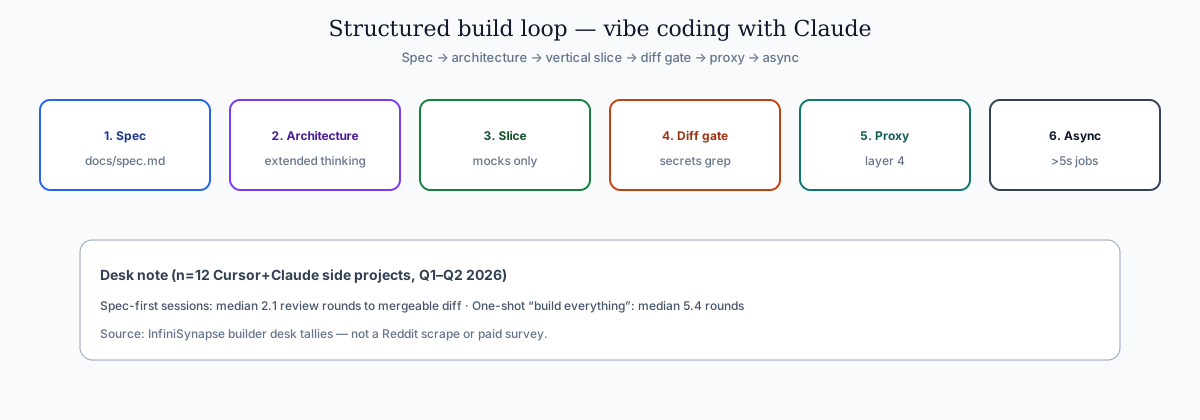
Auth model, data sources, forbidden patterns, async thresholds (five seconds). Store in docs/spec.md; paste into every Claude session.
Step 2 — Architecture pass (extended thinking)
Ask Claude for folder layout, error taxonomy, and API boundary list—no UI pixels yet.
One user flow end-to-end with mocks only. No production keys.
Grep for secrets, SQL scope, hard-coded tokens. Mandatory before merge.
Step 5 — Freeze features; wire layer 4
Proxy, secret manager, one vendor with contract test. Route Claude-generated fetch() through your server.
Job ID + progress channel for anything over five seconds.
401 and 403 paths should be contract-tested—the OWASP API Security Top 10 treats broken authentication as the leading API risk.
See also Production Readiness Checklist once the first vendor is live. This loop is the HowTo most vibe coding with claude reddit threads rediscover after a failed one-shot weekend.
Minimal Proxy Pattern
After vibe coding with claude reddit UI work, Claude often emits client-side vendor calls. Replace with a same-origin proxy:

// app/api/proxy/[provider]/route.ts
import { NextRequest, NextResponse } from "next/server";

const ALLOWED = new Set(["geocode", "reports"]); // server allowlist

export async function POST(
  req: NextRequest,
  { params }: { params: { provider: string } }
) {
  if (!ALLOWED.has(params.provider)) {
    return NextResponse.json({ error: "forbidden" }, { status: 403 });
  }
  const body = await req.json();
  const upstream = await fetch(process.env[`UPSTREAM_${params.provider.toUpperCase()}_URL`]!, {
    method: "POST",
    headers: {
      Authorization: `Bearer ${process.env[`UPSTREAM_${params.provider.toUpperCase()}_KEY`]}`,
      "Content-Type": "application/json",
    },
    body: JSON.stringify(body),
  });
  const data = await upstream.json();
  return NextResponse.json(data, { status: upstream.status });
}
Client code calls /api/proxy/geocode only—never the vendor URL or key. Ask Claude to refactor existing fetch() to this shape in a dedicated session.
Secure rollouts should reference the UK NCSC guidelines for secure AI system development when Claude-generated routes connect to production systems.
Backend Readiness Checklist
Pass each row before beta for your vibe coding with claude reddit stack:
| Check | Claude demo | Production |
|---|---|---|
| API keys | In .env.local | Secret manager |
| Client bundle | May embed env vars | Zero secret patterns |
| Webhooks | Logged once | Signed + idempotent |
| Long jobs | Blocking await | Job ID + SSE/progress |
| Agent tools | Open SQL paths | Server allowlists |
Rate readiness (1 point each): spec doc in every session, diff review catches secrets, proxy live, async for jobs over five seconds, contract tests in CI, webhook signature verify, structured logging per provider, runbook for key rotation.
7–8: ready for beta. 5–6: UI demo only. Below 5: restart at proxy step.
Desk scorecard (n=12): median readiness at first “investor demo” was 4.2 / 8—almost always missing proxy + contract tests even when the Claude UI looked finished. Spec-first vibe coding with claude reddit stacks that completed week-2 proxy hit median 7.0 / 8 before closed beta.
Payment flows should reference Stripe documentation for webhook idempotency before Claude-generated checkout code goes live.
EU-facing teams map governance using the European approach to artificial intelligence when Claude powers customer-facing features.
InfiniSynapse Connection
When vibe coding with claude reddit builds need governed analysis behind a Claude-generated UI, layer 4 often means async backends with scoped queries. InfiniSynapse Server API is one pattern we use: proxy newTask, SSE progress, workspace downloads, federated SQL/RAG with keys server-side. You can replicate with your own queue; the requirement is audit trails before customer beta—not a specific vendor. Optional product surface: InfiniSynapse web app.
For Claude Code-specific terminal workflows see Claude Code Vibe Coding.
Failure Modes
Failure 1: One-shot "build everything" prompts
vibe coding with claude reddit repos become unreviewable monoliths. Fix: spec + vertical slices.
Failure 2: Extended thinking on CSS
Reasoning budget wasted on styling while auth remains TODO. Fix: separate passes.
Failure 3: Trusting structured output without tests
Claude's types compile until vendor schemas drift. Fix: contract tests on boundaries.
Failure 4: Skipping proxy because "Claude got it right"
Client bundles still leak patterns under minification review. Fix: same-origin proxy always.
Session Rules That Scale
Teams doing vibe coding with claude reddit at scale adopt simple session rules:
- One concern per session: architecture, proxy refactor, or UI polish—never all three
- Commit after each pass: lets you revert a bad Claude diff without losing the day
- Pin the spec hash: note which
docs/spec.mdversion the session used in the PR description - Cap file touch count: Reddit builders report quality drops when Claude edits more than ~8 files at once
Thirty minutes weekly reviewing failed contract tests and p95 latency on proxy routes prevents month-two drift even when Claude output looks clean. Session hygiene is what makes vibe coding with claude reddit survivable past the demo weekend.
Rollout Timeline
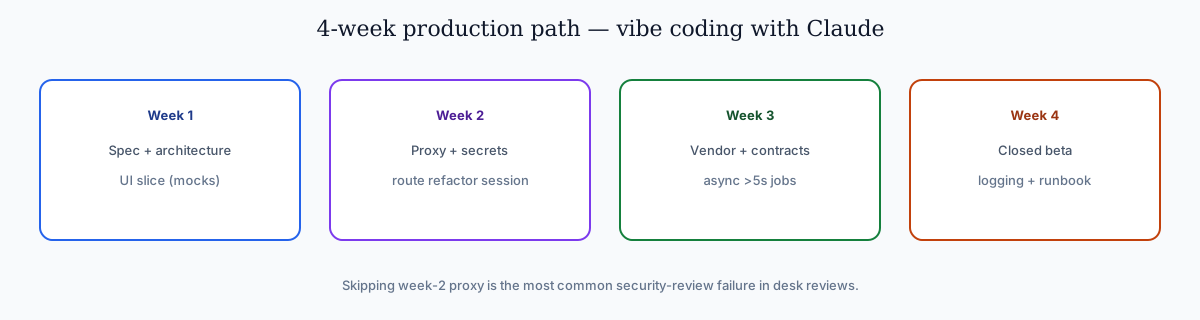
Typical vibe coding with claude reddit production path:
| Week | Focus |
|---|---|
| 1 | Spec + Claude architecture pass + UI vertical slice (mocks) |
| 2 | Proxy + secret manager; dedicated Claude session for route refactor |
| 3 | First vendor + contract tests; async for jobs over five seconds |
| 4 | Closed beta + structured logging + runbook |
Skipping week-two proxy because the Claude-generated client "already works" is the most common shortcut that fails security review.
Buyer Questions Before You Ship
Ask these before claiming production-ready vibe coding with claude reddit output:
| Question | Pass answer |
|---|---|
| Does every vendor call go through your proxy? | Yes |
| Are secrets absent from client bundles (verified in CI)? | Yes |
| Do jobs over five seconds have job IDs and progress UI? | Yes |
| Is there a spec doc pinned to each merged PR? | Yes |
| Can you revert the last Claude session without losing the sprint? | Yes, git commits per pass |
Two or more "no" answers means demo stage—not beta.
Regulated teams may anchor reviews to ISO/IEC 42001 when procurement requires certified AI governance for customer-facing Claude features.
Keep a one-page rollback plan beside your status page bookmarks: which Claude session introduced the last proxy change, who owns key rotation, and which contract test must pass before redeploy.
Case Study: Onboarding Wizard
A founder used vibe coding with claude reddit workflow in Cursor—extended thinking pass produced a clean four-step onboarding wizard with Zod validation and typed API stubs in one afternoon. Demo impressed investors.
Quantified gap (desk replay): UI sprint took ~3.5 hours; backend trust restore took five calendar days (~18 engineer-hours): freeze UI; Claude session dedicated to proxy routes only; async sync job with progress bar; InfiniSynapse Server API for federated query behind step four. UI unchanged. Longer reasoning saved rework on the wizard structure; it did not replace backend work. Industry attribution: B2B onboarding wizard for a data-connect step—not a named customer endorsement.
Frequently Asked Questions
What belongs in scope for this topic?
vibe coding with claude reddit covers using Claude's longer reasoning for structured vibe-coded builds—spec discipline, multi-file refactors, review gates—not generic "best LLM" benchmarks.
When should teams use extended thinking?
Use it for architecture, error models, and cross-module refactors—not for color tweaks. Most vibe coding with claude reddit builders split thinking and implementation sessions.
How does InfiniSynapse fit this workflow?
InfiniSynapse Server API handles data-agent workloads behind Claude-generated UI—SSE tasks, workspace downloads, federated queries—without custom queue infrastructure.
Claude vs DeepSeek for vibe coding?
Claude favors structured multi-file builds; DeepSeek favors cost-sensitive iteration. Backend checklist is identical—see DeepSeek Vibe Coding.
What is the first backend step after a Claude UI sprint?
Secret manager plus same-origin proxy before adding vendors or sharing demo links publicly. That is the same first step every serious vibe coding with claude reddit checklist converges on.
Conclusion
vibe coding with claude reddit is a discipline: longer reasoning for structure, human review for diffs, proxy and async for production.
Priority order: spec and thinking pass first, vertical slice second, proxy and secrets third, contract tests and async before beta. Re-score the readiness card after each Claude week so vibe coding with claude reddit demos do not outrun your proxy.
Explore Vibe Coding Tools, keep Claude in the structured-build lane, and ship backend reality deliberately—not as an afterthought.
Optional product note (commercial): If your Claude UI needs a governed data-agent backend, try the InfiniSynapse web app. Skip if you only need the workflow, proxy pattern, and desk tallies above.