
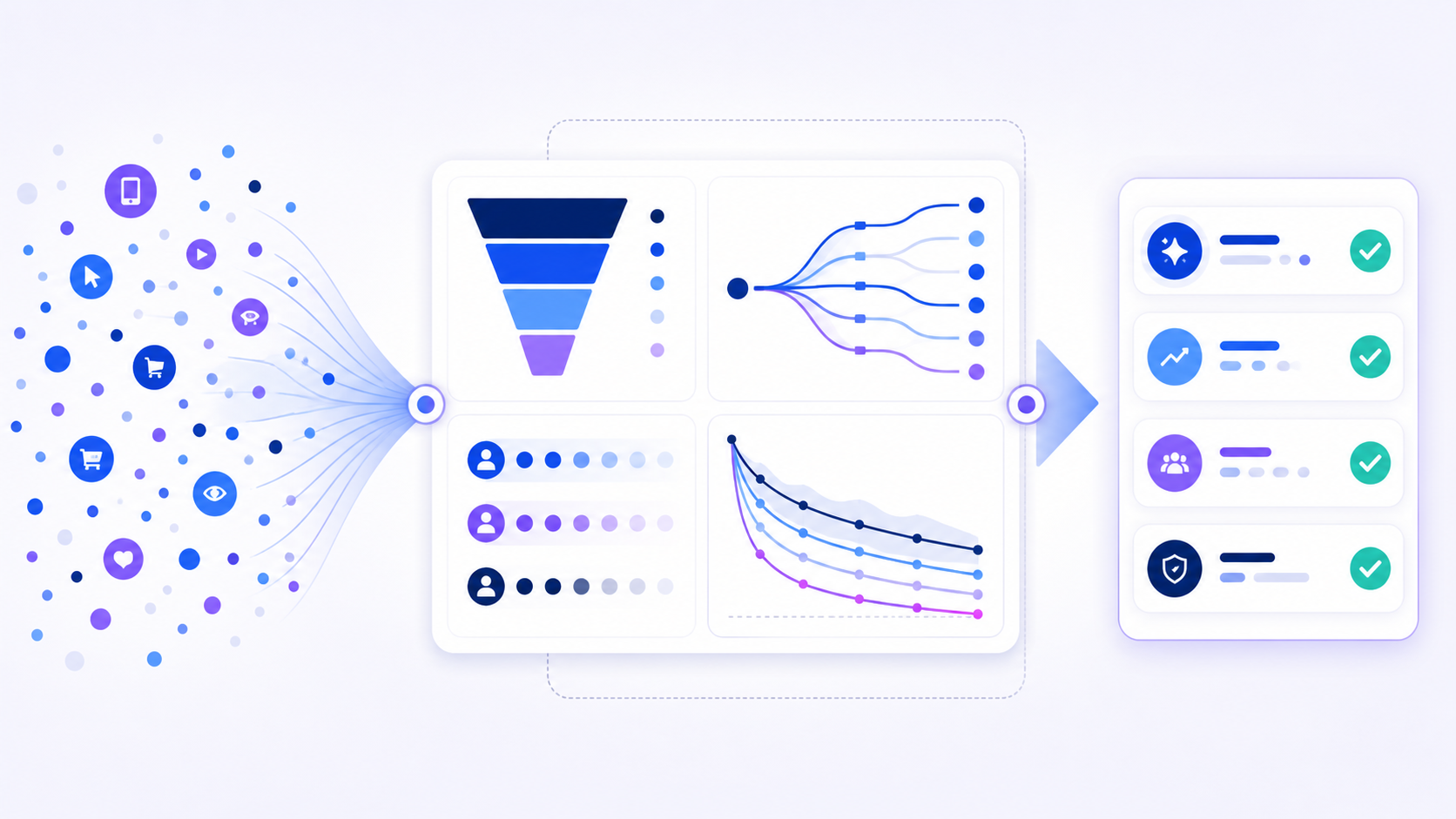
User behavior analytics: a quick answer用户行为分析:快速回答
User behavior analytics is the systematic collection and interpretation of event, user, session, and account data to understand how people use a digital product, where they encounter friction, and which behaviors are associated with activation, conversion, engagement, or retention. It turns recorded actions into decision evidence through segmentation, funnel analysis, path analysis, cohort analysis, retention analysis, and targeted qualitative follow-up.
用户行为分析是系统采集并解释事件、用户、会话和账户数据的过程,用于理解人们如何使用数字产品、在哪里遇到摩擦,以及哪些行为与激活、转化、参与或留存相关。它通过分群、漏斗、路径、队列、留存分析和有针对性的定性补充,把已记录动作转化为决策证据。
The key discipline is to begin with a decision, not a dashboard. “Which onboarding step should we investigate before the next release?” is actionable. “Show every user metric” is not. A sound analysis defines the population, observation window, event semantics, comparison group, and validation test before interpreting a chart.
关键原则是从决策开始,而不是从仪表板开始。“下次发布前应优先调查哪个新手引导步骤?”是可执行问题;“展示所有用户指标”则不是。可靠分析会在解释图表前定义目标人群、观察窗口、事件语义、对照组与验证方法。
What user behavior analytics covers—and what it does not用户行为分析覆盖什么,又不覆盖什么
User behavior analytics becomes useful when aggregate traffic reports no longer explain a product outcome. A team may know that activation declined, but not which step changed; that retention differs, but not for which cohort; or that a feature is used, but not whether it contributes to a repeatable workflow. The method follows sequences and segments rather than treating all users and page views as interchangeable.
当汇总流量报告无法解释产品结果时,产品团队会寻找用户行为分析方法。他们可能知道激活率下降,却不知道哪个步骤发生变化;知道留存存在差异,却不知道差异集中在哪个队列;知道某功能有人使用,却不知道它是否进入可重复工作流。该方法关注序列与分群,而不是把所有用户和页面浏览视为同一种记录。
Studies events inside a product: activation, task completion, feature discovery, paths, repeat use, and retention.
研究产品内事件:激活、任务完成、功能发现、路径、重复使用与留存。
Often emphasizes traffic acquisition, content performance, pages, sessions, campaigns, and key events. It overlaps with behavior analysis but may stop at the website boundary.
通常强调流量获取、内容表现、页面、会话、营销活动与关键事件;它与行为分析重叠,但可能止于网站边界。
Uses usability tests, interviews, open responses, or session evidence to understand context, expectations, and plausible motives that event logs cannot directly reveal.
使用可用性测试、访谈、开放回答或会话证据,理解事件日志无法直接揭示的情境、预期与可能动机。
Detects anomalous or risky user and entity activity. It is a separate cybersecurity discipline and is not the focus of this product analytics guide.
检测用户与实体的异常或高风险活动。这属于独立的网络安全领域,不是本产品分析指南的重点。
Important inference boundary: an event log can show that a user opened pricing, invited a teammate, and returned seven days later. It cannot by itself prove why the user returned or that the invitation caused retention. Motivation needs qualitative evidence; causation generally needs a credible experiment or design.
重要推断边界:事件日志可以显示用户查看价格、邀请队友并在七天后返回,但不能单独证明用户为何返回,也不能证明邀请行为导致了留存。动机需要定性证据;因果结论通常需要可信的实验或研究设计。
Start with a behavioral question and analysis contract从行为问题与分析约定开始
A useful question names a population, behavior, time window, comparison, and decision. For example: “Among new self-serve workspace owners who signed up after the July release, which onboarding step has the largest verified drop-off, and does completion predict seven-day return after controlling for acquisition channel?” This is narrower than “Why is retention low?” and it exposes the data required.
有用的问题应明确人群、行为、时间窗口、比较对象和决策。例如:“在七月版本发布后注册的自助式工作区所有者中,哪个新手引导步骤具有最大的已验证流失?在控制获客渠道后,完成该步骤是否与七日回访相关?”这比“为什么留存低?”更具体,也会暴露所需数据。
Prepare these inputs before analysis:
分析前准备以下输入:
- A written metric definition: eligible population, numerator, denominator, timezone, attribution rule, and observation window.书面指标定义:符合条件的人群、分子、分母、时区、归因规则和观察窗口。
- Stable pseudonymous user and account identifiers, plus a documented anonymous-to-known identity merge policy.稳定的假名化用户与账户标识符,以及匿名身份合并为已知身份的书面规则。
- Timestamped events with a controlled name, version, source, and properties that describe the action—not guesses about intent.带时间戳的事件,具有受控名称、版本、来源和描述动作的属性,而不是对意图的猜测。
- Release, experiment, plan, device, geography, and acquisition context needed for comparison, subject to lawful collection and minimization.比较所需的版本、实验、套餐、设备、地域与获客背景,并遵守合法采集和数据最小化要求。
- A data-quality baseline: missing IDs, duplicate events, client/server mismatches, late arrivals, bot or test traffic, and consent exclusions.数据质量基线:缺失 ID、重复事件、客户端/服务端不一致、迟到数据、机器人或测试流量,以及同意排除项。
Design event data for reliable user behavior analytics为可靠的用户行为分析设计事件数据
Event data is useful only when its semantics survive implementation changes. Prefer names such as workspace_created or report_exported that describe completed actions. Record parameters such as report type, entry surface, result status, and schema version separately. Avoid names such as engaged_user that silently embed a conclusion.
只有当事件语义能经受实现变化时,事件数据才有价值。优先使用 workspace_created 或 report_exported 这类描述已完成动作的名称,并分别记录报告类型、入口界面、结果状态与模式版本等参数。避免使用 engaged_user 这种暗中包含结论的名称。
| Layer层级 | Examples示例 | Primary risk主要风险 | Control控制方法 |
|---|---|---|---|
| Event事件 | Action, timestamp, result, source动作、时间戳、结果、来源 | Duplicates or semantic drift重复或语义漂移 | Schema registry and version事件模式登记与版本 |
| User用户 | Pseudonymous ID, role, signup date假名 ID、角色、注册日期 | Broken identity joins身份连接错误 | Documented merge and split rules书面合并与拆分规则 |
| Account账户 | Workspace, plan, lifecycle state工作区、套餐、生命周期状态 | Mixing user and buyer behavior混淆使用者与购买者行为 | Analyze both grains explicitly明确分析两个粒度 |
| Session会话 | Start, end, device, referrer开始、结束、设备、来源 | Arbitrary timeout changes paths任意超时规则改变路径 | Declare and sensitivity-test timeout声明并敏感性测试超时值 |
| Context背景 | Release, experiment, consent state版本、实验、同意状态 | Confounding and unlawful use混杂与不当使用 | Governed dimensions and access治理维度与访问权限 |
Google Analytics documents custom events as named actions with parameters that add information about what happened. That event-and-parameter model is a useful conceptual reference even when your warehouse schema or product analytics stack is different. See the official Google Analytics custom events documentation.
Google Analytics 官方文档把自定义事件描述为带名称的动作,并使用参数补充动作发生时的信息。即使你的数仓模式或产品分析栈不同,这种“事件加参数”模型仍是有用的概念参考。参见Google Analytics 自定义事件官方文档。
A seven-step user behavior analysis workflow可重复执行的七步用户行为分析工作流
- Write the decision and falsifiable question写下决策与可证伪问题State what will change if the evidence supports or contradicts the hypothesis. Define the eligible population and exclusion rules before looking at the result.说明证据支持或反驳假设时将改变什么,并在查看结果前定义符合条件的人群与排除规则。
- Audit tracking and identity审计追踪与身份Sample raw records, compare client and server counts, inspect duplicate and missing IDs, confirm timestamps and timezones, and verify anonymous-to-known user merges.抽查原始记录,对比客户端与服务端计数,检查重复和缺失 ID,确认时间戳与时区,并验证匿名用户到已知用户的身份合并。
- Build a baseline and segments建立基线与分群Measure the overall rate, then compare meaningful segments such as new versus returning, plan, device, release, acquisition channel, role, or account maturity. Do not mine dozens of segments without a correction or follow-up plan.先测量总体比率,再比较新老用户、套餐、设备、版本、获客渠道、角色或账户成熟度等有意义分群。不要在没有校正或后续计划时盲目挖掘数十个分群。
- Choose the method that matches the question选择与问题匹配的方法Use funnels for expected sequences, paths for exploratory navigation, cohorts for change over time, retention for repeat value, and event or feature analysis for frequency and adoption.预期序列使用漏斗,探索导航使用路径,观察随时间变化使用队列,评估重复价值使用留存,频率与采用情况使用事件或功能分析。
- Trace aggregates back to records从汇总追溯到记录Inspect representative converted, dropped, unusual, and borderline cases. Confirm that chart labels match raw event order and that retries, background events, and duplicate tabs are handled.检查具有代表性的转化、流失、异常与边界案例,确认图表标签与原始事件顺序一致,并处理重试、后台事件与重复标签页。
- Triangulate and test alternatives三角验证并测试替代解释Compare releases and channels, inspect support or research evidence, run sensitivity checks on windows and definitions, and list plausible confounders. Treat behavioral patterns as hypotheses until stronger evidence exists.比较版本与渠道,检查支持或研究证据,对窗口和定义进行敏感性检查,并列出可能混杂因素。在出现更强证据前,把行为模式视为假设。
- Decide, instrument the change, and monitor决策、埋点变更并持续监测Record the decision, evidence, owner, expected effect, guardrail metrics, and review date. Add instrumentation for the changed experience and compare outcomes using an experiment or credible before-and-after design.记录决策、证据、负责人、预期效果、护栏指标与复核日期,为变更后的体验补充埋点,并通过实验或可信的前后对照设计比较结果。
Choose user behavior analytics methods by decision按决策选择用户行为分析方法
| Method方法 | Answers回答 | Useful metrics常用指标 | Main limitation主要限制 |
|---|---|---|---|
| Funnel analysis漏斗分析 | Where does an expected sequence lose eligible users?预期序列在哪一步失去符合条件的用户? | Step conversion, drop-off, time to convert步骤转化、流失、转化耗时 | A predefined funnel can hide alternate valid paths.预定义漏斗可能隐藏其他有效路径。 |
| Path analysis路径分析 | What do users do before or after a focal event?用户在关键事件前后做了什么? | Path share, loops, exits, transition rate路径占比、循环、退出、转移率 | High-cardinality paths become noisy and need grouping.高基数路径容易产生噪声,需要合理归类。 |
| Cohort analysis队列分析 | How does behavior differ by start time or shared action?行为如何随开始时间或共同动作而变化? | Return rate, activity rate, cumulative conversion回访率、活跃率、累计转化率 | Changing acquisition mix can confound cohort comparisons.获客结构变化可能混淆队列比较。 |
| Retention analysis留存分析 | Do users repeatedly receive value after a start event?用户在起始事件后是否持续获得价值? | N-day, rolling, bracket, survival第 N 日、滚动、区间、生存留存 | The wrong return event measures visits rather than value.错误的回访事件只衡量访问而非价值。 |
| Feature adoption功能采用 | Who discovers, starts, succeeds, and repeats a feature?谁发现、开始、成功并重复使用某功能? | Eligible adoption, success, depth, repeat use符合条件的采用、成功、深度、重复使用 | “Used once” may not represent durable adoption.“使用一次”不代表持久采用。 |
| Qualitative follow-up定性补充 | What context or expectation may explain a pattern?什么情境或预期可能解释该模式? | Task success, themes, observed friction任务成功、主题、观察到的摩擦 | Small samples are not population prevalence estimates.小样本不能估计总体发生率。 |
Avoid a “single north-star chart” becoming the whole analysis. Pair the outcome with diagnostic and guardrail measures. If the outcome is report completion, diagnostics may include time to first successful query and error recovery; guardrails may include cancellation, support contacts, latency, and privacy exceptions.
不要让“单一北极星图表”代替全部分析。结果指标应与诊断指标和护栏指标配对。若结果是报告完成,诊断指标可以包括首次成功查询耗时和错误恢复;护栏可以包括取消、支持请求、延迟和隐私例外。
Example: diagnosing onboarding behavior without inventing causality示例:在不虚构因果的前提下诊断新手引导行为
Hypothetical example: a team operates a collaborative reporting product. Its question is whether the “connect a data source” step is a meaningful activation signal for new workspace owners. All figures below are illustrative, not InfiniSynapse customer data or a benchmark.
假设示例:某团队运营协作式报告产品,想判断“连接数据源”步骤是否是新工作区所有者的有效激活信号。以下数字仅用于说明,不是 InfiniSynapse 客户数据或行业基准。
The funnel reveals the largest loss between credential submission and connection success. Record review shows that many failed attempts share an unsupported permission state. A cohort comparison finds higher seven-day return among users who completed a connection, but those users also come disproportionately from larger accounts. The team therefore records two separate findings: a verified usability defect in permission handling, and a non-causal association between completion and return.
漏斗显示,凭据提交到连接成功之间损失最大。记录复核发现,许多失败尝试具有相同的不支持权限状态。队列比较显示,完成连接的用户七日回访更高,但这些用户也更多来自大型账户。因此团队记录两个独立结论:权限处理存在已验证的可用性缺陷;连接完成与回访之间存在非因果关联。
The immediate decision is to fix permission guidance and instrument success, failure reason, and recovery. The team then runs a controlled test of the revised flow. It does not claim that connection causes retention until the design supports that inference. This separation prevents an actionable defect from being delayed while also preventing an attractive correlation from becoming a false product narrative.
直接决策是改进权限引导,并记录成功、失败原因与恢复行为;随后对修订流程开展对照测试。在研究设计足以支持因果推断前,团队不会声称“完成连接导致留存”。这种区分既避免了可执行缺陷被拖延,也避免把有吸引力的相关关系写成错误产品叙事。
Common user behavior analytics errors, privacy risks, and limits用户行为分析的常见错误、隐私风险与限制
- Tracking without a decision: collecting every interaction increases cost and privacy exposure without guaranteeing useful evidence. Use purpose limitation and data minimization.没有决策目的地追踪:收集所有互动会增加成本和隐私暴露,却不保证形成有用证据。应遵循目的限制与数据最小化。
- Denominator drift: an adoption rate changes when the eligible population changes. Store the eligibility rule with the metric.分母漂移:符合条件的人群变化会改变采用率。应把资格规则与指标一同保存。
- Identity inflation: clearing cookies, changing devices, shared accounts, and incorrect merges can create or erase users. Test user-level results against account-level and anonymous-event views.身份膨胀:清除 Cookie、更换设备、共享账户和错误合并可能增加或消除用户。应将用户级结果与账户级及匿名事件视图交叉检查。
- Survivorship bias: analyzing only users who reached a later event excludes people blocked earlier. Anchor populations at an earlier eligible event.幸存者偏差:只分析到达后续事件的用户,会排除更早受阻的人。人群应锚定在更早的资格事件。
- Instrumentation release effects: a tracking change may look like behavior change. Maintain schema versions and annotate deployments.埋点版本效应:追踪变化可能看起来像行为变化。应维护模式版本并标注发布。
- Multiple comparisons: searching many segments will surface chance differences. Pre-register priority cuts or validate discoveries on a holdout period.多重比较:搜索大量分群会发现偶然差异。应预先登记优先切片,或在留出时期验证发现。
Tracking obligations depend on jurisdiction, technology, purpose, and data. The UK Information Commissioner's Office provides an official online tracking guidance hub covering businesses that track users and their activities online. Treat this page as analytical guidance, not legal advice; involve qualified privacy and legal owners for your deployment.
追踪义务取决于司法辖区、技术、目的和数据。英国信息专员办公室提供了面向在线追踪组织的官方在线追踪指导中心。本页是分析方法指南,不是法律意见;实际部署应由合格的隐私与法律负责人参与。
How to validate a user behavior analysis如何验证用户行为分析结果
Validation happens at four layers. First, verify data collection against the product interface and server records. Second, verify transformations with row-level examples and reconciliation totals. Third, verify analysis logic by changing reasonable windows, identity rules, and segment definitions. Fourth, verify the decision with qualitative evidence, an experiment, or an explicit monitoring plan.
验证分为四层。第一,用产品界面与服务端记录核对数据采集;第二,用行级示例和对账总数验证转换;第三,通过改变合理的窗口、身份规则与分群定义验证分析逻辑;第四,用定性证据、实验或明确的监测计划验证决策。
Trigger a known action, confirm one expected event, parameters, consent state, timestamp, and no duplicate.
触发已知动作,确认恰好一个预期事件、参数、同意状态与时间戳,并排除重复。
Compare warehouse, source, and reporting counts for a fixed closed period; explain every material difference.
在固定且已关闭的时期比较数仓、来源与报告计数,并解释所有重大差异。
Repeat with alternate reasonable windows, session timeouts, eligibility rules, and identity grains.
使用其他合理窗口、会话超时、资格规则与身份粒度重复分析。
Record what evidence would reverse the decision, which guardrails matter, and when the team will review.
记录什么证据会推翻决策、哪些护栏重要,以及团队何时复核。
A deliverable should preserve the query or transformation, metric contract, data snapshot date, exclusions, limitations, and links to supporting records. A screenshot without definitions is not a reproducible behavioral analysis.
交付物应保留查询或转换、指标约定、数据快照日期、排除项、局限和支持记录链接。没有定义的截图不是可重复的行为分析。
Connect behavioral data to an evidence-based analysis workflow把行为数据连接到基于证据的分析工作流
Before opening a tool, prepare a governed event table or warehouse connection, stable user or account keys, the metric contract, release and experiment context, and any documents needed to interpret definitions. InfiniSynapse is presented as an AI-powered data analyst that connects to databases and supports joint analysis across structured data and documents. This page does not describe it as a session-replay recorder, automatic client-side event collector, consent platform, or dedicated product analytics SDK.
打开工具前,请准备受治理的事件表或数仓连接、稳定的用户或账户键、指标约定、版本与实验背景,以及解释定义所需的文档。InfiniSynapse 的公开定位是可连接数据库,并支持结构化数据与文档联合分析的 AI 数据分析工具。本页不会把它描述为会话回放记录器、自动客户端事件采集器、同意管理平台或专用产品分析 SDK。
Use your prepared event data and definitions to investigate funnels, segments, retention patterns, and supporting evidence. Review generated logic and trace important findings back to source records before making a product decision.
使用准备好的事件数据与定义,调查漏斗、分群、留存模式和支持证据。在制定产品决策前,复核生成的逻辑,并把重要发现追溯到来源记录。
Open InfiniSynapse for connected data analysis打开 InfiniSynapse 开展连接数据分析For connection prerequisites and supported workflows, review the InfiniSynapse documentation. To evaluate other analysis and integration entry points, browse the InfiniSynapse tools directory.
有关连接前提和支持工作流,请查阅 InfiniSynapse 文档。若要评估其他分析与集成入口,可浏览 InfiniSynapse 工具目录。
Best practices and next steps for product teams产品团队的最佳实践与下一步
- Maintain an event dictionary with owner, purpose, trigger, properties, examples, version, and downstream metrics.维护事件字典,记录负责人、目的、触发条件、属性、示例、版本与下游指标。
- Define activation as a completed value-bearing behavior, not simply a visit, click, or setup screen view.把激活定义为完成具有价值的行为,而不是简单访问、点击或查看设置页面。
- Use account and user grains deliberately in collaborative or B2B products; a buyer, admin, and daily user may be different people.在协作或 B2B 产品中有意识地区分账户与用户粒度;购买者、管理员和日常用户可能是不同的人。
- Pair discovery with confirmation: explore paths and segments, then validate the priority finding on another period or through a designed test.把发现与确认配对:探索路径和分群,再在另一个时期或通过设计好的测试验证优先发现。
- Keep a decision log linking questions, queries, evidence, caveats, chosen action, owner, and observed outcome.保留决策日志,把问题、查询、证据、注意事项、所选行动、负责人和观察结果连接起来。
- Re-audit tracking after interface, identity, consent, billing, or data-pipeline changes; silent semantic drift can invalidate historical comparisons.界面、身份、同意、计费或数据管道变化后重新审计追踪;无声的语义漂移会使历史比较失效。
Frequently asked questions about user behavior analytics关于用户行为分析的常见问题
User behavior analytics is the systematic collection and interpretation of event, user, session, and account data to understand how people use a digital product, where they encounter friction, and which behaviors are associated with activation, conversion, engagement, or retention.
用户行为分析是系统采集并解释事件、用户、会话和账户数据的过程,用于理解人们如何使用数字产品、在哪里遇到摩擦,以及哪些行为与激活、转化、参与或留存相关。
Start with a stable user or account identifier, timestamped events, meaningful event properties, relevant user or account properties, and a documented tracking plan. Add session replay, surveys, support records, or interviews only when they answer a defined question and can be governed appropriately.
从稳定的用户或账户标识符、带时间戳的事件、有意义的事件属性、相关用户或账户属性和书面追踪计划开始。只有当会话回放、问卷、支持记录或访谈能回答明确问题且可被适当治理时,才将其加入。
Web analytics often emphasizes traffic, acquisition, pages, and sessions. User behavior analytics follows identifiable or pseudonymous users and accounts through product events to study funnels, paths, cohorts, feature use, and retention. The disciplines overlap, but their decision scope and data model differ.
网站分析通常强调流量、获客、页面和会话。用户行为分析则通过产品事件跟踪可识别或假名化的用户与账户,研究漏斗、路径、队列、功能使用和留存。两者有重叠,但决策范围和数据模型不同。
Behavioral data directly shows what was recorded, not a person's motive. Analysts can form hypotheses from patterns, but interviews, usability tests, surveys, session evidence, or experiments are needed to support causal or motivational claims.
行为数据直接显示的是记录了什么,而不是人的动机。分析师可以从模式形成假设,但因果或动机主张需要访谈、可用性测试、问卷、会话证据或实验支持。
No. Product user behavior analytics studies digital-product usage and experience. User and Entity Behavior Analytics in cybersecurity focuses on anomalous or risky activity. The acronym UBA can refer to either field, so the business objective and data context must be stated explicitly.
不同。产品用户行为分析研究数字产品使用与体验;网络安全中的用户与实体行为分析关注异常或高风险活动。UBA 缩写可能指向两个领域,因此必须明确业务目标与数据背景。
Sources and verification references来源与验证参考
- Google Analytics custom events documentation — official reference for action names and event parameters.Google Analytics 自定义事件文档——事件动作名称与参数的一手参考。
- UK ICO online tracking guidance — official resources for organizations tracking users and online activity.英国 ICO 在线追踪指南——面向追踪用户及在线活动组织的官方资源。
- InfiniSynapse product page — source for the product capability boundaries described in this guide.InfiniSynapse 产品页——本指南中产品能力边界描述的来源。