
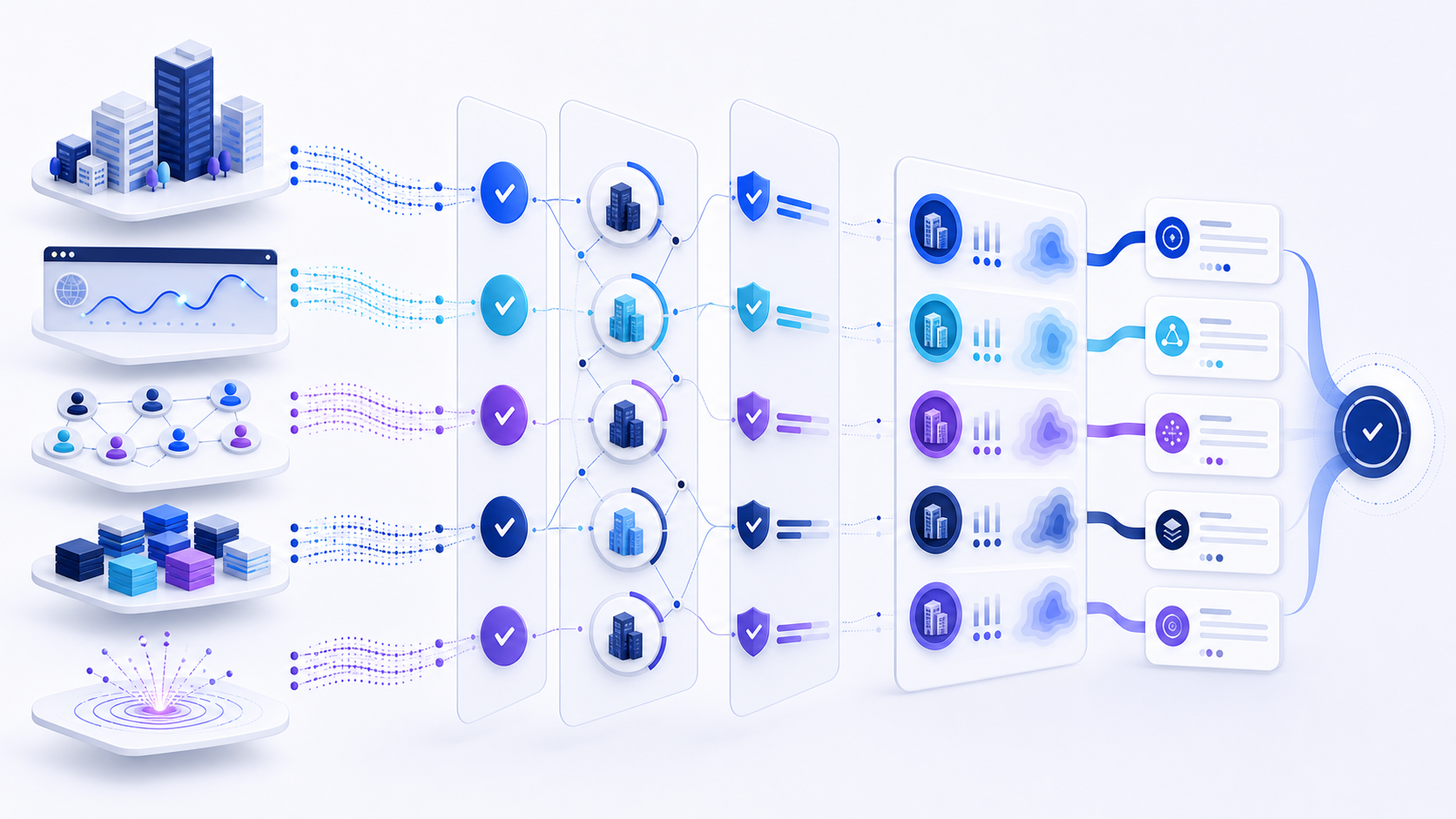
What Is Sales Intelligence?什么是销售情报?
The discipline answers four practical questions: Which accounts fit the offer? Who is involved in the buying process? What has changed or signaled possible demand? What should a seller research or do next? It is useful before outreach, during account planning, when qualifying an opportunity, and when monitoring an existing customer for expansion or risk. It is not simply a purchased contact list, a high intent score, or an automated message generator.
这项工作回答四个实用问题:哪些账户符合产品定位?谁参与购买流程?哪些变化或行为可能表示需求?销售接下来应研究或执行什么?它可用于触达前、账户规划、商机资格判断,以及对现有客户扩展机会或风险的监测。它不等同于购买联系人名单、一个高意向分数或自动消息生成器。
Sales intelligence complements the broader sales analytics system. Intelligence improves the context available for account and deal decisions; analytics measures pipeline, conversion, performance, forecasts, and revenue patterns. One can feed the other, but they answer different primary questions.
销售情报是更广泛销售分析体系的补充。情报改善账户和交易决策所需的背景;分析则衡量 Pipeline、转化、绩效、预测和收入规律。两者可以相互提供输入,但核心问题不同。
Seven Types of Sales Intelligence Data七类销售情报数据
A dependable view combines stable attributes with time-sensitive evidence. Each field should carry a source, observation time, verification status, permitted use, and confidence or quality note. A value without provenance is difficult to challenge and easy to misuse.
可靠视图需要结合稳定属性与时效性证据。每个字段都应携带来源、观测时间、验证状态、允许用途以及置信度或质量说明。没有来源的数据难以质疑,也容易被误用。
| Data type数据类型 | Examples示例 | Decision supported支持的决策 | Quality risk质量风险 |
|---|---|---|---|
| Firmographic公司属性 | Industry, size, geography, ownership, revenue band行业、规模、地区、所有权、收入区间 | ICP fit and territoryICP 匹配和区域分配 | Stale or inconsistent categories过期或分类不一致 |
| Contact and role联系人和角色 | Title, function, seniority, verified channel, buying role职位、职能、级别、验证渠道、购买角色 | Committee mapping and research决策委员会映射和研究 | Job changes, identity mismatch, privacy职位变化、身份错配、隐私 |
| Technographic技术属性 | Installed tools, platforms, infrastructure, adoption clues已用工具、平台、基础设施、采用线索 | Compatibility and problem hypothesis兼容性和问题假设 | Inferred data mistaken for confirmed use将推断误作确认使用 |
| Engagement互动数据 | Consented site visits, event attendance, replies, content activity经许可的网站访问、活动参与、回复、内容互动 | Research timing and topic relevance研究时机和主题相关性 | Bot traffic, shared devices, weak identity match机器人流量、共享设备、身份匹配薄弱 |
| Intent意向数据 | Time-bound topic or category activity above a baseline高于基线的时限性主题或品类活动 | Account prioritization账户优先级 | Opaque scoring and false positives评分不透明和假阳性 |
| Event triggers事件触发 | Funding, hiring, leadership change, launch, expansion, regulation融资、招聘、管理层变化、发布、扩张、监管 | A reason to re-research now重新研究的时机 | Event does not prove a need事件不证明需求存在 |
| Deal and relationship交易和关系 | Past outcomes, objections, stakeholders, warm paths, next steps历史结果、异议、利益相关者、关系路径、下一步 | Contextual qualification情境化资格判断 | Subjective notes and access controls主观备注和访问控制 |
Salesforce’s official overview similarly distinguishes firmographic, contact, technographic, event-trigger, and deal data. The value is not the taxonomy itself; it is knowing what a signal represents, when it was observed, and whether it can support the intended decision.
Salesforce 官方概述也区分了公司属性、联系人、技术属性、事件触发和交易数据。价值不在分类名称本身,而在于理解信号代表什么、何时观测,以及它能否支持预期决策。
Sales Intelligence vs CRM, Sales Analytics, BI and Revenue Intelligence销售情报与 CRM、销售分析、BI 和收入情报的区别
These categories overlap in software, but separating their responsibilities prevents inflated claims and broken workflows.
这些类别在软件中可能重叠,但明确职责边界可以防止能力夸大和工作流混乱。
| Discipline领域 | Primary question核心问题 | Typical output典型输出 | What it does not replace不能替代 |
|---|---|---|---|
| CRM | What accounts, contacts, opportunities, and activities are we managing?我们在管理哪些账户、联系人、商机和活动? | System-of-record fields and workflow state记录系统字段和流程状态 | External research or governed analytics外部研究或受治理分析 |
| Sales intelligence销售情报 | Who fits, what changed, who matters, and what should we research next?谁匹配、发生了什么变化、谁重要、接下来研究什么? | Enriched profiles, verified signals, account hypotheses丰富画像、验证信号、账户假设 | Seller judgment or CRM execution销售判断或 CRM 执行 |
| Sales analytics销售分析 | What happened across pipeline and performance, and why?Pipeline 和绩效发生了什么、为什么? | Metrics, trends, segments, forecasts, diagnosis指标、趋势、分群、预测、诊断 | Prospect data collection潜客数据收集 |
| BI | How can governed business data be reported across functions?如何跨职能报告受治理业务数据? | Dashboards, reports, semantic metricsDashboard、报告、语义指标 | Sales-specific research workflow销售专属研究流程 |
| Revenue intelligence收入情报 | What evidence across the revenue process affects deals, forecasts, and growth?收入流程中的哪些证据影响交易、预测和增长? | Deal risk, conversation evidence, forecast context交易风险、会话证据、预测背景 | A complete prospect database完整潜客数据库 |
Build a Trustworthy Sales Intelligence Data Foundation建立可信的销售情报数据基础
Start with a decision and an entity model, not with every available feed. Define account, site, person, role, relationship, signal, source, observation, opportunity, and action. Assign stable identifiers, record source-specific IDs, and keep raw observations separate from resolved entities and derived scores.
应从决策和实体模型开始,而不是先接入所有可用数据源。定义账户、地点、人员、角色、关系、信号、来源、观测、商机和行动。分配稳定标识符,保留来源专属 ID,并将原始观测、解析后的实体和派生评分分开。
Match company domains, legal entities, subsidiaries, CRM accounts, contacts, and observed activity. Preserve match method and confidence; do not force uncertain matches.
匹配公司域名、法律实体、子公司、CRM 账户、联系人和观测活动。保留匹配方法与置信度,不强制合并不确定记录。
Store observed-at, verified-at, valid-from, and valid-to timestamps where appropriate. Keep changes instead of silently replacing job titles or technologies.
按需保存观测、验证、生效和失效时间。保留变化历史,不要静默覆盖职位或技术信息。
For each field or signal, record source, collection method, licensing or consent constraints, transformation, and accountable owner.
每个字段或信号都应记录来源、收集方法、许可或同意限制、转换过程和责任人。
Apply purpose-based access, retention limits, deletion workflows, audit logs, and restrictions for sensitive notes or personal data.
实施基于目的的访问控制、保留期限、删除流程、审计日志,以及对敏感备注或个人数据的限制。
Run reconciliation checks: unique account keys, duplicate domains, orphan contacts, impossible employment dates, conflicting industries, suppressed records reappearing, and signals attached to the wrong subsidiary. Publish a data dictionary that distinguishes confirmed, provider-reported, inferred, and seller-entered values.
应检查唯一账户键、重复域名、孤立联系人、不可能的任职日期、冲突行业、已抑制记录重新出现,以及信号错误关联至子公司等问题。数据字典必须区分已确认、供应商报告、推断和销售录入的值。
How to Interpret Buyer Signals and Intent Data如何解释购买信号与意向数据
A signal is an observation that may change a hypothesis; it is not proof of purchase intent. A funding announcement may increase capacity but say nothing about category need. A website visit may represent a buyer, a student, an employee, a vendor, or a bot. A job change can matter, but only after role, account, timing, and relevance are verified.
信号是可能改变假设的观测,不是购买意向的证明。融资公告可能增加预算能力,却不能证明品类需求;网站访问者可能是买方、学生、员工、供应商或机器人;职位变化可能重要,但必须验证角色、账户、时点和相关性。
- Confirm the source.确认来源。 Is it first-party, provider-reported, public, seller-entered, or inferred? What collection and permitted-use rules apply? 它是一方数据、供应商报告、公开数据、销售录入还是推断?适用哪些收集和使用规则?
- Check recency and duration.检查时效和持续时间。 Record when activity occurred, when it was received, and whether the behavior persists beyond a one-off spike. 记录活动发生和接收时间,并判断行为是否持续,而非一次峰值。
- Resolve the entity.解析实体。 Verify whether the activity belongs to the correct person, account, subsidiary, geography, and buying group. 验证活动是否属于正确人员、账户、子公司、地区和购买群体。
- Compare with a baseline.与基线比较。 Ask whether activity is unusual for that account, segment, season, campaign, or channel. 判断活动相对该账户、客群、季节、Campaign 或渠道是否异常。
- Combine independent evidence.组合独立证据。 Fit, timing, engagement, relationship, and deal context should corroborate rather than duplicate one provider score. 匹配度、时机、互动、关系和交易背景应相互印证,而不是重复同一供应商分数。
- Choose a proportionate action.选择相称行动。 The next step may be research, verification, routing, monitoring, or human review—not automatically outreach. 下一步可以是研究、验证、路由、监控或人工复核,而不一定自动触达。
LinkedIn’s official Buyer Intent FAQ describes an aggregated score built from multiple activities and makes the underlying activity available in account views. That illustrates a good review principle: inspect the component evidence and context instead of treating an aggregate label as self-explanatory.
LinkedIn 官方 Buyer Intent FAQ 说明其汇总分数由多项活动组成,并在账户视图中提供相关活动。这体现了良好复核原则:检查组成证据与背景,而不是把汇总标签视为无需解释的结论。
A Repeatable Sales Intelligence Process可重复执行的销售情报流程
- Define the decision contract.定义决策契约。 State the audience, decision, eligible accounts, time window, acceptable evidence, prohibited uses, owner, and review cadence. 明确使用者、决策、合格账户、时间窗口、可接受证据、禁止用途、责任人和复核频率。
- Specify ICP and exclusions.定义 ICP 和排除项。 Separate hard eligibility constraints from preferences. Version the definition and explain each field. 将硬性资格条件与偏好分开,对定义进行版本管理并解释每个字段。
- Collect minimum necessary data.收集最少必要数据。 Connect governed CRM, product, web, marketing, billing, and licensed external sources only when they serve the decision. 仅在服务于决策时,连接受治理的 CRM、产品、网站、营销、Billing 和许可外部数据。
- Resolve, deduplicate, and verify.解析、去重并验证。 Preserve raw values, matching evidence, uncertainty, freshness, conflicts, and manual corrections. 保留原始值、匹配证据、不确定性、新鲜度、冲突和人工修正。
- Create features and evidence rules.建立特征和证据规则。 Convert observations into fit, timing, engagement, relationship, and risk features without hiding provenance. 将观测转换为匹配度、时机、互动、关系和风险特征,同时保留来源。
- Prioritize with reasons.带理由排序。 Produce a queue with evidence, confidence, missing information, recommended research, and an expiry time—not only a score. 生成包含证据、置信度、缺失信息、建议研究和失效时间的队列,而非只有分数。
- Review outcomes and corrections.复盘结果和修正。 Capture accepted, rejected, overridden, stale, and misassigned intelligence. Use reason codes to improve data and rules. 记录接受、拒绝、覆盖、过期和错误分配的情报,用原因代码改善数据和规则。
The process should be reproducible from a dated snapshot. If an account’s priority changes, a reviewer should be able to see which source changed, which rule fired, which evidence expired, and whether a human overrode the result.
流程应能基于带日期的快照复现。当账户优先级改变时,复核者应能看出哪个来源变化、哪条规则触发、哪些证据过期,以及是否有人工作出覆盖。
Design an Explainable Account Prioritization Framework设计可解释的账户优先级框架
Prioritization should answer “why now?” and “what next?” rather than create a mysterious ranking. Keep eligibility, fit, timing, relationship, and risk as separate dimensions. A weighted score can support ordering, but the underlying evidence must remain visible.
优先级应回答“为什么是现在”和“下一步是什么”,而不是生成神秘排名。资格、匹配度、时机、关系和风险应作为独立维度。加权分数可以支持排序,但底层证据必须可见。
| Dimension维度 | Example evidence示例证据 | Guardrail防护规则 |
|---|---|---|
| Eligibility资格 | Service geography, minimum size, supported use case服务地区、最低规模、支持用例 | Hard gate; do not compensate with intent硬门槛;不能用意向抵消 |
| Fit匹配度 | Industry, operating model, data environment, historical similarity行业、运营模式、数据环境、历史相似度 | Avoid proxy discrimination and circular labels避免代理歧视和循环标签 |
| Timing时机 | Verified trigger, recent first-party activity, active initiative已验证触发、近期一方活动、进行中项目 | Time decay and expiry required必须设置时间衰减和失效 |
| Relationship关系 | Known stakeholder, prior conversation, consented channel, warm path已知利益相关者、历史沟通、许可渠道、关系路径 | Verify recency and permission验证时效和许可 |
| Risk风险 | Suppression, conflict, stale identity, weak match, active dispute抑制、冲突、身份过期、弱匹配、进行中争议 | Can block or route to review可阻止或转人工复核 |
Calibrate thresholds against operational capacity. A queue of 10,000 “high-priority” accounts is not useful to a team that can research 100. Publish expected queue size, coverage, freshness, and the number excluded by each guardrail. Review whether certain geographies, company types, or customer groups are systematically underrepresented because of data availability rather than business fit.
阈值必须与运营产能校准。对于只能研究 100 个账户的团队,包含 10,000 个“高优先级”账户的队列没有价值。应发布预计队列规模、覆盖率、新鲜度和被各防护规则排除的数量,并检查某些地区、公司类型或客户群是否因数据可用性而非业务匹配被系统性低估。
Worked Sales Intelligence Example销售情报工作示例
Hypothetical example: A data-platform sales team reviews four existing target accounts. The decision is not “send outreach”; it is “which account deserves analyst research this week?” Eligibility requires supported geography, an appropriate company size, and a relevant data environment. The team then reviews verified fit, time-bound signals, relationship context, and risk.
假设示例:某数据平台销售团队评审四个现有目标账户。决策不是“自动发送触达”,而是“本周哪个账户值得分析师研究”。资格要求包括支持的地区、适当公司规模和相关数据环境,随后评审已验证的匹配度、时限性信号、关系背景和风险。
| Account账户 | Evidence证据 | Uncertainty or risk不确定性或风险 | Next action下一步 |
|---|---|---|---|
| A | Strong ICP fit; verified data-leadership hire 12 days ago; two consented first-party visitsICP 高匹配;12 天前验证的数据负责人入职;两次经许可的一方访问 | Website activity resolved only to account level网站活动仅解析到账户层 | Research the new role and current architecture研究新角色和当前架构 |
| B | Medium fit; high third-party topic score中等匹配;第三方主题分高 | Provider method opaque; no corroborating first-party or CRM evidence供应商方法不透明;没有一方或 CRM 证据印证 | Monitor and verify, not immediate outreach监控并验证,不立即触达 |
| C | Strong fit; prior successful conversation and known stakeholder高匹配;过去有成功沟通和已知利益相关者 | Contact changed employer; relationship record is stale联系人已换公司;关系记录过期 | Correct identity and remap the committee修正身份并重新映射决策委员会 |
| D | Recent funding and hiring event近期融资和招聘事件 | Outside supported geography不在支持地区 | Exclude under eligibility rule按资格规则排除 |
Account A receives the first research slot, but the analyst records that activity is account-level and does not identify a person. Account B remains in monitoring because a high score without transparent, independent support is insufficient. Account C triggers data correction before prioritization. Account D cannot become eligible merely because its timing signal is strong.
账户 A 获得第一个研究名额,但分析师会记录其活动仅为账户层,不能识别个人。账户 B 因高分缺少透明且独立的支持证据而继续监控;账户 C 在排序前先触发数据修正;账户 D 不能仅因时机信号强而突破资格限制。
This example demonstrates why a single composite score is weaker than a reasoned queue. The output preserves evidence, uncertainty, guardrails, and a proportionate action. No result claims that an account will buy.
该示例说明,只有综合分数不如带理由的队列。输出保留证据、不确定性、防护规则和相称行动,任何结果都不声称账户一定会购买。
Measure Sales Intelligence Quality and Decision Value衡量销售情报质量与决策价值
Measure the intelligence system before measuring revenue impact. Data and operational quality are observable sooner and are easier to attribute than closed revenue. Keep provider quality, entity resolution, queue operations, user corrections, and downstream outcomes in separate layers.
在衡量收入影响前,应先衡量情报系统本身。数据与运营质量更早可观测,也比最终收入更容易归因。供应商质量、实体解析、队列运营、用户修正和下游结果应分层衡量。
- Data quality: completeness by source, verification age, duplicate rate, conflict rate, invalid contact rate, and suppression compliance.数据质量:按来源统计完整度、验证年龄、重复率、冲突率、无效联系人率和抑制合规。
- Matching quality: account and contact precision, unresolved rate, false merge rate, and manual correction reasons.匹配质量:账户与联系人精确率、未解析率、错误合并率和人工修正原因。
- Signal quality: latency, expiry, corroboration rate, stability, and the share that changes a decision after review.信号质量:延迟、失效、印证率、稳定性,以及复核后改变决策的比例。
- Operational value: research time, queue acceptance, override rate, stale-item rate, and capacity utilization.运营价值:研究时间、队列接受率、覆盖率、过期项目率和产能利用。
- Downstream outcomes: qualified progression, meeting or opportunity creation, cycle, win rate, and revenue—reported with appropriate cohorts and without claiming causation from an observational comparison.下游结果:资格推进、会议或商机创建、周期、赢率和收入;应使用适当 Cohort,并避免根据观察性比较声称因果关系。
Compare a prioritized cohort with a contemporaneous, eligible baseline and disclose selection differences. If rules change, version them. Review performance by source, segment, geography, and time to detect coverage bias and provider drift.
应将优先 Cohort 与同一时期的合格基线比较,并披露选择差异。规则变化时必须版本化;按来源、客群、地区和时间复核绩效,以发现覆盖偏差与供应商漂移。
Common Sales Intelligence Errors, Privacy Risks and Limits销售情报的常见错误、隐私风险与限制
Topic activity, funding, hiring, and visits can inform research but do not prove a buying project or named person’s intention.
主题活动、融资、招聘和访问可以支持研究,但不能证明购买项目或具体个人意愿。
Scores without source, time, components, and confidence prevent review and responsible correction.
缺少来源、时间、组成和置信度的分数无法复核和负责任地修正。
Account-level activity should not be represented as an identified individual’s action.
账户层活动不能被描述为已识别个人的行为。
A former title, departed contact, expired technology, or old trigger can create irrelevant actions at scale.
旧职位、离职联系人、过期技术或陈旧触发会大规模产生无关行动。
More records and alerts can increase noise, review burden, and inappropriate outreach instead of decision quality.
更多记录和提醒可能增加噪声、复核负担与不当触达,而不是提高决策质量。
Availability does not automatically authorize collection, enrichment, profiling, retention, sharing, or outreach.
数据可获得并不自动授权收集、丰富、画像、保留、共享或触达。
Privacy and marketing rules differ by jurisdiction, data category, collection method, role, and intended action. Involve qualified legal and privacy owners; document lawful basis or consent where applicable; honor access, correction, deletion, suppression, and objection workflows; minimize data; and restrict sensitive inferences. The NIST Privacy Framework provides a voluntary risk-management structure, but it is not a substitute for jurisdiction-specific legal advice.
隐私和营销规则会因司法辖区、数据类型、收集方式、角色和预期行动而不同。应让合格的法务与隐私负责人参与;在适用时记录合法基础或同意;落实访问、更正、删除、抑制和反对流程;实施数据最小化并限制敏感推断。NIST Privacy Framework 提供自愿的风险管理结构,但不能替代针对具体司法辖区的法律建议。
How to Evaluate Sales Intelligence Software如何评估销售情报软件
Software evaluation is a supporting topic here; this guide provides evaluation criteria rather than a vendor ranking. Start with a representative sample and a documented decision, then test claims against your entities, regions, languages, privacy requirements, CRM structure, and operating capacity.
软件评估是本页的支持主题;本指南提供评估标准,而不是供应商排行榜。应从代表性样本和明确决策开始,根据自身实体、地区、语言、隐私要求、CRM 结构和运营产能验证产品主张。
| Evaluation area评估领域 | Questions to test测试问题 |
|---|---|
| Coverage and accuracy覆盖与准确性 | What share of your eligible accounts and roles is covered? How are fields verified, dated, corrected, and benchmarked?合格账户和角色覆盖多少?字段如何验证、标注日期、修正和基准比较? |
| Provenance and transparency来源与透明度 | Can users inspect source, observation time, match logic, component signals, confidence, and score changes?用户能否检查来源、观测时间、匹配逻辑、组成信号、置信度和分数变化? |
| Governance治理 | What consent, licensing, permitted-use, retention, deletion, suppression, regional, and access controls exist?提供哪些同意、许可、允许用途、保留、删除、抑制、地区和访问控制? |
| Integration集成 | Are sync direction, IDs, conflicts, ownership, history, failure handling, and rollback explicit?同步方向、ID、冲突、归属、历史、失败处理和回滚是否明确? |
| Workflow fit工作流匹配 | Does the output explain why, expire stale items, route exceptions, capture overrides, and fit human capacity?输出是否解释原因、使过期项目失效、路由异常、记录覆盖并匹配人工产能? |
| Validation and exit验证与退出 | Can you run a controlled pilot, export data and audit history, remove records, and avoid permanent lock-in?能否受控试点、导出数据和审计历史、删除记录并避免永久锁定? |
Do not evaluate solely by database size or the number of signals. Test precision on known accounts, freshness on known job changes, match quality across subsidiaries, suppression handling, and whether the resulting queue produces valid research actions.
不要只按数据库规模或信号数量评估。应在已知账户上测试精确率、在已知职位变化上测试新鲜度、检查跨子公司匹配质量与抑制处理,并确认最终队列是否产生有效研究行动。
Analyze Sales Intelligence with Connected Evidence使用连接证据分析销售情报
Before starting, prepare governed account and contact tables, source metadata, dated signals, CRM activity, outcome history, permitted-use fields, the ICP definition, and a focused question. Useful questions include: Which accounts changed priority this week and why? Which high-intent records lack independent corroboration? Where do provider attributes conflict with verified CRM values? Which accounts are excluded because evidence is stale or consent is missing?
开始前,请准备受治理的账户与联系人表、来源元数据、带日期信号、CRM 活动、结果历史、允许用途字段、ICP 定义和明确问题。例如:哪些账户本周改变了优先级、原因是什么?哪些高意向记录缺少独立印证?哪些供应商属性与已验证 CRM 值冲突?哪些账户因证据过期或缺少同意被排除?
InfiniSynapse can support connected analysis by helping users examine evidence across available data sources, compare definitions, investigate changes, and document conclusions for human review. It does not itself guarantee that upstream prospect data is accurate, licensed, consented, or lawful for a specific action; those controls remain with the responsible data, sales, privacy, and legal owners.
InfiniSynapse 可通过跨可用数据源检查证据、比较定义、调查变化并记录供人工复核的结论,支持连接分析。它本身不保证上游潜客数据对特定行动而言准确、已许可、已获同意或合法;这些控制仍由负责的数据、销售、隐私和法务负责人承担。
Prepare entity definitions, source and timestamp fields, permitted-use rules, signals, CRM evidence, and a review question. Then use InfiniSynapse to examine connected evidence and document a traceable conclusion.
准备实体定义、来源与时间字段、允许用途规则、信号、CRM 证据和复核问题,然后使用 InfiniSynapse 检查连接证据并记录可追溯结论。
Try InfiniSynapse Online在线体验 InfiniSynapseA defensible output includes the decision scope, snapshot time, entity and match status, observed facts, derived signals, missing evidence, conflicts, confidence, permitted action, expiry, and reviewer. It should clearly distinguish fact, provider assertion, model inference, analyst hypothesis, and final human decision.
可辩护输出包括决策范围、快照时间、实体与匹配状态、观测事实、派生信号、缺失证据、冲突、置信度、允许行动、失效时间和复核者,并清楚区分事实、供应商陈述、模型推断、分析师假设和最终人工决策。
Sales Intelligence Implementation Checklist销售情报实施检查清单
- Decision: Is the user, question, eligible population, action, cadence, and owner defined?决策:是否定义用户、问题、合格群体、行动、频率和责任人?
- Entities: Are account, subsidiary, site, person, role, relationship, signal, and action modeled separately?实体:账户、子公司、地点、人员、角色、关系、信号和行动是否分开建模?
- Provenance: Does every important value have source, observation time, method, confidence, and permitted use?来源:每个重要值是否有来源、观测时间、方法、置信度和允许用途?
- Quality: Are duplicates, stale fields, false merges, conflicts, latency, and coverage measured?质量:是否衡量重复、过期字段、错误合并、冲突、延迟和覆盖?
- Signals: Are recency, baseline, entity resolution, corroboration, decay, and expiry explicit?信号:新鲜度、基线、实体解析、印证、衰减和失效是否明确?
- Privacy: Are purpose, lawful basis or consent, minimization, access, retention, deletion, suppression, and objection handled?隐私:是否处理目的、合法基础或同意、最小化、访问、保留、删除、抑制和反对?
- Explanation: Can a reviewer see why an account is prioritized and what evidence is missing?解释:复核者能否看到账户为何优先以及缺少哪些证据?
- Feedback: Are corrections, overrides, rejected signals, outcomes, and provider drift reviewed?反馈:是否复核修正、覆盖、拒绝信号、结果和供应商漂移?
Begin with one decision, a narrow eligible population, a small number of reliable sources, and a human review queue. Establish quality baselines before adding more providers, predictive scores, or automation. Complexity is justified only when it improves a measured decision without weakening transparency, privacy, or operational control.
从一个决策、狭窄的合格群体、少量可靠来源和人工复核队列开始。在增加供应商、预测评分或自动化前建立质量基线。只有在不削弱透明度、隐私和运营控制的前提下改善可衡量决策时,复杂度才有价值。
Sales Intelligence FAQ销售情报常见问题
Sales intelligence is the governed collection, verification, analysis, and application of company, contact, technology, engagement, intent, event, and deal data to support account selection, buyer research, timing, and sales decisions.
销售情报是对公司、联系人、技术、互动、意向、事件和交易数据进行受治理的收集、验证、分析与应用,以支持账户选择、买方研究、时机判断和销售决策。
A CRM records accounts, contacts, opportunities, activities, and workflow. Sales intelligence enriches and interprets internal and external signals so teams can research, prioritize, and contextualize those records. The two work together but are not substitutes.
CRM 记录账户、联系人、商机、活动和工作流;销售情报丰富并解释内外部信号,使团队能够研究、排序并理解这些记录。两者协同工作,但不能互相替代。
Examples include firmographics, verified contact roles, technographics, hiring or funding events, first-party engagement, consented intent signals, relationship paths, CRM activity, and historical deal evidence.
示例包括公司属性、已验证联系人角色、技术属性、招聘或融资事件、一方互动、经许可的意向信号、关系路径、CRM 活动和历史交易证据。
Use buyer intent as time-bound evidence that changes research or prioritization, not as proof that an account will buy. Validate source, recency, identity resolution, baseline behavior, consent, and fit before acting.
购买意向应作为改变研究或优先级的时限性证据,而不是账户必然购买的证明。行动前要验证来源、新鲜度、身份解析、基线行为、同意和匹配度。
Measure field completeness, verification age, match precision, duplicate rate, signal latency, coverage, override reasons, and downstream decision outcomes. Compare prioritized accounts with an appropriate baseline without claiming causation from correlation alone.
衡量字段完整度、验证年龄、匹配精确率、重复率、信号延迟、覆盖率、覆盖原因和下游决策结果。将优先账户与适当基线比较,但不要仅凭相关性声称因果关系。
No. It can reduce repetitive collection and surface relevant evidence, but sellers must verify context, understand the account, respect privacy, and decide whether and how to engage.
不能。它可以减少重复收集并呈现相关证据,但销售仍须验证背景、理解账户、尊重隐私,并决定是否以及如何互动。
Sources and Further Reading资料来源与延伸阅读
- Salesforce — What Is Sales Intelligence?:销售情报数据类型、用途及与 CRM 的关系。
- LinkedIn Sales Navigator — Buyer Intent FAQ:购买意向信号、汇总分数和账户视图。
- NIST Privacy Framework:隐私风险识别与管理框架。
Examples are explicitly hypothetical and do not represent InfiniSynapse customer results. Product capabilities and data permissions must be verified against the current application and governing agreements before publication or operational use.
示例均明确为假设,不代表 InfiniSynapse 客户结果。发布或运营使用前,必须根据当前应用和治理协议验证产品能力与数据权限。