
What Is a Sales Forecast Template?什么是 Sales Forecast Template?
A sales forecast template is a repeatable spreadsheet structure that turns defined sales inputs into a dated, reviewable revenue outlook. A useful template separates assumptions, opportunity-level evidence, forecast rollups, submissions, actual outcomes, and accuracy measures. It does not create accuracy by itself; accuracy depends on consistent definitions, historical snapshots, owner judgment, data quality, and disciplined review.
Sales Forecast Template 是一种可重复的工作表结构,用于把定义明确的销售输入转换为带日期、可复核的收入展望。有效模板应分离假设、商机级证据、预测汇总、提交、实际结果与准确性指标。模板本身不会自动产生准确性;准确性取决于一致定义、历史快照、负责人判断、数据质量与严格复核。
This page provides a copy-ready workbook blueprint for Excel or Google Sheets. It focuses on structure, fields, formulas, operating controls, and validation. For the complete forecasting discipline, read the sales forecasting guide. For model choice, use the forecasting techniques comparison.
本页提供可复制到 Excel 或 Google Sheets 的工作簿蓝图,专注于结构、字段、公式、运营控制与验证。完整预测制度请参阅销售预测指南;模型选择请参阅预测方法比较。
Choose the Right Sales Forecast Spreadsheet选择合适的 Sales Forecast Spreadsheet
| Template模板 | Use when适用条件 | Primary inputs主要输入 |
|---|---|---|
| Opportunity-based商机型 | A B2B team forecasts named deals within a month or quarterB2B 团队预测月度或季度内的具名商机 | Amount, close date, stage, category, probability, owner evidence金额、预计成交日、阶段、类别、概率、负责人证据 |
| Unit and price销量与价格型 | Revenue is driven by repeatable products, orders, subscriptions, or locations收入由可重复产品、订单、订阅或门店驱动 | Units, price, mix, conversion, seasonality, returns or churn销量、价格、组合、转化、季节性、退货或流失 |
| Driver-based驱动因素型 | Leads, capacity, meetings, conversion, or renewals explain future salesLeads、产能、会议、转化或续约可解释未来销售 | Volume, conversion, lag, capacity, average value, retention数量、转化、滞后、产能、平均价值、留存 |
| Hybrid混合型 | Near-term named pipeline and longer-term demand require different logic近期具名 Pipeline 与较长期需求需要不同逻辑 | Opportunity forecast plus historical or driver-based baseline商机预测加历史或驱动因素基线 |
Do not force a pipeline template onto a high-volume transactional business, or a monthly trend sheet onto a small enterprise-deal motion. Define forecast horizon, grain, currency, revenue event, ownership, and update cadence before selecting the layout.
不要把 Pipeline 模板强加给高频交易业务,也不要把月度趋势表用于少量企业大单模式。选择布局前应定义预测周期、粒度、币种、收入事件、所有权与更新节奏。
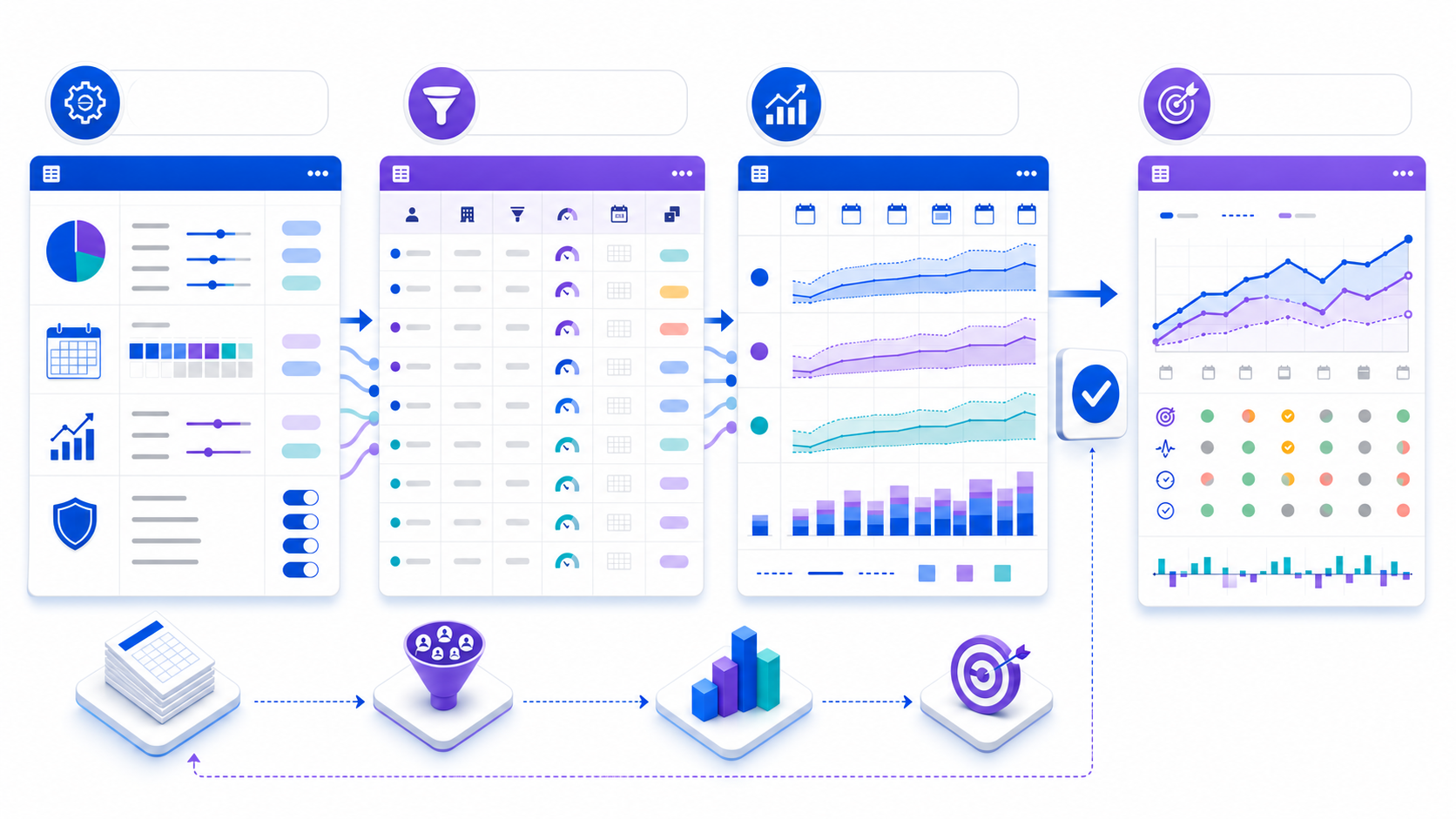
Build the Template as a Four-Tab Workbook把模板建立为四表工作簿
- Settings设置表
Store periods, stage-to-category mapping, default probabilities, scenario multipliers, currencies, target, cutoff rules, and data dictionary. Protect formula cells and make editable assumptions visually distinct.
保存期间、阶段至类别映射、默认概率、情景系数、币种、目标、截止规则与数据字典。保护公式单元格,并在视觉上区分可编辑假设。
- Opportunities商机表
Use one row per opportunity at the cutoff. Preserve the CRM identifier so updates can be reconciled without duplicate deals or ambiguous names.
在截止点每个商机使用一行,并保留 CRM 标识符,以便更新时对账,避免重复商机或名称歧义。
- Forecast预测表
Roll up closed, commit, best case, open pipeline, weighted value, scenario range, target, gap, and submitted forecast by period, team, owner, segment, or region.
按期间、团队、负责人、分群或区域汇总 Closed、Commit、Best Case、Open Pipeline、加权值、情景区间、目标、差距与提交预测。
- Accuracy准确性表
Join each frozen submission to the final actual, calculate error and bias, and retain notes about major slips, pulls, amount changes, and one-time events.
把每次冻结提交与最终实际结果关联,计算误差与偏差,并保留重大延期、提前、金额变化与一次性事件说明。
Create the Settings and Definitions Tab建立设置与定义表
A template fails when users silently disagree about what a period, amount, stage, or category means. Put definitions beside assumptions, not in a separate document nobody opens.
当用户对期间、金额、阶段或类别含义存在隐性分歧时,模板就会失败。应把定义放在假设旁,而不是放在无人打开的独立文档中。
Forecast date, period start and end, snapshot cutoff, amount basis, currency and conversion date, recognized event, owner hierarchy, inclusion criteria, and actual source.
预测日期、期间起止、快照截止、金额口径、币种与换算日期、确认事件、负责人层级、纳入条件与实际值来源。
Stage probabilities, low and high multipliers, seasonality, capacity, average price, conversion, renewal rate, and approved overrides—each with owner and effective date.
阶段概率、低高情景系数、季节性、产能、平均价格、转化、续约率与获批覆盖项,并为每项记录负责人和生效日。
Copy These Opportunity Forecast Fields复制这些商机预测字段
| Field group字段组 | Columns列 | Control控制 |
|---|---|---|
| Identity身份 | Opportunity ID, account, opportunity, owner, manager, segment, region商机 ID、账户、商机、负责人、经理、分群、区域 | ID must be unique and stableID 必须唯一且稳定 |
| Timing时间 | Created date, expected close, previous close, last activity, next step date, snapshot date创建日、预计成交日、原成交日、最后活动日、下一步日期、快照日 | Use true date values, not free text使用真实日期值而非自由文本 |
| Value价值 | Currency, amount, recurring value, one-time value, quantity, price, weighted amount币种、金额、经常性价值、一次性价值、数量、价格、加权金额 | Define whether gross, net, bookings, or revenue定义毛额、净额、签约额或收入 |
| Evidence证据 | Stage, forecast category, probability, next step, blocker, buyer evidence, manager override, notes阶段、预测类别、概率、下一步、阻碍、买方证据、经理覆盖、说明 | Restrict categories with validation lists使用数据验证列表限制类别 |
| Outcome结果 | Final status, actual close, actual value, loss or slip reason最终状态、实际成交日、实际价值、输单或延期原因 | Lock after the outcome is reconciled结果对账后锁定 |
Design the Monthly Sales Forecast Template设计月度 Sales Forecast Template
Create one row per forecast period and optional dimensions such as team or region. Use columns for target, closed actual-to-date, commit, best case, pipeline, weighted forecast, submitted forecast, low case, high case, target gap, prior submission, and week-over-week change. Keep category rollups mutually understood: if a cumulative commit includes closed deals, do not add closed twice.
每个预测期间使用一行,并可加入团队或区域等维度。列应包含目标、截至当前的 Closed 实际、Commit、Best Case、Pipeline、加权预测、提交预测、低情景、高情景、目标差距、上次提交与周环比变化。所有人必须理解类别汇总方式:若累计 Commit 已包含 Closed,就不能再次相加 Closed。
Recommended display: show the submitted number beside a mechanically weighted baseline and a scenario range. The gap exposes manager judgment; it should be explained, approved, and later evaluated rather than hidden.
推荐展示:把提交数字与机械加权基线和情景区间并列显示。两者差距会暴露经理判断,应被解释、批准并在事后评估,而不是隐藏。
Add Transparent Sales Forecast Formulas添加透明的销售预测公式
| Output输出 | Formula pattern公式模式 | Interpretation解释 |
|---|---|---|
| Weighted amount加权金额 | =Amount * Probability | A baseline, not a promise; calibrate probability from comparable outcomes这是基线而非承诺;应使用可比结果校准概率 |
| Period category total期间类别合计 | =SUMIFS(Amount, CloseDate, ">="&Start, CloseDate, "<="&End, Category, SelectedCategory) | Adds value meeting date and category conditions汇总同时满足日期与类别条件的价值 |
| Low and high cases低高情景 | =BaseForecast * ScenarioMultiplier | Use evidence-based multipliers and preserve their effective date使用有证据的系数并保留其生效日 |
| Absolute percentage error绝对百分比误差 | =ABS(Forecast-Actual)/ABS(Actual) | Do not use when actual is zero; define an alternative treatment实际值为零时不可使用;应定义替代处理 |
| Bias偏差 | =(Forecast-Actual)/ABS(Actual) | Positive and negative signs reveal persistent over- or under-forecasting正负符号揭示持续高估或低估 |
Excel and Google Sheets both document SUMIFS in Microsoft Excel and SUMIFS in Google Sheets. Match the size of every criteria range to the sum range, and test formulas with controlled rows before loading production data.
Excel 与 Google Sheets 分别提供 Microsoft Excel SUMIFS 和 Google Sheets SUMIFS 官方说明。每个条件范围必须与求和范围尺寸一致,并在加载生产数据前使用受控测试行验证公式。
Map Sales Stages to Forecast Categories把销售阶段映射到预测类别
Stage describes process position; forecast category expresses expected inclusion in the outlook. Keep them separate. A stage can map to a default category, but sellers or managers may override the category only with a reason, timestamp, and reviewer. Salesforce documents standard categories including Pipeline, Best Case, Commit, Omitted, and Closed; your terminology may differ, so record the exact mapping in Settings.
Stage 描述流程位置;Forecast Category 表达商机预计如何纳入展望,两者应分开。阶段可以映射默认类别,但销售或经理只有在记录原因、时间戳与复核人后才能覆盖。Salesforce 官方说明的标准类别包括 Pipeline、Best Case、Commit、Omitted 与 Closed;企业术语可以不同,因此必须在设置表记录精确映射。
Use the Salesforce forecast category documentation as an example of category semantics, not as a mandatory model for every CRM.
可把 Salesforce Forecast Category 官方文档作为类别语义示例,而不是所有 CRM 必须采用的模型。
Run a Controlled Forecast Submission Workflow运行受控预测提交工作流
- Refresh and validate刷新并验证
Load the cutoff snapshot, identify missing IDs, dates, amounts, categories, owners, duplicates, and late changes. Resolve exceptions before rollup.
加载截止快照,识别缺失 ID、日期、金额、类别、负责人、重复项与迟到变化,在汇总前解决异常。
- Submit with evidence凭证据提交
Reps confirm deal evidence; managers enter a dated forecast and explain material overrides from the weighted baseline or prior submission.
销售确认商机证据;经理输入带日期的预测,并解释相对加权基线或上次提交的重大覆盖。
- Review movement复核变化
Discuss new pipeline, progression, regression, slips, pulls, amount changes, wins, losses, and concentration—not only the current total.
讨论新增 Pipeline、推进、倒退、延期、提前、金额变化、赢单、输单与集中度,而不只讨论当前总额。
- Freeze and archive冻结并归档
Save an immutable submission with cutoff, owner, version, and source. Never overwrite the history required for later accuracy analysis.
保存带截止点、负责人、版本与来源的不可变提交;绝不能覆盖后续准确性分析所需的历史。
Worked Example: From Pipeline to Submitted Forecast演算示例:从 Pipeline 到提交预测
Hypothetical example: a team has 300 already closed, 250 in Commit, 400 in Best Case, and 700 in other Pipeline for the period. Its calibrated weighted open-pipeline baseline is 520. Closed plus the weighted baseline gives 820. After reviewing a documented 120 renewal that is contractually scheduled but absent from the CRM export, the manager submits 940 and records the 120 override. The period closes at 900.
假设示例:某团队本期已有 300 Closed、250 Commit、400 Best Case 与 700 其他 Pipeline。经校准的开放 Pipeline 加权基线为 520;Closed 加加权基线得到 820。经理复核一笔合同已排期但未出现在 CRM 导出中的 120 续约后,提交 940 并记录 120 覆盖,最终实际为 900。
The submission error is 40, or about 4.4% of actual. The mechanical baseline error is 80, or about 8.9%. The override improved this single forecast, but one case does not prove a reliable rule. Track the manager's overrides across comparable periods to determine whether they add signal or merely add volatility.
提交误差为 40,约占实际值 4.4%;机械基线误差为 80,约占实际值 8.9%。这次覆盖改善了单次预测,但单一案例不能证明规则可靠。应跨可比期间跟踪经理覆盖,判断其增加了信号还是只增加波动。
Add Low, Base, and High Forecast Scenarios加入低、基准与高预测情景
A scenario is a coherent set of changed assumptions, not an arbitrary percentage above or below plan. The low case might apply higher slippage and lower conversion to exposed deals; the high case might include documented pulls and additional capacity. State which inputs change, why, over what period, and who approved them. Avoid mixing a downside pipeline scenario with an unrelated price increase unless both are part of one explicit business condition.
情景是一组相互一致的假设变化,而不是计划上下随意加减百分比。低情景可以对暴露商机应用更高延期率和更低转化;高情景可以纳入有证据的提前成交与额外产能。应说明哪些输入变化、为什么变化、作用期间以及谁批准。除非两者属于同一明确业务条件,否则不要把 Pipeline 下行情景与无关的涨价混在一起。
Backtest the Forecast Accuracy Tracker回测 Forecast Accuracy Tracker
Retain multiple forecast horizons—such as first submission, midpoint, and final call—because accuracy naturally changes as the outcome approaches. Compare forecast with actual at the same grain and currency, then review absolute error, percentage error where valid, signed bias, category conversion, slip rate, and forecast stability. Segment by team, market, deal size, product, and horizon before attributing a problem to individual behavior.
应保留多个预测时间点,例如首次提交、中期提交与最终 Call,因为越接近结果,准确性自然会变化。在相同粒度和币种下比较预测与实际,然后复核绝对误差、适用时的百分比误差、带符号偏差、类别转化、延期率与预测稳定性。在把问题归因于个人行为前,应按团队、市场、商机规模、产品与预测期限分群。
- Exclude neither misses nor uncomfortable periods; define correction rules before seeing results.不要排除失误或表现不佳期间;应在看到结果前定义修正规则。
- Treat zero or near-zero actuals carefully because percentage errors can become undefined or misleading.谨慎处理实际值为零或接近零的情况,因为百分比误差可能无定义或误导。
- Measure whether overrides improve error and bias relative to the same mechanical baseline.衡量覆盖相对于同一机械基线是否改善误差与偏差。
Protect the Template with Data Validation and Governance用数据验证与治理保护模板
Use controlled lists, required IDs, valid date windows, nonnegative amount checks, probability bounds, duplicate flags, exception columns, protected formulas, and reconciliation totals.
使用受控列表、必填 ID、有效日期窗口、非负金额检查、概率边界、重复标记、异常列、公式保护与对账合计。
Record source, refresh time, submitter, reviewer, override reason, version, approval, and access. Limit sensitive customer data to fields required for the forecast.
记录来源、刷新时间、提交人、复核人、覆盖原因、版本、批准与访问,并把敏感客户数据限制为预测所需字段。
Never paste live CRM exports into an uncontrolled shared file without confirming authorization, retention, sharing, and deletion rules. Use synthetic or masked data while designing the template.
在未确认授权、保留、共享与删除规则前,不要把真实 CRM 导出粘贴到不受控共享文件中。设计模板时应使用合成或脱敏数据。
Know When a Spreadsheet Is No Longer Enough判断工作表何时不再够用
A spreadsheet is suitable for prototyping definitions, a small team, periodic snapshots, transparent formulas, and a controlled number of dimensions. Move toward CRM-native or dedicated tooling when manual exports create stale data, row ownership is unclear, multiple currencies and hierarchies become fragile, permissions cannot be enforced, versions conflict, or leaders need automated snapshots, collaboration, audit, scenario modeling, and rollups at scale.
工作表适合原型化定义、小团队、定期快照、透明公式与受控维度数量。当人工导出导致数据陈旧、行所有权不清、多币种和层级变得脆弱、权限无法执行、版本冲突,或管理者需要规模化自动快照、协作、审计、情景建模与汇总时,应转向 CRM 原生或专用工具。
Use the sales forecasting software buyer's guide to evaluate that transition. A template remains valuable as the requirements specification and acceptance test for any new system.
可使用销售预测软件选型指南评估这一转换。即使迁移到系统,模板仍可作为新系统的需求规范与验收测试。
Analyze the Sales Forecast Template with InfiniSynapse使用 InfiniSynapse 分析 Sales Forecast Template
Prepare permission-approved CRM snapshots or spreadsheet exports, the data dictionary, forecast submissions, category mapping, actual outcomes, and the questions to validate. InfiniSynapse can support a cross-source analysis workflow that compares forecasts, actuals, pipeline movement, segments, and error patterns. Review generated logic and reconcile totals before relying on conclusions. InfiniSynapse is an analysis layer; it does not replace the CRM's opportunity ownership or forecast submission process.
准备已获权限批准的 CRM 快照或工作表导出、数据字典、预测提交、类别映射、实际结果与待验证问题。InfiniSynapse 可支持跨源分析工作流,用于比较预测、实际、Pipeline 变化、分群与误差模式。在采用结论前,应复核生成逻辑并对账合计。InfiniSynapse 是分析层,不替代 CRM 的商机所有权或预测提交流程。
Validate Forecasts Against Actual Outcomes根据实际结果验证预测
Bring authorized snapshots, submissions, actuals, and definitions. Then investigate accuracy, bias, overrides, and pipeline movement in a reviewable analysis workflow.
准备获授权的快照、提交、实际值与定义,再在可复核分析工作流中调查准确性、偏差、覆盖与 Pipeline 变化。
Try InfiniSynapse Online在线试用 InfiniSynapseSales Forecast Template Implementation ChecklistSales Forecast Template 实施清单
- The forecast horizon, grain, currency, amount basis, cutoff, actual event, and owner are defined.预测期限、粒度、币种、金额口径、截止点、实际事件与负责人已定义。
- Settings, opportunity inputs, rollups, frozen submissions, outcomes, and accuracy are separated.设置、商机输入、汇总、冻结提交、结果与准确性已经分离。
- Every row has a stable ID; formulas, lists, dates, ranges, duplicates, and totals are tested.每行拥有稳定 ID;公式、列表、日期、范围、重复与合计已经测试。
- Category definitions, cumulative rollups, overrides, scenarios, and approval rules are documented.类别定义、累计汇总、覆盖、情景与批准规则已有文档。
- At least one historical cutoff has been backtested against actual outcomes before operational use.正式运营前,至少一个历史截止点已根据实际结果回测。
- Permissions, sensitive fields, sharing, retention, versioning, archival, and migration limits are approved.权限、敏感字段、共享、保留、版本、归档与迁移边界已获批准。
Frequently Asked Questions常见问题
What should a sales forecast template include?Sales Forecast Template 应包含什么?
Include settings and definitions, stable opportunity IDs, owners, amounts, dates, stages, categories, probabilities, evidence, monthly rollups, targets, submitted forecasts, scenarios, frozen snapshots, actual outcomes, error measures, and an audit trail. Remove fields that do not affect a decision or validation.
应包含设置与定义、稳定商机 ID、负责人、金额、日期、阶段、类别、概率、证据、月度汇总、目标、提交预测、情景、冻结快照、实际结果、误差指标与审计轨迹。删除不影响决策或验证的字段。
Can I use this sales forecast template in Excel or Google Sheets?可以在 Excel 或 Google Sheets 中使用吗?
Yes. The four-tab structure and core arithmetic work in either tool. Confirm formula syntax, date and locale behavior, separators, named ranges, permissions, protected cells, and imported data types in the chosen environment before operational use.
可以。四表结构与核心计算可用于两种工具。正式使用前,应在所选环境验证公式语法、日期与 Locale 行为、分隔符、命名范围、权限、保护单元格与导入数据类型。
How do you calculate a weighted sales forecast?如何计算加权销售预测?
Multiply each eligible opportunity amount by its calibrated probability, then sum the weighted amounts for the defined period and population. Treat the result as a baseline. Do not assume stage percentages are reliable until they are tested on comparable historical outcomes.
把每个符合条件的商机金额乘以经校准概率,再对定义期间与总体的加权金额求和。应把结果视为基线;在使用可比历史结果验证前,不要假定阶段概率可靠。
How often should a sales forecast spreadsheet be updated?销售预测工作表应多久更新一次?
Match the cadence to decision speed and source latency. Many teams review weekly and submit at defined cutoffs, while faster motions may monitor daily exceptions. Preserve immutable snapshots at every formal submission so later accuracy and movement analysis remains possible.
更新节奏应匹配决策速度与数据延迟。许多团队每周复核并在规定截止点提交,较快业务可每日监控异常。每次正式提交都应保留不可变快照,以支持后续准确性与变化分析。
When should a team replace a forecast spreadsheet with software?团队何时应以软件替代预测工作表?
Consider software when manual refreshes create stale data, files conflict, permissions and ownership cannot be enforced, rollups are fragile, or the team needs automated snapshots, workflow, audit, hierarchy, scenario, and integration at scale. Keep the spreadsheet as a documented acceptance test.
当人工刷新造成数据陈旧、文件冲突、权限和所有权无法执行、汇总脆弱,或团队需要规模化自动快照、工作流、审计、层级、情景与集成时,应考虑软件。仍可保留工作表作为文档化验收测试。
Official Sources and Template References官方来源与模板参考
Formula behavior was checked against official Microsoft Excel SUMIFS and Google Sheets SUMIFS documentation. Category examples were checked against Salesforce forecast categories. The HubSpot sales forecasting template was reviewed as a current first-party example of template intent. Validate all formulas, definitions, access rules, and source data in your own environment.
公式行为依据官方 Microsoft Excel SUMIFS 与 Google Sheets SUMIFS 文档核实;类别示例依据 Salesforce Forecast Categories 核实;HubSpot Sales Forecasting Template作为当前第一方模板意图示例查阅。所有公式、定义、访问规则与源数据仍须在企业自身环境中验证。