
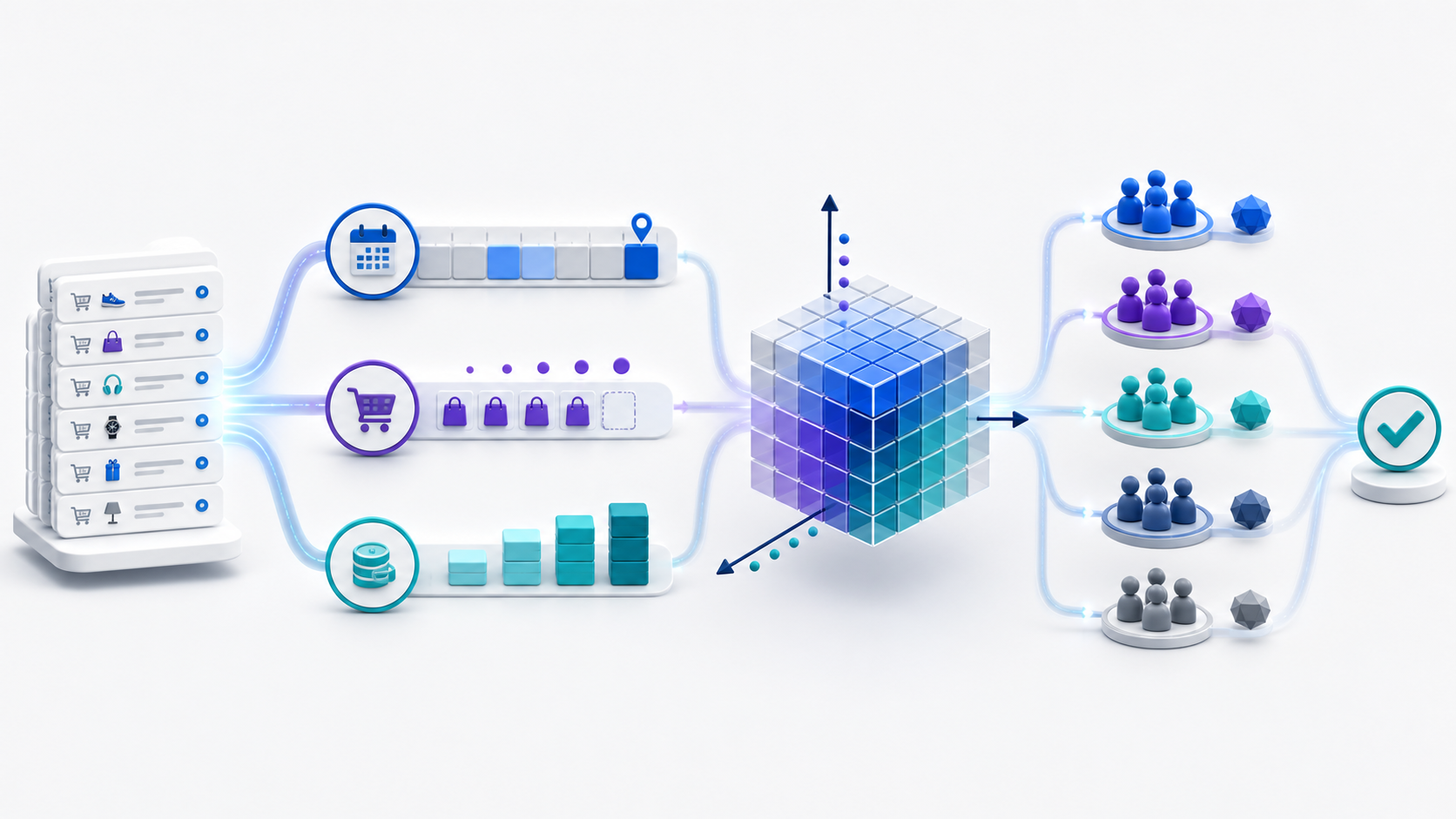
RFM analysis in one practical definition用一个实用定义理解 RFM 分析
RFM analysis is a rule-based way to rank and segment customers by how recently they bought, how often they bought, and how much value they generated within a defined period. Calculate all three measures at the same snapshot, convert them to documented bands such as 1–5, keep the component scores visible, and map meaningful patterns to actions that can be tested.
RFM 分析是一种基于规则的客户排序与分群方法,依据客户最近一次购买距今多久、购买多频繁,以及在指定期间产生多少价值。三个指标必须在同一快照计算,再转换为有文档记录的评分区间(例如 1–5 分);保留各维度分数,并把有意义的组合映射到可以测试的行动。
The model is attractive because most transaction systems already contain its inputs and its rules are explainable. It is best used as a behavioral baseline for prioritization, campaign design, lifecycle review, or feature engineering. It does not reveal why someone behaved that way, prove that a message caused a purchase, predict future value by itself, or replace consent and eligibility rules.
该模型的优势在于多数交易系统已具备所需输入,而且规则容易解释。它适合作为行为基线,用于优先级排序、活动设计、生命周期复盘或特征工程。但它不能解释客户行为原因,不能证明某条消息导致购买,也不能独立预测未来价值,更不能替代同意与资格规则。
Recency, frequency, and monetary value need precise definitions最近购买、购买频率与消费金额必须精确定义
Usually the number of days between the snapshot date and the latest eligible completed transaction. Lower raw recency is better, so its score direction is reversed.
通常指快照日期与最近一笔合格已完成交易之间的天数。原始天数越小越好,因此评分方向需要反转。
The count of eligible orders or transactions during the observation window—not line items, unless line-item activity is the intended unit.
观察窗口内合格订单或交易的次数,而不是商品明细行数,除非分析目标本来就是明细活动。
The approved economic measure over the same window: net revenue, gross margin, contribution, or another defined value. Revenue is not automatically profit.
同一窗口内经批准的经济指标,可以是净收入、毛利、贡献利润或其他明确价值;收入不能自动视为利润。
All dimensions must use the same customer grain, eligibility rules, time zone, currency treatment, observation window, and reproducible snapshot date.
三个维度必须采用相同的客户粒度、资格规则、时区、币种处理、观察窗口与可复现快照日期。
A subscription business might define frequency as paid renewals; a marketplace might count completed orders; a charity might use donations; a content service may need recency, frequency, and engagement instead of monetary value. These are adaptations, not interchangeable labels. Write the business event first, then name the metric.
订阅业务可以把频率定义为已支付续费次数;平台可以统计完成订单;公益组织可以统计捐赠;内容服务可能更适合用最近性、频率与参与度替代金额。这些是不同改编,不能只换标签就视为等价。应先写清业务事件,再命名指标。
When an RFM model fits—and when to choose another methodRFM 模型何时适用,何时应选择其他方法
| Decision need决策需求 | Best starting point合适起点 | Reason原因 |
|---|---|---|
| Prioritize customers from reliable repeat transactions依据可靠的重复交易确定客户优先级 | RFM | Transparent, fast, and easy to audit透明、快速且容易审计 |
| Understand retention by acquisition period按获客时期理解留存 | Cohort analysis群组分析 | Preserves customer age and calendar context保留客户年龄与日历语境 |
| Estimate future economic contribution估计未来经济贡献 | CLV | Requires a forward-looking model and assumptions需要前瞻模型与明确假设 |
| Explain needs, motivations, or satisfaction解释需求、动机或满意度 | Research plus behavioral evidence研究与行为证据结合 | Transactions show what happened, not why交易只能显示发生了什么,不能解释原因 |
| Predict churn or next purchase预测流失或下次购买 | Validated predictive model经过验证的预测模型 | RFM scores alone are descriptiveRFM 评分本身只是描述性结果 |
RFM works best when repeat purchasing is meaningful and enough customers have multiple observed opportunities. It is weaker for one-off purchases, long replacement cycles, new businesses with little history, contractual services where “frequency” is fixed, or cases where margin, cost-to-serve, category, seasonality, and channel fundamentally change the interpretation.
当重复购买有明确意义,而且足够多客户拥有多次可观察机会时,RFM 最有效。对于一次性购买、超长更换周期、历史很少的新业务、频率固定的合同服务,或利润、服务成本、品类、季节性与渠道会根本改变解释的场景,RFM 的适用性较弱。
Prepare transaction data before calculating RFM scores计算 RFM 评分前先准备交易数据
Build a transaction-level table before aggregating to one row per customer. At minimum, preserve a stable customer identifier, a transaction or order identifier, event timestamp, amount or approved value field, currency, and the status fields needed to distinguish completed purchases, cancellations, refunds, tests, internal accounts, and fraud. The UCI Online Retail dataset documentation illustrates why invoice number, invoice date, quantity, unit price, customer ID, and cancellation indicators matter in a real transaction schema.
在聚合为每位客户一行之前,应先建立交易级表格。至少保留稳定的客户标识、交易或订单标识、事件时间戳、金额或已批准价值字段、币种,以及用于区分已完成购买、取消、退款、测试、内部账户与欺诈的状态字段。UCI Online Retail 数据集文档展示了发票号、发票日期、数量、单价、客户 ID 与取消标记为何在真实交易结构中重要。
- Snapshot date: a fixed “as of” date later than the included events. Do not use the analyst's current clock if reproducibility matters.快照日期:晚于纳入事件的固定“截至”日期。若重视可复现性,不要直接使用分析者电脑的当前时间。
- Observation window: a defined lookback such as the previous 365 days, chosen for the purchase cycle rather than copied from another company.观察窗口:例如过去 365 天的明确回看期,应按自身购买周期选择,而不是照搬其他公司。
- Customer grain: person, household, account, or organization. Identity merges and splits can change all three measures.客户粒度:个人、家庭、账户或组织。身份合并与拆分会改变三个指标。
- Economic rule: state whether M uses gross sales, net sales after returns, margin, or another measure; document currency conversion and tax.经济口径:说明 M 使用销售总额、退款后净销售额、利润还是其他指标,并记录汇率与税费处理。
- Reconciliation: compare included customers, orders, units, and value with trusted source totals before scoring.对账:评分前把纳入客户、订单、件数与金额同可信来源总额比较。
How to calculate RFM analysis step by step如何逐步完成 RFM 分析计算
- Define the decision and population定义决策与人群Name the decision owner, target population, allowable action, exclusion rules, and success metric. “Find valuable customers” is too vague.明确决策负责人、目标人群、允许行动、排除规则与成功指标。“寻找有价值客户”过于模糊。
- Freeze the snapshot and window固定快照与窗口Choose one reproducible snapshot date and an observation window that captures enough purchase opportunities without mixing obsolete behavior.选择一个可复现快照日期,以及既能覆盖足够购买机会、又不会混入过时行为的观察窗口。
- Clean eligible transactions清理合格交易Normalize time zones and currencies, identify duplicates, process returns and cancellations, and exclude tests or unauthorized records before aggregation.统一时区与币种,识别重复,处理退款与取消,并在聚合前排除测试或未经授权记录。
- Aggregate one row per customer聚合为每位客户一行R = snapshot date minus latest eligible transaction date; F = distinct eligible orders; M = the approved value sum over the same window.R = 快照日期减去最近合格交易日期;F = 合格订单去重计数;M = 同一窗口内经批准价值之和。
- Inspect distributions检查分布Review missing IDs, zero and negative values, tied frequencies, extreme spend, category or regional differences, and customers with only one order.检查缺失 ID、零值与负值、频率并列、极端消费、品类或地区差异,以及仅有一笔订单的客户。
- Assign scores consistently一致地分配评分Choose business thresholds, quantiles, or another documented rule. Give more recent customers higher R scores and higher F/M values higher scores.选择业务阈值、分位数或其他有文档的规则。购买越近期,R 分越高;F/M 越高,分数越高。
- Map scores to interpretable segments把评分映射为可解释分群Keep R, F, and M separate, then map only meaningful combinations to a manageable number of mutually exclusive labels.保留 R、F、M 独立分数,再把有意义组合映射为数量可控、互斥的标签。
- Validate before activation激活前验证Reconcile totals, profile segment size and outcomes, test threshold sensitivity, review fairness and consent, and run controlled interventions where possible.对账总额、查看分群规模与结果、测试阈值敏感性、审查公平性与同意状态,并尽可能进行受控干预测试。
Choose RFM scoring rules that fit the decision选择符合决策的 RFM 评分规则
| Approach方法 | Strength优势 | Risk / check风险 / 检查 |
|---|---|---|
| Quantiles分位数 | Usually produces similarly sized score bands and adapts to the current distribution通常形成规模接近的评分区间,并适应当前分布 | Ties can collapse boundaries; thresholds drift; relative “best” may still be weak并列会压缩边界;阈值会漂移;相对最佳仍可能绝对表现很弱 |
| Business thresholds业务阈值 | Easy to explain and aligns with purchase cycles, service levels, or economics容易解释,并可对齐购买周期、服务等级或经济条件 | May create tiny segments; requires evidence and scheduled review可能产生很小分群;需要证据与定期复审 |
| Standardized values or clustering标准化数值或聚类 | Can preserve more continuous structure and interactions可保留更多连续结构与交互关系 | Harder to explain; sensitive to scaling, skew, algorithm, and cluster choice更难解释,并对缩放、偏态、算法与簇数量敏感 |
| Weighted composite加权总分 | Can reflect a documented decision priority可体现有文档记录的决策优先级 | Different profiles can produce the same total; weights can hide assumptions不同画像可能得到相同总分;权重可能隐藏假设 |
Three bands are often clearer for small or tied datasets; five bands preserve more detail when the population is large enough. More bands do not create more truth. Never assume “555” is universally the best group: a recent, frequent, high-revenue customer may also have high return rates, low margin, an open complaint, or no permission for the intended communication.
对于规模较小或大量并列的数据,三档通常更清晰;当人群足够大时,五档可以保留更多细节。档位更多并不意味着更真实。也不能假设“555”在任何业务中都是最佳群体:近期、高频、高收入客户也可能退货率很高、利润很低、存在未解决投诉,或没有接受目标沟通的许可。
RFM analysis example with transparent assumptions带透明假设的 RFM 分析示例
Hypothetical example—not observed customer data: an online retailer sets a snapshot date of January 1, 2026, uses completed orders from the previous 365 days, removes fully refunded orders, counts distinct order IDs for frequency, and uses net revenue after returns for monetary value. It assigns five scores with documented thresholds derived before campaign outcomes are examined.
以下为假设示例,并非真实客户数据:某在线零售商把快照日期设为 2026 年 1 月 1 日,使用此前 365 天的已完成订单,剔除全额退款订单,按不同订单 ID 统计频率,并用退货后的净收入作为金额价值。团队在查看活动结果之前,根据有文档记录的阈值分配五档评分。
| Customer客户 | Raw R / F / M原始 R / F / M | Scores评分 | Responsible interpretation负责任的解释 |
|---|---|---|---|
| A | 8 days / 9 orders / $1,2408 天 / 9 单 / 1,240 美元 | 5-5-5 | Strong recent historical activity; verify margin, returns, service status, and permission before any action近期历史活动强;行动前仍需核对利润、退货、服务状态与许可 |
| B | 14 days / 1 order / $1,90014 天 / 1 单 / 1,900 美元 | 5-1-5 | Recent high-value first or infrequent purchase; do not label loyal近期高价值的首次或低频购买;不能直接标记为忠诚 |
| C | 175 days / 8 orders / $980175 天 / 8 单 / 980 美元 | 1-5-4 | Historically frequent but inactive under this window; investigate cycle and category before win-back历史高频但在当前窗口不活跃;召回前先检查周期与品类 |
| D | 42 days / 3 orders / $21042 天 / 3 单 / 210 美元 | 3-3-2 | Middle profile; a generic label adds little unless tied to a decision or experiment中间型画像;若不连接具体决策或实验,通用标签价值有限 |
The digits preserve information that a sum destroys. Customers B and C could receive similar weighted totals while requiring very different questions. Use segment names only after checking the underlying R, F, and M profile, and include the raw measures in analyst-facing outputs.
三位评分保留了总分会丢失的信息。客户 B 与 C 可能得到相近加权总分,但需要回答的问题完全不同。只有查看底层 R、F、M 画像后才能命名分群,并在面向分析人员的输出中保留原始指标。
Turn RFM segmentation into testable actions, not stereotypes把 RFM 分群转化为可测试行动,而不是刻板标签
A useful segment has a defined membership rule, business question, eligible action, suppression rule, owner, metric, and review date. Keep the list manageable—often five to eight operational groups are easier to govern than all 125 possible five-band combinations. Merge score cells only when they support the same decision.
有用的分群必须包含明确的成员规则、业务问题、允许行动、抑制规则、负责人、指标与复审日期。分群数量应保持可管理;与五档评分的 125 种可能组合相比,五至八个运营群组通常更容易治理。只有当评分单元支持相同决策时才合并。
Test service recognition, replenishment relevance, or loyalty benefits. Do not assume high margin or message consent.
可测试服务识别、补货相关性或忠诚权益,但不能假设其利润高或已同意接收消息。
Treat as a first-purchase or occasional-buyer question. Measure second-purchase conversion without pressuring customers.
应视为首次购买或偶发购买问题,在不过度打扰客户的前提下衡量二次购买转化。
Check expected cycle, inventory, unresolved service issues, and seasonality before defining a reactivation test.
定义召回测试前,检查预期周期、库存、未解决服务问题与季节性。
Keep separate from low-value labels. Insufficient observation is not evidence of weak potential.
应与低价值标签区分。观察不足并不等于潜力弱。
For reliable customer entities and permissions, use the customer data management guide. To connect RFM segments with retention, LTV, campaign, and channel questions, use the marketing data analysis playbook rather than treating segment movement as proof of business impact.
若要建立可靠的客户实体与权限,请参考客户数据管理指南。若要把 RFM 分群连接到留存、LTV、活动与渠道问题,请使用营销数据分析实战手册,而不是把分群迁移直接当作业务影响证据。
Use InfiniSynapse for a prepared RFM analysis workflow用 InfiniSynapse 执行准备充分的 RFM 分析工作流
InfiniSynapse is a general AI data analysis application, not a CRM, campaign sender, identity-resolution guarantee, or dedicated RFM product. Its project-approved product language supports analysis across prepared databases and files, natural-language analytical workflows, tables, charts, and multi-source analysis. Human owners remain responsible for definitions, permissions, identity policy, interpretation, and action.
InfiniSynapse 是通用 AI 数据分析应用,不是 CRM、活动发送平台、身份解析保证工具,也不是专用 RFM 产品。项目已批准的产品表述支持分析准备好的数据库与文件、自然语言分析工作流、表格、图表与多源分析。定义、权限、身份策略、解释与行动仍由人员负责。
Before opening the app, prepare an authorized CSV, spreadsheet, or database connection; a data dictionary; customer and transaction keys; snapshot date; observation window; currency and return rules; exclusions; trusted totals; scoring plan; and the decision to test. Use the workspace to profile records, build reproducible customer-level measures, compare score distributions, create segment tables and charts, and document validation.
打开应用前,请准备已授权的 CSV、电子表格或数据库连接、数据字典、客户与交易键、快照日期、观察窗口、币种与退货规则、排除项、可信总额、评分方案和待测试决策。可在工作区中概览记录、构建可复现客户级指标、比较评分分布、创建分群表格与图表并记录验证。
Open the InfiniSynapse AI Data Analyst打开 InfiniSynapse AI 数据分析工具Start with row counts, date coverage, identifier completeness, duplicates, cancellations, returns, currency, and reconciliation. Ask for the calculation logic and intermediate tables, not only a final chart. Review the InfiniSynapse tool directory and InfiniSynapse documentation for product and implementation details.
先检查行数、日期覆盖、标识完整度、重复、取消、退货、币种与对账。要求保留计算逻辑和中间表,而不仅是最终图表。可查看 InfiniSynapse 工具目录与 InfiniSynapse 文档了解产品与实施细节。
Validate RFM results and set a responsible refresh cycle验证 RFM 结果并设定负责任的刷新周期
| Layer层级 | Check检查 | Stop condition停止条件 |
|---|---|---|
| Source来源 | Permissions, schema, coverage, duplicate orders, returns, totals权限、模式、覆盖、重复订单、退货、总额 | Unknown provenance or unreconciled value来源不明或金额无法对账 |
| Calculation计算 | One customer grain, fixed snapshot, distinct order count, shared window统一客户粒度、固定快照、订单去重计数、共同窗口 | Changing run date changes historical results unexpectedly运行日期变化导致历史结果意外变化 |
| Scoring评分 | Direction, ties, thresholds, missing values, sensitivity方向、并列、阈值、缺失值、敏感性 | Small threshold changes rewrite most segments阈值微调就改写大多数分群 |
| Interpretation解释 | Raw profiles, margin, category, region, tenure, service context原始画像、利润、品类、地区、客户年龄、服务语境 | Label is treated as motive, cause, or future certainty把标签当作动机、原因或未来确定事实 |
| Action行动 | Consent, suppressions, owner, holdout, success and guardrail metrics同意、抑制规则、负责人、留出组、成功与护栏指标 | No permitted action or measurable test没有获准行动或可测量测试 |
Refresh often enough for the purchase cycle and decision cadence—not simply every day. Weekly may fit frequent retail; monthly or quarterly may fit slower categories. At every refresh, monitor score thresholds, segment sizes, transition rates, coverage, data latency, and outcome differences. Version the rules so a change in membership can be traced to behavior, data, or methodology.
刷新频率应匹配购买周期与决策节奏,而不是机械地每天更新。高频零售可能适合每周刷新,较慢品类可能适合每月或每季度刷新。每次刷新都要监测评分阈值、分群规模、迁移率、覆盖率、数据延迟与结果差异,并对规则进行版本管理,使成员变化可以追溯到行为、数据或方法变化。
RFM analysis limitations, failure modes, and privacy boundariesRFM 分析的局限、失败条件与隐私边界
- Historical, not causal: RFM summarizes observed transactions. A high or low score does not explain motivation or the effect of marketing.历史描述而非因果:RFM 汇总已观察交易。高分或低分不能解释动机,也不能说明营销效果。
- Value can be misstated: gross revenue ignores discounts, returns, margin, service costs, and risk. Choose M for the decision.价值可能失真:销售总额忽略折扣、退货、利润、服务成本与风险。应按决策选择 M。
- Window bias: a 12-month window can disadvantage seasonal buyers, long-cycle categories, and newly acquired customers.窗口偏差:12 个月窗口可能不利于季节性客户、长周期品类与新获客客户。
- Identity errors multiply: split identities undercount F and M; incorrect merges inflate all dimensions and can expose data to the wrong person.身份错误会被放大:身份拆分会低估 F 与 M;错误合并会抬高三个维度,还可能把数据暴露给错误对象。
- Quantiles are relative: they force rankings even when the population is uniformly weak and can become unstable when many values tie.分位数是相对的:即使整体表现都弱,也会强制排序;大量并列时还会不稳定。
- Labels can stigmatize: names such as “lost” or “low value” are operational shorthand, not facts about a person. Prefer neutral behavior descriptions.标签可能污名化:“流失”或“低价值”等名称只是运营缩写,不是对个人的事实判断。应优先使用中性行为描述。
Privacy boundary: use only data authorized for a defined purpose, minimize fields, restrict access, support correction and deletion, honor communication preferences, and review applicable law and policy. Do not use RFM as an eligibility, credit, employment, insurance, medical, pricing, or other high-impact decision rule without specialized legal, governance, fairness, and human review.
隐私边界:只使用为明确目的获准的数据,尽量减少字段,限制访问,支持更正与删除,并遵守沟通偏好及适用法律政策。未经专门法律、治理、公平性与人工审查,不得把 RFM 用作资格、信贷、就业、保险、医疗、定价或其他高影响决策规则。
RFM analysis questionsRFM 分析常见问题
It is a rule-based customer segmentation method that summarizes transaction history using recency, frequency, and monetary value. Each dimension is calculated for a defined customer, window, and snapshot date, then scored and mapped to groups for testing.
它是一种基于规则的客户细分方法,用最近购买、购买频率与消费金额汇总交易历史。每个维度都针对明确客户、窗口与快照日期计算,再评分并映射到待测试群组。
At minimum, use a stable customer ID, order ID, transaction date, amount or approved value measure, and status fields for completed purchases, cancellations, and returns. Define snapshot, window, currency, time zone, eligibility, and grain.
至少需要稳定客户 ID、订单 ID、交易日期、金额或经批准价值指标,以及已完成购买、取消和退货的状态字段。同时定义快照、窗口、币种、时区、资格与粒度。
Calculate days since the latest eligible transaction, distinct eligible orders in the window, and the chosen value total. Convert measures to a common scale, reverse recency so recent customers score higher, and keep the three components separate.
计算距最近合格交易的天数、窗口内不同合格订单数及选定价值总额。把指标转换到共同量表,反转最近性使近期客户得分更高,并保留三个独立分数。
There is no universal best number. Five bands preserve detail but need enough customers and distinct values; three are easier to explain and can be more stable. Document thresholds and test sensitivity.
没有普遍最佳档数。五档保留更多细节,但需要足够客户与不同数值;三档更容易解释,也可能更稳定。必须记录阈值并测试敏感性。
Yes, for a manageable dataset. Use a fixed snapshot cell, customer-level aggregation, distinct-order logic, and documented lookup or percentile thresholds. Reconcile totals and avoid volatile formulas. Larger or recurring workflows are usually safer in a database or scripted pipeline.
可以,前提是数据规模可管理。使用固定快照单元格、客户级聚合、订单去重逻辑及有文档的查找或百分位阈值,并对账总额、避免易变公式。更大或重复执行的工作流通常更适合数据库或脚本管道。
Match the purchase cycle and decision cadence. Weekly may suit frequent retail, while monthly or quarterly may suit slower cycles. Recheck distributions, thresholds, size, and movement whenever the data or business changes.
应匹配购买周期与决策节奏。高频零售可能适合每周,慢周期可能适合每月或每季度。数据或业务变化时都要重新检查分布、阈值、规模与迁移。
No. RFM describes selected past transaction behavior at a snapshot. CLV estimates future economic contribution under assumptions. RFM can support prioritization or features, but is not a forecast, causal explanation, or profit measure.
不等同。RFM 描述快照时点选定的历史交易行为;CLV 在假设下估计未来经济贡献。RFM 可支持优先级或特征构建,但不是预测、因果解释或利润指标。
Authoritative sources and evidence scope权威来源与证据范围
- Google Cloud guidance on actionable customer segmentation models defines RFM and emphasizes starting segmentation with a business goal and testing whether findings are useful.Google Cloud 可执行客户细分模型指南定义 RFM,并强调从业务目标出发、通过测试确认发现是否有用。
- UCI Machine Learning Repository Online Retail dataset documents an invoice-level retail schema, including transaction identifiers, dates, quantities, unit prices, customer IDs, and cancellation markers.UCI 机器学习资料库 Online Retail 数据集记录了发票级零售数据结构,包括交易标识、日期、数量、单价、客户 ID 与取消标记。
- InfiniSynapse product overview is the first-party source for the product capabilities described in the tool workflow.InfiniSynapse 产品概览是工具工作流中产品能力表述的第一方来源。