
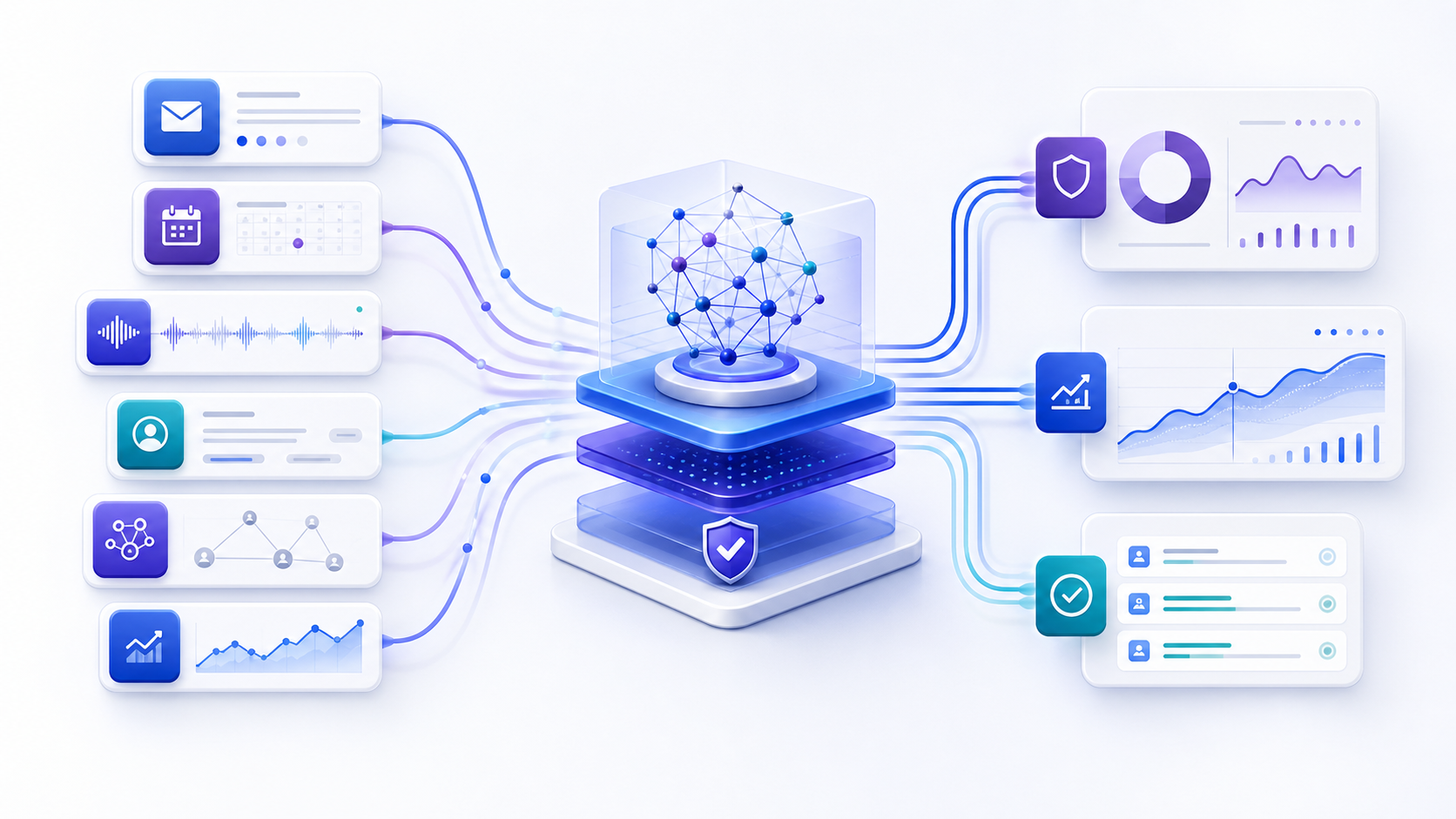
What Is Revenue Intelligence?什么是 Revenue Intelligence?
Revenue intelligence is a governed operating approach that connects revenue-related data, converts observable evidence into deal and pipeline signals, and delivers those signals to forecasting, inspection, and action workflows. Its job is not merely to describe the past; it helps teams decide what needs attention before an expected outcome becomes final.
Revenue Intelligence 是一种受治理的运营方法:连接收入相关数据,把可观察证据转化为交易与 Pipeline 信号,并把信号送入预测、检查和行动工作流。它不只是描述过去,而是帮助团队在结果最终形成前判断什么需要关注。
The category commonly combines CRM fields, opportunity history, email and calendar activity, conversation data, buyer and stakeholder engagement, product or service signals, targets, forecasts, and realized outcomes. Rules or models transform these inputs into findings such as missing engagement, unusual stage age, pushed close dates, weak buying-committee coverage, inconsistent forecast categories, or expansion potential.
这一领域通常结合 CRM 字段、商机历史、邮件与日历活动、对话数据、买方和利益相关者参与、产品或服务信号、目标、预测与实际结果。规则或模型把这些输入转成发现,例如参与不足、阶段停留异常、成交日期后移、购买委员会覆盖薄弱、预测类别不一致或扩张机会。
A signal is evidence for review, not a guaranteed prediction. Revenue intelligence is useful only when the organization defines the event, population, time window, expected behavior, owner, action, and validation method behind each signal. Otherwise it becomes another layer of alerts that sales teams ignore.
信号是供复核的证据,不是结果保证。只有当企业为每个信号定义事件、统计总体、时间窗口、预期行为、负责人、行动和验证方法时,Revenue Intelligence 才有用;否则它只是另一层被销售团队忽略的提醒。
Revenue Intelligence vs. Related CategoriesRevenue Intelligence 与相关类别的区别
Revenue intelligence overlaps with sales intelligence, conversation intelligence, revenue analytics, forecasting, CRM, and RevOps. The difference is best understood through the decision being supported, not through a vendor feature list.
Revenue Intelligence 与 Sales Intelligence、Conversation Intelligence、Revenue Analytics、预测、CRM 和 RevOps 都有交集。最可靠的区分方式是看它支持什么决策,而不是比较供应商功能列表。
| Category类别 | Primary focus主要关注 | Typical output典型输出 |
|---|---|---|
| Revenue intelligence | Connected evidence about in-flight revenue execution进行中收入执行的连接证据 | Deal risk, forecast confidence, pipeline change, next review交易风险、预测信心、Pipeline 变化与后续复核 |
| Sales intelligence | Prospect, account, market, and contact information潜在客户、账户、市场与联系人信息 | Research, targeting, qualification, and outreach context研究、定向、资格判断与触达背景 |
| Conversation intelligence | Calls, meetings, and customer conversations通话、会议与客户对话 | Transcript, topics, objections, summaries, and coaching evidence转录、主题、异议、摘要与辅导证据 |
| Revenue analytics | Governed measurement and explanation of revenue outcomes收入结果的受治理衡量与解释 | Growth, segment, cohort, variance, and realized-outcome analysis增长、分群、队列、差异与实际结果分析 |
| CRM | System of record and execution workflow记录系统与执行工作流 | Accounts, opportunities, stages, tasks, and ownership账户、商机、阶段、任务与所有权 |
| RevOps | Function aligning process, data, systems, and governance统一流程、数据、系统与治理的职能 | Operating model, definitions, cadence, controls, and enablement运营模式、定义、节奏、控制与赋能 |
Detailed forecasting methods belong in the sales forecasting guide. Commercial comparison and procurement questions belong on the planned revenue intelligence platform page. Keeping these intents separate prevents a definition guide from becoming a disguised vendor list.
详细预测方法请参阅销售预测指南;商业比较与采购问题应由规划中的 Revenue Intelligence Platform 页面承接。分开这些意图,可以避免定义指南变成伪装的供应商列表。
Which Decisions Should Revenue Intelligence Support?Revenue Intelligence 应支持哪些决策?
Start from a decision inventory. Sales representatives need a short, explainable list of deals that warrant attention. Managers need evidence for inspection and coaching. Forecast owners need to understand changes, risk, and overrides. RevOps needs stable definitions, adoption, and model monitoring. Finance needs clear boundaries between pipeline expectations and recognized revenue.
应从决策清单开始。销售人员需要简短且可解释的重点交易列表;经理需要复盘与辅导证据;预测负责人需要理解变化、风险和人工覆盖;RevOps 需要稳定定义、采用情况与模型监控;财务需要明确 Pipeline 预期和确认收入的边界。
Which opportunities changed materially, what evidence changed, and what review or action is justified?
哪些商机发生重大变化、什么证据改变,以及什么复核或行动是合理的?
Where are stage age, movement, coverage, engagement, or data quality inconsistent with the operating model?
哪些阶段停留、移动、覆盖、参与或数据质量与运营模型不一致?
What changed since the last snapshot, which assumptions weakened, and where does judgment differ from evidence?
自上次快照后发生了什么,哪些假设变弱,以及人工判断与证据在哪里不一致?
Which repeatable behaviors correlate with outcomes, and which gaps require enablement rather than an alert?
哪些可重复行为与结果相关,哪些差距需要赋能而不是提醒?
Exclude decisions that lack a legitimate owner, safe action, or outcome measure. A signal that nobody can act on adds surveillance and noise. A score used for compensation or employment decisions requires much stronger validation, fairness review, access control, and human governance than a coaching prompt.
应排除没有合法负责人、安全行动或结果衡量的决策。无法行动的信号只会增加监控感和噪声。用于薪酬或雇佣决策的评分,比辅导提示需要更严格的验证、公平性审查、访问控制与人工治理。
From Raw Events to Actionable Revenue Signals从原始事件到可行动收入信号
A revenue signal should have four layers: observable event, derived feature, evaluated condition, and governed action. For example, a meeting cancellation is an event; days since the last customer interaction is a feature; “engagement gap exceeds the segment’s expected range” is a condition; “review stakeholder plan before the next forecast call” is the action. Skipping layers makes a signal difficult to explain or validate.
收入信号应包含四层:可观察事件、派生特征、评估条件与受治理行动。例如,会议取消是事件,距上次客户互动的天数是特征,“参与间隔超过该分群预期范围”是条件,“下次预测会前复核利益相关者计划”是行动。跳过任何层都会降低可解释性和可验证性。
Every displayed finding should answer: What changed? Compared with what baseline? Over which time window? Which source records support it? How confident is the system? Who should review it? What should happen next? When will the outcome be evaluated? This turns a score into a reviewable decision object.
每条展示的发现都应回答:发生了什么变化?与什么基准比较?时间窗口多长?哪些源记录支持?系统信心如何?谁负责复核?下一步是什么?何时评估结果?这样才能把评分转为可复核的决策对象。
Do not equate activity volume with buyer intent. More emails can reflect confusion; more meetings can reflect complexity; silence can be normal for a procurement phase. Contextualize signals by sales motion, stage, customer segment, deal size, geography, expected cadence, and historical outcomes.
不要把活动量等同于买方意图。更多邮件可能意味着困惑,更多会议可能意味着复杂性,采购阶段的沉默也可能正常。信号必须按销售模式、阶段、客户分群、交易规模、地区、预期节奏与历史结果进行语境化。
Revenue Intelligence Data SourcesRevenue Intelligence 的数据来源
| Source来源 | Useful evidence可用证据 | Primary caution主要注意事项 |
|---|---|---|
| CRM | Opportunity state, amount, owner, stage, close date, contacts, products, forecast category商机状态、金额、负责人、阶段、成交日期、联系人、产品、预测类别 | Manual updates, stale values, and overwritten history人工更新、过期值与历史被覆盖 |
| Email and calendar邮件与日历 | Recency, frequency, reply pattern, attendance, stakeholder breadth最近互动、频率、回复模式、出席与利益相关者广度 | Privacy, shared mailboxes, automated messages, and missing consent隐私、共享邮箱、自动消息与授权缺失 |
| Conversation systems对话系统 | Topics, questions, objections, commitments, next steps, participants主题、问题、异议、承诺、后续步骤与参与者 | Transcription error, language coverage, context loss, sensitive content转录错误、语言覆盖、上下文丢失与敏感内容 |
| Marketing and product营销与产品 | Campaign response, web engagement, trial or product usage, adoption活动响应、网站参与、试用或产品使用、采用情况 | Identity resolution, attribution, and weak causal meaning身份解析、归因与因果含义薄弱 |
| Contracts, billing, and warehouse合同、计费与数据仓库 | Commitment, renewal, expansion, billing state, realized outcomes, snapshots承诺、续约、扩张、计费状态、实际结果与快照 | Timing, currency, revenue-state definitions, and reconciliation时间、币种、收入状态定义与对账 |
Preserve event history instead of only current state. Store when a stage, amount, close date, forecast category, contact role, or signal changed; record source event time and ingestion time; snapshot forecasts. Without history, the system cannot explain movement, reproduce a past review, or measure whether an alert preceded the outcome.
必须保留事件历史,而不只是当前状态。记录阶段、金额、成交日期、预测类别、联系人角色或信号何时变化,并保存源事件时间、摄取时间和预测快照。没有历史,就无法解释变化、重现过去复盘,也无法衡量提醒是否先于结果。
Create Reliable Identity and Data Contracts建立可靠的身份与数据契约
The hardest technical problem is often identity, not AI. An email participant, CRM contact, account, opportunity, product workspace, contract, and billing customer may use different identifiers. Define durable keys and a documented resolution hierarchy. Record ambiguous and unmatched identities instead of forcing every event into a deal.
最难的技术问题往往是身份而不是 AI。邮件参与者、CRM 联系人、账户、商机、产品工作区、合同和计费客户可能使用不同标识。应定义稳定键与书面解析优先级,并记录模糊和未匹配身份,而不是强行把每个事件归入某笔交易。
A source contract should specify owner, fields, meaning, allowed values, event grain, update behavior, latency, retention, privacy classification, and quality tests. For each feature or signal, document source lineage, calculation window, missing-data behavior, applicable population, effective date, and version. This prevents silent changes when a CRM field, stage map, or calendar integration is reconfigured.
来源契约应说明负责人、字段、含义、允许值、事件粒度、更新行为、延迟、保留期、隐私分类与质量测试。每个特征或信号还要记录来源血缘、计算窗口、缺失数据处理、适用总体、生效日期与版本,避免 CRM 字段、阶段映射或日历集成重新配置时发生静默变化。
Coverage must be visible. If only 63% of opportunities have reliable activity capture, a “no recent engagement” signal cannot be interpreted as buyer silence for the remainder. Show capture coverage, missingness, freshness, match rate, and excluded populations beside the result.
覆盖率必须可见。如果只有 63% 的商机拥有可靠活动采集,那么其余商机的“近期无参与”不能被解释为买方沉默。结果旁应显示采集覆盖率、缺失率、新鲜度、匹配率与排除总体。
Design and Validate Revenue Signals设计并验证收入信号
-
Name the decision and population.明确决策与总体。
Define the user, action, sales motion, stages, segment, horizon, and exclusions. One rule rarely fits new business, renewal, usage expansion, and channel sales.
定义用户、行动、销售模式、阶段、分群、时间范围与排除项。新增、续约、用量扩张和渠道销售很少适合同一规则。
-
Choose observable evidence.选择可观察证据。
Prefer dated, attributable events over subjective labels. Preserve the records that allow a reviewer to verify the finding.
优先使用带日期、可归属的事件,而不是主观标签,并保留让复核者验证发现的记录。
-
Define the baseline and threshold.定义基准与阈值。
Use documented policy, comparable historical outcomes, or a controlled experiment. Avoid arbitrary universal cutoffs.
使用书面政策、可比历史结果或受控实验,避免任意的通用阈值。
-
Backtest on historical snapshots.使用历史快照回测。
Calculate precision, recall, false positives, false negatives, lead time, calibration, and coverage by segment and period.
按分群与期间计算精确率、召回率、假阳性、假阴性、提前量、校准与覆盖率。
-
Run in shadow mode.以影子模式运行。
Show findings to a controlled reviewer group without triggering automated actions. Collect reason-coded feedback and examine workload.
先向受控复核组展示发现而不触发自动行动,收集带原因代码的反馈并检查工作量。
-
Release, monitor, and retire.发布、监控与退役。
Version the signal, monitor drift and adoption, evaluate later outcomes, and retire rules whose costs exceed their value.
对信号进行版本化,监控漂移与采用情况,评估后续结果,并淘汰成本高于价值的规则。
Use Deal Risk Signals Without Creating a Black Box在不制造黑箱的前提下使用交易风险信号
Deal risk is not one universal score. It is a set of evidence-backed conditions that could prevent an opportunity from reaching a defined outcome within a horizon. Useful families include data risk, process risk, engagement risk, stakeholder risk, timing risk, commercial risk, implementation risk, and model uncertainty.
交易风险不是一个通用分数,而是一组有证据支持的条件,可能阻止商机在规定时间内达到定义结果。常见风险族包括数据、流程、参与、利益相关者、时间、商业、实施以及模型不确定性。
Close date moved twice, amount fell, key stakeholder disappeared, or next step expired.
成交日期两次后移、金额下降、关键利益相关者消失或下一步已过期。
Stage age, engagement cadence, stakeholder coverage, or sequence differs from comparable won deals.
阶段停留、参与节奏、利益相关者覆盖或流程顺序与可比赢单不同。
Missing capture, sparse segment history, identity ambiguity, or recent process change weakens confidence.
采集缺失、分群历史稀疏、身份模糊或近期流程变化会降低信心。
Confirm evidence, contact owner, update mutual plan, revise category, or document an override.
确认依据、联系负责人、更新共同计划、调整类别或记录人工覆盖。
Rank by expected decision value, not risk probability alone. A high-risk, low-value opportunity may matter less than a medium-risk strategic renewal. Combine potential impact, time remaining, actionability, confidence, and review cost. Let users dismiss, defer, or challenge a signal with a reason; that feedback is valuable only after review, not automatically treated as ground truth.
排序不能只看风险概率,而应看预期决策价值。高风险低价值商机可能不如中风险战略续约重要。应结合潜在影响、剩余时间、可行动性、信心与复核成本,并允许用户带原因地忽略、延后或质疑信号;这些反馈需要复核,不能自动视为事实。
Connect Revenue Intelligence to Pipeline and Forecasting把 Revenue Intelligence 连接到 Pipeline 与预测
A pipeline view shows current opportunity states; intelligence explains material movement and challenges unsupported assumptions. Track additions, progression, regression, slippage, amount changes, category changes, and closures between snapshots. Then connect each movement to source evidence and expected forecast impact.
Pipeline 视图显示当前商机状态,Revenue Intelligence 则解释重要变化并质疑缺少证据的假设。应在快照间跟踪新增、推进、倒退、延期、金额变化、类别变化与关闭,再把每个变化连接到源证据和预期预测影响。
Preserve submitted forecast, manager adjustment, model estimate, and actual outcome as separate fields. A representative’s commit is a judgment; a probability model is an estimate; closed revenue is an outcome under a defined policy. Comparing them reveals bias, calibration, and override value. Collapsing them into one number destroys the evidence needed to learn.
提交预测、经理调整、模型估计与实际结果必须保存为不同字段。销售人员的 Commit 是判断,概率模型是估计,成交收入是在定义政策下的结果。比较它们可以揭示偏差、校准与人工覆盖价值;合并为一个数字会破坏学习所需证据。
Use sales pipeline management for stage governance, inspection cadence, aging, coverage, and flow. Use revenue intelligence to focus the review on meaningful change, contradictory evidence, and decisions. Neither replaces a disciplined forecast process.
销售 Pipeline 管理负责阶段治理、检查节奏、老化、覆盖与流动;Revenue Intelligence 用于聚焦重大变化、矛盾证据与决策。两者都不能替代严谨的预测流程。
Embed Intelligence in the Revenue Operating Cadence把收入智能嵌入收入运营节奏
Signals create value only when they arrive at the correct decision point. A daily seller view should be brief and action-oriented. A weekly manager inspection should compare changes since the last review, material risks, unsupported categories, and owner commitments. A forecast call should focus on assumptions and aggregate impact rather than reading every deal. A monthly RevOps review should examine signal quality, coverage, drift, adoption, and unintended behavior.
信号只有在正确决策点出现才有价值。销售人员的每日视图应简短且面向行动;经理的每周检查应比较上次复盘后的变化、重大风险、缺少证据的类别与负责人承诺;预测会应聚焦假设与总体影响,而不是逐笔念交易;RevOps 月度复盘应检查信号质量、覆盖、漂移、采用与意外行为。
| Cadence节奏 | Review object复核对象 | Required output必要输出 |
|---|---|---|
| Daily每日 | New material changes and due actions新的重大变化与到期行动 | Owner, next step, due date, reason负责人、下一步、截止日期、原因 |
| Weekly每周 | Deal and pipeline inspection交易与 Pipeline 检查 | Confirmed risk, override, category or action已确认风险、覆盖、类别或行动 |
| Forecast cycle预测周期 | Snapshot change, assumptions, range, scenarios快照变化、假设、范围与情景 | Submitted view with documented judgment带书面判断的提交视图 |
| Monthly每月 | Coverage, accuracy, calibration, drift, workload覆盖、准确性、校准、漂移与工作量 | Keep, change, test, or retire decision保留、调整、测试或退役决策 |
Measure workflow outcomes as well as model metrics: time from signal to review, percentage reviewed, action completion, accepted versus challenged findings, forecast change, and later realized outcome. High click-through or alert volume is not success if decisions do not improve.
除模型指标外,还要衡量工作流结果:从信号到复核的时间、复核比例、行动完成率、接受与质疑情况、预测变化和后续实际结果。即使点击率或提醒量很高,如果决策没有改进,也不算成功。
A Practical Revenue Intelligence Implementation Roadmap实用的 Revenue Intelligence 实施路线
-
Select one decision and owner.选择一个决策与负责人。
Begin with a bounded workflow such as reviewing slipped commit deals, not “make forecasts intelligent.”
从边界清晰的工作流开始,例如复核延期的 Commit 交易,而不是“让预测智能化”。
-
Baseline the current process.建立当前流程基线。
Measure data coverage, review time, forecast error, common overrides, and action completion before intervention.
干预前衡量数据覆盖、复核时间、预测误差、常见人工覆盖与行动完成率。
-
Connect the minimum evidence.连接最低必要证据。
Use the fewest sources required to answer the decision, with history, identity, permissions, and contracts intact.
只使用回答该决策所需的最少来源,同时保持历史、身份、权限与契约完整。
-
Build transparent rules first.先建立透明规则。
Test dated changes, missing next steps, stage age, or stakeholder gaps before introducing complex models.
在引入复杂模型前,先测试带日期的变化、缺失下一步、阶段停留或利益相关者缺口。
-
Validate and run a controlled pilot.验证并开展受控试点。
Backtest, use shadow mode, train reviewers, collect reason-coded feedback, and assess workload and harm.
进行回测和影子运行,培训复核者,收集带原因反馈,并评估工作量与潜在伤害。
-
Integrate the review and feedback loop.整合复核与反馈闭环。
Deliver evidence inside the actual operating cadence, retain outcomes, monitor drift, and expand only after proving value.
在真实运营节奏中交付证据,保留结果,监控漂移,并只在证明价值后扩展。
Worked Example: Review a Forecast-Risk Signal演算示例:复核预测风险信号
Hypothetical example: the following values illustrate the workflow and are not InfiniSynapse customer results or benchmarks.
假设示例:以下数值只用于说明工作流,并非 InfiniSynapse 客户结果或行业基准。
A $240,000 opportunity is submitted as commit for the current quarter. Since the previous weekly snapshot, its close date moved 18 days, the opportunity amount fell 10%, the scheduled procurement meeting was cancelled, and no new date is recorded. The system also detects that only one contact is linked although comparable enterprise opportunities normally involve multiple roles. It marks the deal for review, not as “will lose.”
某笔 24 万美元商机被提交为本季度 Commit。自上周快照后,成交日期后移 18 天,金额下降 10%,原定采购会议取消且没有新日期。系统还发现只关联了一名联系人,而可比企业商机通常涉及多个角色。因此系统把交易标记为需要复核,而不是断言“必输”。
The manager opens the evidence, confirms the date and amount changes, and learns that procurement has changed representatives. The account owner provides a new meeting invitation and a revised mutual plan. Because the underlying commercial scope changed, the manager moves the opportunity from commit to best case and documents the reason. The forecast rollup updates while preserving the original submission, manager override, and source evidence.
经理打开证据,确认日期与金额变化,并了解到采购更换了代表。客户负责人提供新的会议邀请与修订后的共同计划。由于商业范围已经变化,经理把商机从 Commit 调整为 Best Case,并记录原因。预测汇总随之更新,同时保留原提交、经理覆盖与源证据。
After the quarter, the deal closes in the following period. The signal is counted as an early, correctly reviewed timing risk—not as proof that every cancellation predicts slippage. RevOps evaluates similar signals across segments, reviews false positives, and decides whether the 18-day threshold should differ by sales motion. The learning loop improves the rule without rewriting the historical result.
季度结束后,该交易在下一期间成交。该信号被记为较早且正确复核的时间风险,而不是“所有会议取消都会延期”的证明。RevOps 按分群评估类似信号、检查假阳性,并判断 18 天阈值是否应因销售模式而不同。学习闭环改进规则,同时不重写历史结果。
Govern AI, Privacy, and Human Review治理 AI、隐私与人工复核
Revenue intelligence may process communications, calendars, recordings, customer data, employee activity, and predictions. Before collection, establish a lawful basis, notice and consent where required, purpose limitation, access controls, retention, deletion, regional handling, vendor terms, and an incident process. Restrict sensitive content and provide appropriate redaction or exclusion.
Revenue Intelligence 可能处理通信、日历、录音、客户数据、员工活动与预测。采集前应建立合法依据、必要的通知与同意、目的限制、访问控制、保留与删除、区域处理、供应商条款和事件流程,并限制敏感内容,提供适当遮盖或排除。
For model governance, document training and evaluation populations, feature lineage, intended use, prohibited use, performance by segment, calibration, confidence, override path, monitoring, and rollback. Protect against target leakage: a feature created after the forecast cutoff must not be used to claim earlier predictive accuracy. Preserve timestamps and evaluate only with information available at prediction time.
模型治理应记录训练和评估总体、特征血缘、预期用途、禁止用途、分群表现、校准、信心、人工覆盖路径、监控与回滚。还要防止目标泄漏:预测截止后产生的特征不能用于宣称此前的预测准确性。必须保留时间戳,并只用预测时可获得的信息评估。
| Risk风险 | Control控制 |
|---|---|
| False certainty虚假确定性 | Show evidence, confidence, coverage, alternatives, and human decision显示证据、信心、覆盖、替代解释与人工决策 |
| Alert overload提醒过载 | Prioritize by decision value, rate-limit, bundle, and retire low-value rules按决策价值排序、限流、合并并淘汰低价值规则 |
| Surveillance and misuse监控与滥用 | Purpose limitation, role access, transparency, appeal, and prohibited-use policy目的限制、角色访问、透明度、申诉与禁止用途政策 |
| Model or process drift模型或流程漂移 | Versioning, segment monitoring, trigger thresholds, review, and rollback版本化、分群监控、触发阈值、复核与回滚 |
Prepare for Platform Evaluation Without Turning This into a Buyer List为平台评估做准备,但不把本页变成采购列表
Before comparing software, prove that the use case, data, and operating process are ready. Define the decision, required sources, history depth, identity model, privacy constraints, integration direction, latency, evidence display, workflow destination, feedback capture, evaluation metrics, and exit plan. A platform cannot compensate for an undefined stage model or a forecast process nobody follows.
比较软件前,先证明用例、数据与运营流程已经准备好。定义决策、所需来源、历史深度、身份模型、隐私约束、集成方向、延迟、证据展示、工作流目标、反馈采集、评估指标和退出方案。平台无法弥补未定义的阶段模型,也无法替代无人遵循的预测流程。
Create a proof-of-value dataset containing representative segments, historical snapshots, known outcomes, missing-data cases, unusual sales motions, and permission scenarios. Evaluate source coverage, reconciliation, explainability, workflow fit, reviewer workload, accuracy by segment, administrative control, data portability, security evidence, and total operating cost. Keep product and vendor comparisons on the dedicated platform-intent page so this guide remains implementation-focused.
建立包含代表性分群、历史快照、已知结果、缺失数据案例、特殊销售模式与权限情景的价值验证数据集。评估来源覆盖、对账、可解释性、工作流适配、复核工作量、分群准确性、管理控制、数据可移植性、安全证据与总运营成本。产品与供应商比较应保留给专门的平台意图页面,使本指南保持实施导向。
Use InfiniSynapse in a Revenue Intelligence Workflow在 Revenue Intelligence 工作流中使用 InfiniSynapse
Prepare governed exports or connected datasets with stable opportunity, account, contact, activity, and snapshot identifiers; event timestamps; source fields; outcome labels; metric and stage definitions; privacy-safe content; and the decision question. InfiniSynapse can help inspect structure, connect evidence, calculate changes, compare segments, explain results, and preserve a reviewable analytical trail.
准备受治理的导出或连接数据,包括稳定的商机、账户、联系人、活动和快照标识,事件时间戳、来源字段、结果标签、指标与阶段定义、隐私安全内容以及决策问题。InfiniSynapse 可帮助检查结构、连接证据、计算变化、比较分群、解释结果,并保留可复核分析轨迹。
Use the output as decision support, not an autonomous verdict. Validate identity matches, timestamps, joins, calculations, classifications, and sample records. Keep CRM updates, forecast submissions, customer communication, policy decisions, and high-impact actions with authorized owners. InfiniSynapse is not a CRM, conversation recorder, accounting system, or automatic revenue-recognition authority.
输出应用作决策支持,而不是自动裁决。需要验证身份匹配、时间戳、连接、计算、分类与样本记录;CRM 更新、预测提交、客户沟通、政策决策和高影响行动仍由授权负责人执行。InfiniSynapse 不是 CRM、对话录音系统、会计系统或自动收入确认权威。
Investigate Revenue Signals with Governed Data使用受治理数据调查收入信号
Prepare the decision, source contracts, historical snapshots, evidence fields, and outcome definitions. Then use InfiniSynapse to investigate change, risk, and forecast evidence in a reviewable workflow.
准备决策、来源契约、历史快照、证据字段与结果定义,再使用 InfiniSynapse 在可复核工作流中调查变化、风险与预测证据。
Try InfiniSynapse Online在线试用 InfiniSynapseRevenue Intelligence Implementation ChecklistRevenue Intelligence 实施检查清单
- Define one decision, user, owner, action, horizon, population, and outcome.
- Separate revenue intelligence from prospect research, conversation analysis, revenue analytics, CRM, and forecasting.
- Map CRM, activity, conversation, buyer, product, contract, and outcome sources.
- Preserve event time, ingestion time, field history, stage changes, and forecast snapshots.
- Resolve identities with durable keys; expose unmatched and ambiguous records.
- Document source contracts, feature lineage, signal logic, versions, and exclusions.
- Show evidence, baseline, time window, confidence, coverage, and next review.
- Backtest by segment; measure false positives, false negatives, lead time, and calibration.
- Run a shadow pilot; capture reason-coded human review before automating actions.
- Embed signals into the actual operating cadence and measure workflow outcomes.
- Apply privacy, security, retention, access, fairness, appeal, and prohibited-use controls.
- Monitor adoption and drift; change or retire signals that create more cost than value.
- 定义一个决策、用户、负责人、行动、时间范围、总体与结果。
- 区分 Revenue Intelligence 与潜客研究、对话分析、Revenue Analytics、CRM 和预测。
- 映射 CRM、活动、对话、买方、产品、合同与结果来源。
- 保留事件时间、摄取时间、字段历史、阶段变化与预测快照。
- 使用稳定键解析身份,并披露未匹配与模糊记录。
- 记录来源契约、特征血缘、信号逻辑、版本与排除项。
- 展示证据、基准、时间窗口、信心、覆盖与后续复核。
- 按分群回测,衡量假阳性、假阴性、提前量与校准。
- 运行影子试点,在自动化行动前采集带原因的人工复核。
- 把信号嵌入真实运营节奏并衡量工作流结果。
- 应用隐私、安全、保留、访问、公平、申诉与禁止用途控制。
- 监控采用与漂移,调整或淘汰成本高于价值的信号。
Revenue Intelligence FAQRevenue Intelligence 常见问题
What is revenue intelligence?
什么是 Revenue Intelligence?
Revenue intelligence connects revenue-related data, converts observable evidence into governed deal and pipeline signals, and delivers those signals to forecasting, inspection, and action workflows.
Revenue Intelligence 连接收入相关数据,把可观察证据转成受治理的交易与 Pipeline 信号,并把信号送入预测、检查与行动工作流。
What data does revenue intelligence use?
Revenue Intelligence 使用哪些数据?
It may use CRM and opportunity history, email and calendar events, conversations, buyer engagement, marketing and product signals, contracts, billing, targets, forecasts, and realized outcomes, subject to governance and permissions.
它可能使用 CRM 与商机历史、邮件与日历事件、对话、买方参与、营销与产品信号、合同、计费、目标、预测和实际结果,并受治理与权限约束。
How is revenue intelligence different from sales intelligence?
Revenue Intelligence 与 Sales Intelligence 有何不同?
Sales intelligence primarily supports prospect and account research, targeting, and qualification. Revenue intelligence primarily connects internal execution and buyer evidence to deal risk, pipeline inspection, and forecast decisions.
Sales Intelligence 主要支持潜客与账户研究、定向和资格判断;Revenue Intelligence 主要把内部执行与买方证据连接到交易风险、Pipeline 检查与预测决策。
Is revenue intelligence the same as revenue analytics?
Revenue Intelligence 与 Revenue Analytics 相同吗?
No. Revenue analytics governs measurement and explanation of realized or expected revenue outcomes. Revenue intelligence emphasizes connected signals and workflows for in-flight deals, pipeline, and forecasting. They share data and should inform each other.
不同。Revenue Analytics 负责实际或预期收入结果的衡量与解释;Revenue Intelligence 强调进行中交易、Pipeline 与预测的连接信号和工作流。两者共享数据并应相互反馈。
Does revenue intelligence guarantee forecast accuracy?
Revenue Intelligence 能保证预测准确吗?
No. It can add evidence, expose change, challenge assumptions, and support calibration, but outcomes remain uncertain. Data coverage, process quality, model performance, human judgment, and external events all affect forecasts.
不能。它可以增加证据、揭示变化、质疑假设并支持校准,但结果仍不确定;数据覆盖、流程质量、模型表现、人工判断与外部事件都会影响预测。
How should a team start implementing revenue intelligence?
团队应如何开始实施 Revenue Intelligence?
Choose one bounded decision, baseline the current process, connect the minimum governed evidence, build transparent rules, backtest them, run a shadow pilot, integrate human review, and expand only after measuring useful outcomes.
选择一个边界明确的决策,建立当前流程基线,连接最低必要的受治理证据,建立透明规则,回测并开展影子试点,整合人工复核,并只在衡量到有效结果后扩展。
Official Sources and Further Reading官方资料与延伸阅读
- Salesforce: What Is Revenue Intelligence? describes connected data and AI used to surface pipeline risks and opportunities.
- Salesforce Trailhead: Review Your Pipeline Forecasts Setup documents forecast objects, measures, dates, hierarchies, categories, and adjustments.
- Salesforce:什么是 Revenue Intelligence介绍如何使用连接数据与 AI 发现 Pipeline 风险和机会。
- Salesforce Trailhead:检查 Pipeline Forecasts 设置说明预测对象、指标、日期、层级、类别与调整。