Production Readiness Review Reddit: Repeatable Process Before You Ship
By William Zhu & the InfiniSynapse Data Team · Published: 2026-06-24 · Last updated: 2026-07-30 · About: Editorial standards · About / team · Company Vision
Author credentials: William Zhu — InfiniSynapse cofounder; public engineering profile GitHub @allwefantasy. Desk contact: zhuhl@infinisynapse.com. Reviewers: data platform · analytics engineering.
Disclosure: We build InfiniSynapse and write these notes like a builder posting after a Reddit thread—not a brochure. Product mentions stay optional and scoped to async agent workloads; the gate criteria below apply to any proxy you own.
Third-party anchors: Google SRE, NIST Cybersecurity Framework, OWASP LLM Top 10, AWS Well-Architected, Gartner Peer Insights — Analytics & BI. Peer-review archive: editorial standards.
Table of Contents
- TL;DR
- Key Definition
- Demo Launch vs Production Readiness Review
- Six Review Domains
- Domain Deep-Dive: What Reviewers Ask
- Repeatable PRR Process
- Gate Criteria and Sign-Off
- Readiness Artifacts
- Architecture Sketch
- Readiness Scorecard
- 30-Day Rollout
- Failure Modes
- Operating Model
- Glossary
- Optional vendor scope
- Case Study
- FAQ
- Who wrote this
- References
- Conclusion
TL;DR
Direct answer: For production readiness review reddit threads, shipping means a documented gate—not "it works on my laptop." Run the same six-domain checklist every release until it is boring.
If you have spent time in r/vibecoding, r/devops, r/SaaS, and r/dataengineering, you have seen these arguments. Here is what held up when vibe-coded products crossed from demo to paying users—not the "we will harden later" hype.
- production readiness review reddit = structured review before traffic: reliability, security, observability, operability, data, and rollback.
- Block launch when scorecard is below threshold—do not negotiate gate criteria during an outage.
- One PRR owner, fixed template, 60–90 minute review, written sign-off.
- Contract tests, runbooks, and status page matter more than feature count for first beta.
Who this is for: founders and small teams shipping data APIs or agent backends after a vibe-coded UI sprint. What you'll learn: domains, process, artifacts, scorecard, rollout.
Cluster companions (editorial, not ads): Professional Data API and Production Readiness Checklist.
Key Definition
Key Definition: production readiness review reddit is a repeatable pre-launch review that verifies a product—especially AI-built data or API surfaces—meets minimum reliability, security, observability, and operability bars before real users, credentials, or revenue depend on it.
production readiness review reddit matters when the UI demo passes user testing but nobody can answer: Who is on call? What happens when Stripe webhooks fail? Can we roll back without redeploying the front end?
Operational maturity aligns with Google SRE launch practices and the AWS Well-Architected Framework reliability and security pillars—not slide decks alone.
Demo Launch vs Production Readiness Review
| Signal | Demo launch | production readiness review reddit bar |
|---|---|---|
| Auth | .env.local keys | Secret manager + rotation tested |
| Errors | Console.log | Structured codes + alerts |
| Long jobs | Blocking UI | Async + progress + timeout UX |
| Data | Mock JSON | Schema validation + tenant isolation |
| Ops | "We will watch it" | Runbook + on-call + rollback owner |
| Review | Ad hoc | Fixed template + sign-off record |
Teams skip production readiness review reddit because the checklist feels slow—then spend two weeks firefighting month-one incidents that a ninety-minute review would have caught.
Six Review Domains
Run every production readiness review reddit across these domains—same order every time:
1. Reliability
- Health checks on API and dependencies
- Retries with backoff on outbound calls
- Timeouts on sync paths; async for >5s work
- Idempotency keys on writes and webhooks
2. Security
- No secrets in client bundles or git
- Least-privilege scopes on keys and DB roles
- Input validation at every boundary
- OWASP LLM risks if agents call tools—see OWASP LLM Top 10
3. Observability
- Structured logs: request ID, tenant, endpoint, latency, status
- Error-rate alerts before users report
- Traces on critical paths—OpenTelemetry baseline
- Alerts tied to an explicit SLO
4. Operability
- Runbook for top five failure modes
- Rollback procedure tested once
- Public or buyer-facing status page for beta+
5. Data
- Schema versioning and backward compatibility
- Tenant partition verified in CI
- Retention and export policy documented
6. Rollback and comms
- Rollback owner named
- Feature flags or reversible deploy path
- Customer comms template for Sev-1
Each domain gets one paragraph of evidence in the PRR doc—not a checkbox alone. production readiness review reddit reviewers ask "show me" for alerts, rollback, and tenant tests; "we plan to add logging" is a fail until merged.
Governance maps to NIST Cybersecurity Framework when customer data is in scope.
Domain Deep-Dive: What Reviewers Ask
When facilitators run production readiness review reddit sessions, these questions surface repeat blockers:
| Domain | Question | Pass looks like |
|---|---|---|
| Reliability | What happens when Postgres is slow? | Timeouts + degraded health, not hung UI |
| Security | Can a user A read user B's rows? | CI test proves isolation |
| Observability | How do you know webhooks failed? | Alert fired in staging demo |
| Operability | Who gets paged at 2 a.m.? | Named roster in runbook |
| Data | Can you ship schema v2 without breaking v1? | Versioned contract + migration note |
| Rollback | Last rollback date? | Within 14 days, documented |
Capture answers in the sign-off doc—future you (or a buyer) will not reconstruct them from memory.
Repeatable PRR Process
production readiness review reddit works as a fixed six-step ritual—not a one-time hero effort:
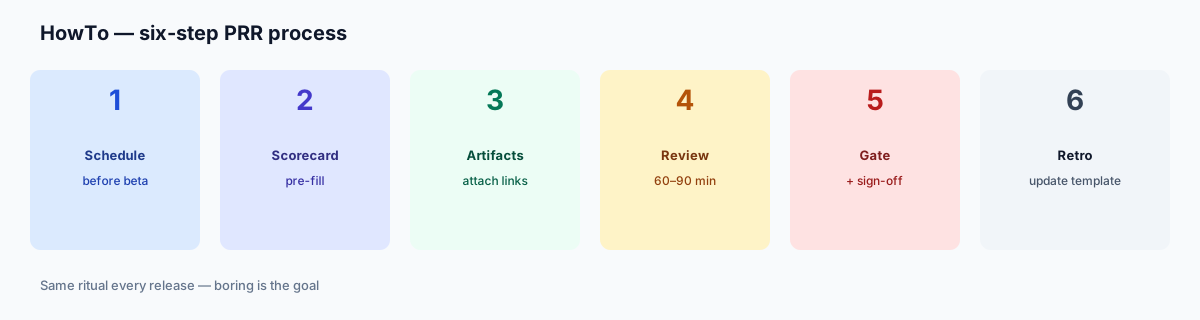
| Step | Owner | Output |
|---|---|---|
| 1. Schedule before beta invites | PRR owner | Calendar hold + invite list |
| 2. Pre-fill scorecard | Eng lead | Draft pass/fail per domain |
| 3. Attach artifacts | PRR owner | Links to runbook, tests, dashboards |
| 4. 60–90 min review | Eng + product | Blockers listed with due dates |
| 5. Gate decision + written sign-off | PRR owner | Ship / ship with waivers / hold |
| 6. Post-launch retro | On-call | Update template from incidents |
Step detail (HowTo anchors):
- Schedule before beta invites — book the review before marketing sends the invite, not the morning of launch.
- Pre-fill scorecard — eng lead marks honest pass/fail so the meeting is decision time, not discovery.
- Attach artifacts — runbook, CI dashboards, and last rollback note must be clickable in the PRR doc.
- 60–90 min review — walk six domains; list blockers with owners and dates.
- Gate decision + written sign-off — ship, ship with timed waivers, or hold; reject verbal LGTM.
- Post-launch retro — after the first week of traffic, update the template from real incidents.
Waivers must have expiry and owner—"accept risk on rate limits until Friday" beats silent debt.
Gate Criteria and Sign-Off
Minimum production readiness review reddit gate (adjust thresholds per product):
| Gate | Threshold |
|---|---|
| Scorecard | ≥8/10 checks pass |
| Blockers | Zero Sev-1 open items |
| Contract tests | Green on main for external boundaries |
| Rollback | Demonstrated in staging within last 14 days |
| On-call | Named human + backup for beta window |
Sign-off template (store in git or Notion):
## PRR Sign-Off — v1.2-beta
- Date: 2026-06-20
- PRR owner: @alex
- Scorecard: 9/10 (waiver: rate-limit load test → 2026-06-27)
- Rollback tested: yes (2026-06-18)
- On-call: @alex / @sam
- Decision: SHIP to closed beta (50 users)
production readiness review reddit teams reject "verbal LGTM"—written record prevents "I thought we tested rollback" after the first outage.
Readiness Artifacts
Attach these links to every review:
Health endpoint example
// app/api/health/route.ts
export async function GET() {
  const dbOk = await pingDatabase();
  const queueOk = await pingJobQueue();
  const status = dbOk && queueOk ? 200 : 503;
  return Response.json(
    { ok: status === 200, checks: { db: dbOk, queue: queueOk } },
    { status }
  );
}
Contract test stub
# tests/test_stripe_webhook_contract.py
def test_checkout_completed_schema(stripe_fixture):
    payload = stripe_fixture("checkout.session.completed")
    assert validate_schema(payload, "CheckoutCompletedV1")
Runbook one-pager: auth failure, webhook backlog, DB connection exhaustion, third-party 429, deploy rollback—each with detection, mitigation, owner.
Status page minimum for beta: API up/down, last incident summary, support email—buyers and users check this before Slack DMs flood your team.
Reliability reviews should cross-check Google SRE error-budget thinking when setting alert thresholds.
Streaming or event-driven paths should reference Apache Kafka documentation only when your PRR scope actually includes consumers—do not cite tools you do not run.
Architecture Sketch
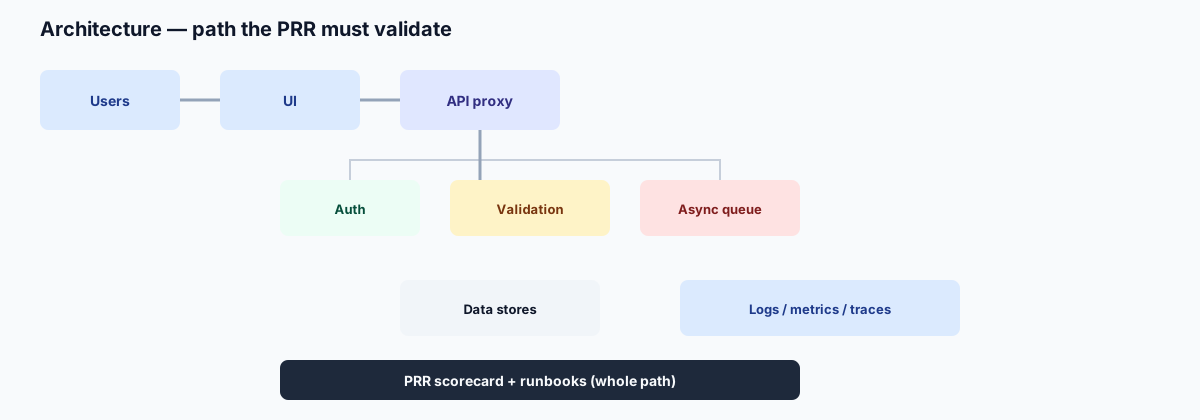
production readiness review reddit rule: the review validates the whole path—not the UI screenshot alone.
Readiness Scorecard
Rate production readiness review reddit readiness (1 point each):
| Check | Pass? |
|---|---|
| Secrets not in git or client | |
| Health check covers critical deps | |
| Structured logging with request ID | |
| Alerts on error rate / latency SLO | |
| Contract or integration tests in CI | |
| Runbook for top failures | |
| Rollback tested in last 14 days | |
| Async path for jobs >5s | |
| Tenant isolation tested | |
| PRR sign-off recorded before beta |
8–10: closed beta ready. 5–7: internal dogfood only. Below 5: demo—run PRR before invites.
Teams finishing production readiness review reddit for agent surfaces should consult UK NCSC guidelines for secure AI system development when agents touch production data.
30-Day Rollout
| Week | Focus |
|---|---|
| 1 | Scorecard draft + health checks + secret store |
| 2 | Contract tests + structured logging + alerts |
| 3 | Runbook + rollback drill + async UX |
| 4 | Full PRR session + sign-off + beta cohort |
Cadence for production readiness review reddit: re-run abbreviated PRR (30 min) on every minor release after v1 beta; full review on major version or new data class.
Week four deliverable: signed PRR doc linked in release notes—external beta users can see you operate with a process, not ad hoc heroics.
Failure Modes
Failure 1: Checklist theater
Boxes ticked without working rollback. Fix: demo rollback in staging during review.
Failure 2: Moving gate
"We ship anyway" every sprint. Fix: named waiver with expiry or hold launch.
Failure 3: UI-only review
PRR ignores webhooks, queues, and batch jobs. Fix: six-domain template mandatory.
Failure 4: No on-call
First Sev-1 at 2 a.m. with no owner. Fix: named on-call before beta invite.
Failure 5: Mock data in prod path
Demo JSON still wired. Fix: contract tests fail CI on mock flags in prod config.
Failure 6: One-time PRR
Never updated after incidents. Fix: retro updates template quarterly.
Operating Model
A durable practice for production readiness review reddit needs one facilitator who owns the template:
- Keep scorecard + sign-off template in git (
docs/prr-template.md) - Schedule PRR before every beta or prod milestone—same calendar invite title
- Track waivers in issues with expiry labels
- After each Sev-1, add one row to failure modes or scorecard
Fifteen minutes post-incident on "would PRR have caught this?" beats a quarterly audit scramble.
Agent-heavy products add a seventh checkpoint: tool execution boundaries and prompt-injection tests—coordinate with Tool Calling scorecards when agents ship in the same release.
Glossary
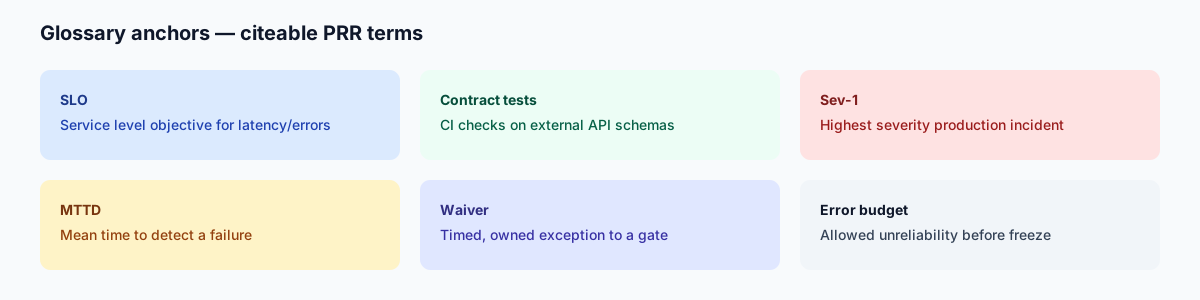
SLO (service level objective). A numeric reliability or latency target (for example, 99.9% successful requests or p95 < 300 ms) that drives alert thresholds. Without an SLO, "too many errors" is an opinion, not a gate.
Contract tests. Automated checks that external payloads (webhooks, partner APIs) still match the schema your service expects. They fail CI when mock fixtures or silent vendor changes would otherwise ship.
Sev-1. Highest severity incident class: customer-visible outage or data-risk event that pages on-call immediately and blocks launch if still open at gate time.
MTTD (mean time to detect). Average time from failure start to first alert or human recognition. Unknown MTTD usually means you learn from user reports.
Waiver. A written, time-boxed exception to a gate criterion with a named owner and expiry. Silent debt is not a waiver.
Error budget. The allowed unreliability remaining before feature work freezes in favor of reliability work—popularized in SRE practice.
Optional vendor scope
Product tooling is optional inside a production readiness review reddit scope for async data-agent workloads. If long analysis routes through a Server API (including InfiniSynapse), include SSE task health, workspace retention, and task failure runbook under Operability. Core gates—auth, logging, rollback—still live in your proxy first.
Wiring patterns for data APIs: API Data Integration.
Case Study: Beta Gate
Dataset license: CC BY 4.0. Attribution to InfiniSynapse Data Team required. Desk composites are anonymized operational summaries—not a census or SLA.
A vibe-coded analytics API skipped review and invited 200 beta users. Day three: webhook backlog, no alerts, keys in a shared Notion page.
Label: anonymized builder desk reconstruction from incident notes and an onboarding survey—not a commissioned customer case study or product SLA.
production readiness review reddit path: 90-minute review, scorecard 4/10 → block two weeks. Added health checks, Stripe contract tests, secret manager, error-rate alert, rollback drill. Re-review: 9/10 with one waiver (load test scheduled).
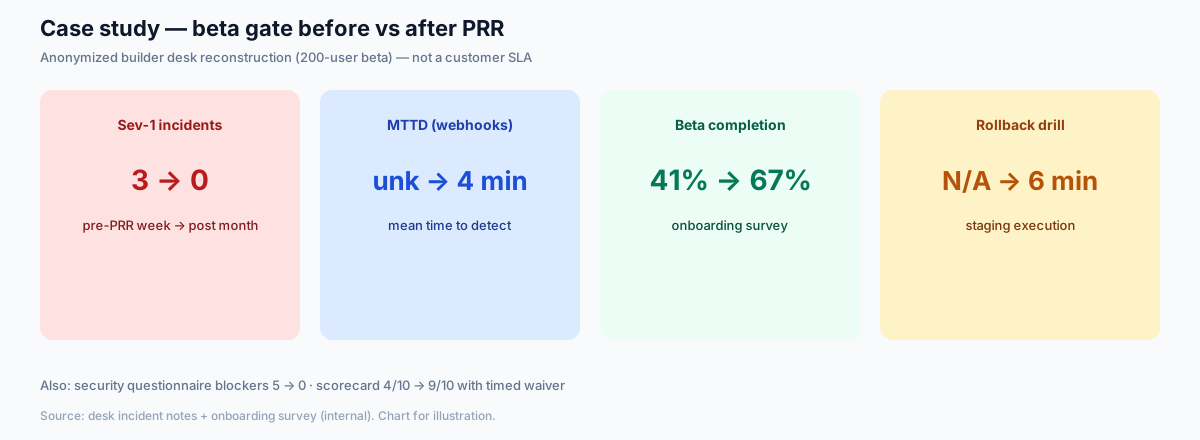
Results after first 30 days post-PRR:
| Metric | Before | After |
|---|---|---|
| Sev-1 incidents | 3 (pre-PRR week) | 0 (post-PRR month) |
| MTTD webhook failures | unknown | 4 minutes |
| Rollback execution (staging) | N/A | 6 minutes |
| Beta completion rate | 41% | 67% |
| Security questionnaire blockers | 5 open | 0 |
The two-week delay saved a public launch that would have failed a buyer review weeks later (see Professional Data API for the questionnaire lens).
Post-PRR, the team added a recurring calendar hold: every second Thursday, 30-minute delta review if shipping that week. production readiness review reddit stopped being a launch panic and became a habit—new engineers onboarded from the template in git instead of oral tradition.
Frequently Asked Questions
PRR vs checklist?
Checklist is the content; production readiness review reddit is the recurring meeting + sign-off that forces decisions.
Who runs the review?
One production readiness review reddit owner—often eng lead or founding engineer—facilitates; product joins for waivers.
How long?
First full PRR: 60–90 minutes. Subsequent minor releases: 30-minute delta review.
Can we ship with waivers?
Yes—with named owner, expiry, and tracking issue. Silent waivers defeat the process.
First step this week?
Copy the 10-row scorecard; mark pass/fail honestly; block launch if below 8.
How does this relate to buyer trust?
PRR internal bar aligns with buyer security questionnaires—run production readiness review reddit before sales sends docs. Cross-check depth in the Production Readiness Checklist.
How often to re-run?
Full production readiness review reddit on major releases; 30-minute delta when only bugfixes ship—still record sign-off.
What is an SLO in a PRR?
An SLO is the numeric reliability or latency target that makes "alerts exist" meaningful. Pair it with contract tests on external boundaries.
Who wrote this
Named author. William Zhu — InfiniSynapse cofounder (GitHub @allwefantasy). Team: InfiniSynapse Data Team. About: editorial standards · Vision.
Corrections: zhuhl@infinisynapse.com · corrections policy.
References
- [Ops] Google. SRE Book. sre.google
- [Framework] AWS. Well-Architected Framework. docs.aws.amazon.com
- [Security] OWASP. LLM Top 10. owasp.org
- [Observability] OpenTelemetry. Documentation. opentelemetry.io
- [Gov] NIST. Cybersecurity Framework. nist.gov
- [Streaming] Apache Kafka. Documentation. kafka.apache.org
- [Secure AI] UK NCSC. Guidelines for secure AI system development. ncsc.gov.uk
- [Independent] Gartner Peer Insights. Analytics and BI. gartner.com
- [Person] William Zhu. Cofounder, InfiniSynapse. github.com/allwefantasy
Conclusion
production readiness review reddit is operational discipline: same six domains, same scorecard, written sign-off, rollback tested—not optimism after a Cursor sprint.
If stakeholders only skim one takeaway from production readiness review reddit, use this order: scorecard honest pass, artifacts linked, review scheduled, gate enforced, then beta invites.
Explore the Production Readiness Checklist and ship with a record—not a hope.