
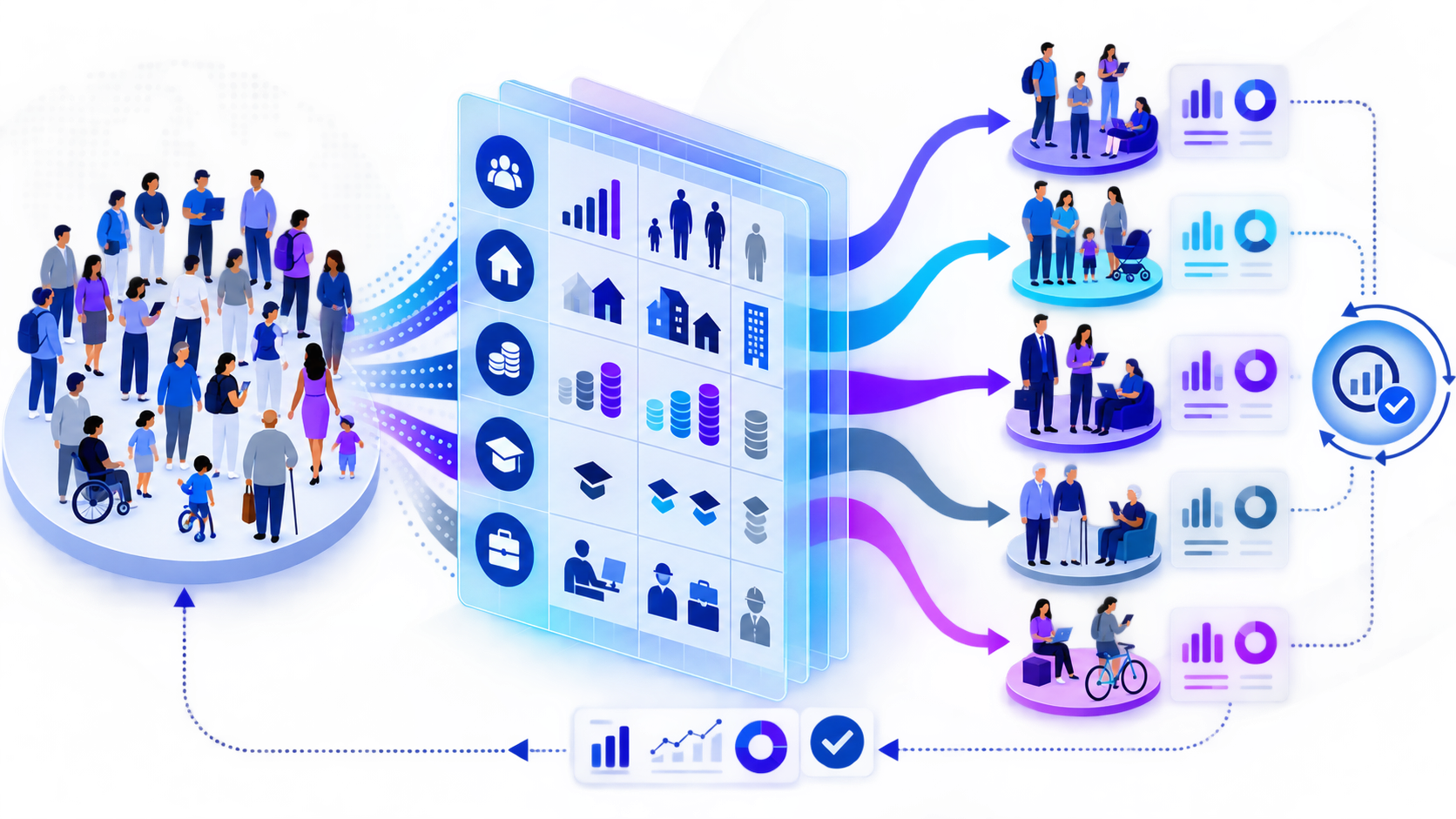
Demographic segmentation: the quick answer人口统计细分:快速回答
Demographic segmentation is the practice of dividing a market or audience into groups using measurable population characteristics. Typical variables include age or life stage, household size, income band, education, occupation, and language. It is useful when those attributes affect a real decision, but it does not prove what an individual needs, believes, can afford, or will do.
人口统计细分是使用可测量的人口特征,把市场或受众划分为若干群组的做法。常见变量包括年龄或生命阶段、家庭规模、收入区间、教育、职业和语言。只有当这些属性会影响真实决策时,它才有用;它不能证明某个个人需要什么、相信什么、能否负担或将采取什么行动。
The practical test is simple: can the team explain why each variable is necessary, classify records consistently, reach the group through an appropriate channel, and measure a different action without unacceptable harm? If not, the segment is descriptive decoration rather than a decision tool.
实用性检验很直接:团队能否说明每个变量为何必要,能否一致地分类记录,能否通过合适渠道触达该群组,并在没有不可接受伤害的前提下衡量差异化行动?如果不能,这个分群只是描述性装饰,而不是决策工具。
When demographic segmentation helps—and when it does not人口统计细分何时有用,何时不适用
People usually search for demographic segmentation because one message, offer, service design, or research sample no longer fits everyone. The method can reveal underrepresented groups, support language and accessibility planning, compare outcomes across life stages, or establish a simple baseline before adding behavioral evidence.
人们通常在同一消息、方案、服务设计或研究样本不再适合所有人时搜索人口统计细分。该方法可以揭示代表性不足的群体,支持语言与无障碍规划,比较不同生命阶段的结果,或在加入行为证据前建立简单基线。
Sampling and representation checks; service eligibility that lawfully depends on age or household status; regional planning with population data; content-language planning; and exploratory outcome comparisons.
样本与代表性检查;依法取决于年龄或家庭状态的服务资格;结合人口数据进行地区规划;内容语言规划;以及探索性结果比较。
Inferring motivation, personality, creditworthiness, health, or intent from a demographic label; making high-impact decisions without review; or using a proxy to bypass restrictions on protected or sensitive data.
根据人口标签推断动机、人格、信用、健康或意图;未经审查作出高影响决策;或使用代理变量绕过对受保护或敏感数据的限制。
Market segmentation versus customer segmentation: market segmentation may include prospects and non-customers, often using survey or public population data. Customer segmentation works with people or accounts already represented in first-party data. Demographic variables can appear in either, but the population, permission, and measurement baseline must be explicit.
市场细分与客户细分:市场细分可能包含潜在客户和非客户,常使用调查或公共人口数据;客户细分处理已存在于第一方数据中的个人或账户。两者都可能使用人口变量,但必须明确总体、权限和衡量基线。
Choose demographic segmentation variables from the decision从决策出发选择人口统计细分变量
A long list of available columns is not a strategy. Begin with the action, then retain only variables with a rational, lawful link to that action. Categories should be meaningful in the relevant market, broad enough to protect privacy and sample reliability, and documented so they can be reproduced.
可用字段很多并不等于有策略。应先明确行动,再只保留与该行动存在合理、合法联系的变量。分类要符合目标市场语境,宽度应足以保护隐私和样本可靠性,并记录口径以便复现。
| Variable变量 | Potential use可能用途 | Main caution主要注意事项 |
|---|---|---|
| Age band or life stage年龄区间或生命阶段 | Eligibility, accessibility, lifecycle planning资格、无障碍、生命周期规划 | Age does not determine digital skill, health, or preference年龄不能决定数字技能、健康或偏好 |
| Household size or structure家庭规模或结构 | Package sizing, service capacity, research quotas包装规格、服务容量、研究配额 | Definitions vary; do not assume relationships or roles定义存在差异;不要假定关系或角色 |
| Income band收入区间 | Affordability research and price testing可负担性研究与价格测试 | Often missing, stale, sensitive, and not equal to disposable income常有缺失、过时且敏感,也不等同于可支配收入 |
| Education or occupation教育或职业 | Terminology, professional context, recruiting术语、专业语境、招募 | Avoid using either as a proxy for intelligence or value不要把两者当作智力或价值的代理 |
| Language语言 | Localization and support routing本地化与支持分流 | Collect preferred language directly when possible应尽量直接收集首选语言 |
| Race, ethnicity, religion, gender种族、族裔、宗教、性别 | Representation or equity research under strict governance在严格治理下用于代表性或公平研究 | May be protected or sensitive; require legal, ethical, and access review可能属于受保护或敏感属性;需要法律、伦理与访问审查 |
Keep “unknown” visible. Do not silently impute, drop, or force people into a category. Missingness can be systematic, and a growing unknown share may signal collection failure, declining trust, or a broken integration.
保留“未知”类别。不要静默插补、删除或强迫个人进入某个分类。缺失可能具有系统性;“未知”占比上升可能表示采集失败、信任下降或集成故障。
Prepare data before demographic segmentation analysis人口统计细分分析前的数据准备
For first-party analysis, prepare one row per person, household, or account—not a mixture. Include a stable permitted key, observation date, source, consent or lawful-basis status where relevant, demographic values with an explicit dictionary, outcome fields, eligibility rules, and trusted totals for reconciliation. Public population tables may be useful for benchmarks, but their geography, year, universe, sampling method, and margins of error must match the question.
对于第一方分析,应确保每行代表一个人、家庭或账户,不要混用。准备稳定且获准使用的键、观察日期、来源、相关的同意或合法依据状态、带明确数据字典的人口字段、结果字段、资格规则,以及用于对账的可信总数。公共人口表可作为基准,但其地区、年份、统计总体、抽样方法和误差范围必须与问题匹配。
- Define the unit: person, household, subscription, or account.定义分析单位:个人、家庭、订阅还是账户。
- Freeze the time window: profile date and outcome period must be unambiguous.固定时间窗口:资料日期与结果期间必须清楚。
- Document categories: labels, boundaries, source values, transformations, and unknown handling.记录分类口径:标签、边界、源值、转换与未知值处理。
- Minimize fields: exclude attributes that are merely interesting or collected “just in case.”最小化字段:排除只是有趣或“以防万一”而采集的属性。
- Separate design from evaluation: retain an outcome or holdout sample not used to invent the rules.分离设计与评估:保留未用于制定规则的结果字段或留出样本。
How to do demographic segmentation in seven repeatable steps如何用七个可复用步骤完成人口统计细分
- Write the decision and guardrails写明决策与护栏State the audience, action, owner, success metric, prohibited uses, and what would cause the project to stop.明确受众、行动、负责人、成功指标、禁止用途以及停止项目的条件。
- Audit permission and provenance审计权限与来源Record where each field came from, why it may be used, who can access it, and when it should be refreshed or deleted.记录每个字段的来源、为何可以使用、谁能访问,以及何时更新或删除。
- Standardize variables标准化变量Normalize categories, define band boundaries, preserve unknown values, and avoid overly narrow intersections.统一分类、定义区间边界、保留未知值,并避免过窄的交叉组合。
- Profile coverage and missingness检查覆盖率与缺失Compare source counts, known rates, duplicates, sample composition, and time coverage with trusted benchmarks.将来源计数、已知率、重复项、样本构成和时间覆盖与可信基准比较。
- Build the smallest useful rules建立最小可用规则Start with one or two decision-relevant variables. Prefer transparent rules to a complex cluster that no operator can explain.先使用一到两个与决策相关的变量。相比无人能解释的复杂聚类,优先采用透明规则。
- Compare outcomes and harms比较结果与伤害Measure size, reachability, outcome differences, uncertainty, error patterns, and potential exclusion for every group.衡量每个群组的规模、可触达性、结果差异、不确定性、错误模式和潜在排斥。
- Pilot, monitor, and retire试点、监测与退役Run a controlled action, compare it with a baseline, monitor drift and unknown rates, and remove the segmentation when it stops improving the decision.开展受控行动,与基线比较,监测漂移和未知率;当细分不再改善决策时,将其移除。
Demographic vs psychographic and behavioral segmentation人口统计、心理与行为细分的比较
These methods answer different questions and often work best in sequence. Demographics describe who is represented, psychographics investigate why people may prefer something, and behavior records what they did in a defined context. None establishes causality on its own.
这些方法回答不同问题,通常按顺序组合使用效果更好。人口统计描述“谁被代表”,心理特征研究“人们为何可能偏好某物”,行为数据记录“人在特定情境做了什么”。任何一种方法都不能单独建立因果关系。
| Method方法 | Best question最适合的问题 | Typical evidence典型证据 | Main limit主要局限 |
|---|---|---|---|
| Demographic人口统计 | Who is represented?谁被代表? | Profile, survey, census, administrative data资料、调查、人口普查、行政数据 | Weak explanation of needs or intent难以解释需求或意图 |
| Behavioral行为 | What happened, how often, and when?发生了什么、频率和时间? | Transactions, events, usage, service history交易、事件、使用、服务历史 | Observed action does not reveal motivation观察到的行动不能揭示动机 |
| Psychographic心理 | What attitudes or motivations matter?哪些态度或动机重要? | Surveys, interviews, validated scales调查、访谈、经验证量表 | Sampling and measurement error抽样与测量误差 |
| Needs-based需求型 | What outcome or job is sought?用户追求什么结果或任务? | Research plus outcome evidence研究与结果证据 | Needs can change by context需求会随情境变化 |
A sensible progression is to use demographics for coverage and context, behavior for timing and observed differences, and direct research for needs or motivations. Add a layer only when it improves a named decision enough to justify the added collection, complexity, and risk.
合理的顺序是:用人口属性检查覆盖与语境,用行为数据识别时机与观察差异,再用直接研究理解需求或动机。只有当新增层能充分改善明确决策,值得额外采集、复杂度和风险时,才应加入。
Demographic segmentation example: plan support without stereotyping人口统计细分示例:在不制造刻板印象的前提下规划支持
Hypothetical example: a subscription learning service wants to improve onboarding completion. It has consented profile data for age band and preferred language, product-event data for onboarding steps, and support-contact data. It does not assume older users are less digitally capable or that language predicts education.
假设示例:某订阅学习服务希望提升新手引导完成率。它拥有经同意收集的年龄区间与首选语言资料、引导步骤的产品事件数据,以及支持联系数据。团队不假定年长用户数字能力较低,也不假定语言能预测教育水平。
The team first reconciles 100,000 eligible accounts as an illustrative total, with 88% known preferred language and 72% known age band. It keeps “unknown” as a group. It compares completion and support-contact rates by one variable at a time, then tests only intersections with adequate sample size. The analysis finds a completion gap associated with preferred language after accounting for device and acquisition channel; age-band differences shrink after those controls.
团队先以 100,000 个符合条件的账户作为示例总量进行对账,其中 88% 的首选语言已知,72% 的年龄区间已知,并保留“未知”群组。团队先逐个变量比较完成率与支持联系率,再只测试样本量足够的交叉组合。分析显示,在控制设备和获客渠道后,首选语言仍与完成差距相关;年龄区间差异则明显缩小。
The action is therefore a localized onboarding pilot, not an age-targeted campaign. Half of eligible users in two language groups receive translated instructions; the rest remain a comparison baseline. The team measures completion, support burden, opt-outs, errors, and complaints. This is a decision linked to evidence—not a claim that demographic identity caused the outcome.
因此,行动是开展本地化引导试点,而不是按年龄定向营销。两个语言群组中一半符合条件的用户收到翻译后的说明,其余保留为比较基线。团队衡量完成率、支持负担、退订、错误和投诉。这是与证据相连的决策,而不是声称人口身份导致了结果。
Common demographic segmentation mistakes, limits, and risks人口统计细分的常见错误、局限与风险
A group pattern is not a reliable statement about every member. Use eligibility and preference data directly when available.
群组模式不能可靠描述每个成员。只要有条件,应直接使用资格与偏好数据。
Too many intersections create tiny, unstable cells and increase re-identification risk. Combine or suppress categories using a documented threshold.
过多交叉会产生极小且不稳定的单元,并增加重新识别风险。应按记录的阈值合并或抑制类别。
Postcode, language, device, or occupation may correlate with protected traits. Removing the protected field does not automatically remove unequal impact.
邮编、语言、设备或职业可能与受保护属性相关。删除受保护字段并不会自动消除不平等影响。
Household, occupation, income, and preferences change. Record dates, source confidence, refresh rules, and correction paths.
家庭、职业、收入和偏好会变化。应记录日期、来源置信度、更新规则与纠正路径。
Privacy and legal context are not universal. Identify the jurisdictions, sector rules, protected attributes, lawful basis, notice, retention, security, and human-review requirements that apply to the actual use. Seek qualified review for high-impact decisions; this guide is a workflow, not legal advice.
隐私与法律语境并非全球统一。应识别实际用途适用的司法辖区、行业规则、受保护属性、合法依据、告知、保留、安全与人工复核要求。高影响决策应寻求合格审查;本指南提供工作流,不构成法律建议。
How to validate demographic segments before activation应用人口分群前如何验证
Validation has three layers. Data validity asks whether counts, categories, dates, joins, and missing values are correct. Segment validity asks whether rules are stable, interpretable, sufficiently sized, and meaningfully different on an outcome not used to create them. Decision validity asks whether a different action improves the target outcome without unacceptable guardrail harm.
验证有三个层次。数据有效性检查计数、分类、日期、连接和缺失值是否正确;分群有效性检查规则是否稳定、可解释、规模足够,并在未用于建立分群的结果上存在有意义差异;决策有效性检查差异化行动能否改善目标结果,同时不造成不可接受的护栏伤害。
- Reconcile the eligible population, exclusions, segment counts, and unknowns to one trusted total.将符合条件总体、排除项、分群计数和未知项对账到一个可信总数。
- Compare sample composition with the target population and report uncertainty rather than hiding it.将样本构成与目标总体比较,并报告不确定性,而不是隐藏它。
- Repeat the rules in another time period or holdout sample and inspect migration between groups.在另一个时期或留出样本中重复规则,并检查群组间迁移。
- Test alternative band boundaries so conclusions do not depend on one arbitrary cutoff.测试替代区间边界,避免结论依赖某个任意阈值。
- Audit reach, errors, complaints, exclusions, and outcome differences across relevant groups.审计相关群组的触达、错误、投诉、排斥和结果差异。
Analyze demographic segmentation data with InfiniSynapse使用 InfiniSynapse 分析人口统计细分数据
InfiniSynapse can support the analytical stage when your prepared data is in CSV, Excel, or a connected database. It can help inspect schemas, calculate group counts and rates, compare outcomes, and iterate on analysis questions across sources. Your team remains responsible for permission, category design, legal review, interpretation, and the decision to act.
当准备好的数据位于 CSV、Excel 或已连接数据库中时,InfiniSynapse 可支持分析阶段。它可协助检查 Schema、计算群组计数与比率、比较结果,并跨数据源迭代分析问题。权限、分类设计、法律审查、结果解释和行动决策仍由您的团队负责。
Before opening the app, prepare one row per analysis unit, a data dictionary, category boundaries, source and permission notes, observation dates, outcome fields, permitted and prohibited uses, and trusted reconciliation totals. Start by asking for a missingness profile and counts by one variable before requesting intersections.
打开应用前,请准备每个分析单位一行的数据表、数据字典、分类边界、来源与权限说明、观察日期、结果字段、允许与禁止用途,以及可信对账总数。先要求生成缺失概况并按单个变量计数,再请求交叉分析。
Open the InfiniSynapse data analysis app打开 InfiniSynapse 数据分析应用A useful first analysis request is: “Reconcile all eligible records to the provided control total; report missing and unknown rates for each demographic variable; then compare the outcome by one variable at a time with counts and uncertainty.” Review the generated logic, exclusions, and denominators before accepting any interpretation.
一个实用的首次分析请求是:“将所有符合条件记录与给定控制总数对账;报告每个人口变量的缺失率和未知率;再逐个变量比较结果,并给出计数与不确定性。”在接受任何解释前,应复核生成的逻辑、排除项和分母。
Demographic segmentation best practices and next steps人口统计细分最佳实践与下一步
- Use the fewest necessary variables. Every additional field increases maintenance, privacy, and interpretation cost.使用最少的必要变量。每增加一个字段,都会增加维护、隐私与解释成本。
- Prefer direct preferences. Ask for language, format, channel, or accessibility needs rather than inferring them from identity.优先使用直接偏好。直接询问语言、格式、渠道或无障碍需求,不要从身份推断。
- Keep labels neutral. Name rules by observable criteria and version, not by a caricatured persona.保持标签中性。按可观察标准与版本命名规则,不要使用漫画化人物名称。
- Separate description from explanation. A difference across groups is an observation, not a causal mechanism.区分描述与解释。群组间差异是观察结果,不是因果机制。
- Design an exit. Set review dates, correction routes, retention limits, and retirement conditions before activation.设计退出机制。在应用前设定复核日期、纠正路径、保留期限和退役条件。
The next step is not to create more groups. Write the decision brief, audit one or two necessary variables, build a transparent baseline, and test whether the differentiated action outperforms a non-segmented alternative. Complexity should be earned by evidence.
下一步不是创建更多群组,而是写明决策简报,审计一到两个必要变量,建立透明基线,并测试差异化行动是否优于不细分的替代方案。复杂度必须由证据证明其必要性。
Frequently asked questions about demographic segmentation关于人口统计细分的常见问题
Demographic segmentation divides a market or audience into groups using measurable population attributes such as age band, income band, education, occupation, household size, or life stage. These attributes describe who is represented; they do not by themselves explain needs, intent, or future behavior.
人口统计细分使用年龄区间、收入区间、教育、职业、家庭规模或生命阶段等可测量人口属性,把市场或受众划分为群组。这些属性描述谁被代表,但本身不能解释需求、意图或未来行为。
Common variables include age or life stage, household size and structure, income band, education, occupation, language, and other lawfully collected population attributes. Choose only variables that are necessary for a defined decision.
常见变量包括年龄或生命阶段、家庭规模与结构、收入区间、教育、职业、语言,以及其他合法收集的人口属性。只选择明确决策所必需的变量。
Define the decision, document lawful data sources, standardize categories, examine missingness and sample coverage, build a small set of interpretable rules, compare outcomes, check stability and fairness, then test the proposed action.
先定义决策并记录合法数据来源,再统一分类、检查缺失与样本覆盖,建立少量可解释规则,比较结果、检查稳定性与公平性,最后测试拟议行动。
Demographic segmentation describes observable population attributes, while psychographic segmentation investigates attitudes, values, motivations, interests, or lifestyles. Demographics can provide context, but they should not be treated as a substitute for direct evidence of motivation.
人口统计细分描述可观察的人口属性;心理细分研究态度、价值观、动机、兴趣或生活方式。人口属性可以提供语境,但不能替代有关动机的直接证据。
Usually not. Demographics can make an audience easier to describe, but behavioral, needs-based, contextual, or direct preference data is often needed to justify a different action. Sensitive or protected characteristics also require legal and ethical review.
通常不足。人口属性可让受众更容易描述,但往往还需要行为、需求、情境或直接偏好数据,才能证明差异化行动合理。敏感或受保护属性还需要法律与伦理审查。
Reconcile counts to trusted totals, inspect missing and unknown categories, compare sample composition with the target population, test segment stability over time, assess whether the rule changes a useful outcome, and audit errors or harms across groups.
将计数与可信总数对账,检查缺失与未知类别,将样本构成与目标总体比较,测试分群随时间的稳定性,评估规则是否改变有用结果,并审计不同群组的错误或伤害。
Authoritative sources权威来源
- OpenStax Principles of Marketing: market segmentation — an academic overview of demographic, geographic, behavioral, and psychographic segmentation variables.OpenStax《营销学原理》的市场细分章节——学术性介绍人口、地理、行为和心理细分变量。
- United States Census Bureau data resources — official population and demographic tables whose universe, geography, year, and methodology must be checked before use.美国人口普查局数据资源——官方人口与人口统计表;使用前必须检查统计总体、地区、年份和方法。
- UK ICO guidance on data minimisation — official guidance for one regulatory context on keeping personal data adequate, relevant, and limited to what is necessary.英国 ICO 数据最小化指南——在一种监管语境下说明个人数据应充分、相关且限于必要范围。