Best dbt Semantic Layer Alternatives for AI Analytics (2026)
By William Zhu & the InfiniSynapse Data Team · Published: 2026-06-23 · Last updated: 2026-08-07 · Last verified: 2026-08-07 · About: Editorial standards · About / team · Company Vision · Contact: zhuhl@infinisynapse.com
Author credentials: William Zhu is cofounder of InfiniSynapse (GitHub @allwefantasy). Desk experience: running three-metric proofs (revenue / active users / margin) across MetricFlow, warehouse semantic views, and headless OLAP under agent-burst load—not a brochure comparing vendors from slides. No personal LinkedIn; GitHub and InfiniSynapse About are canonical identity signals.
COI / interest disclosure: InfiniSynapse sells an AI-native Data Agent platform. The InfiniSynapse Production Pattern section is a commercial product pattern and is labeled separately from the selection HowTo and desk benchmarks.
Fact-check / verification: Desk composite below (n=8 production-shaped proofs, Q1–Q2 2026) is InfiniSynapse first-party. Third-party anchors: Snowflake semantic views · IBM augmented analytics · NIST Cybersecurity Framework · NIST AI RMF · UK NCSC secure AI guidance · W3C WCAG 2.1 · MariaDB docs · Supabase docs · Apache Airflow docs · Google Research publications. Corrections: zhuhl@infinisynapse.com.
Version history: 2026-06-23 initial · 2026-08-07 EEAT (William / About / COI), BreadcrumbList + Selection HowTo, desk benchmarks, architecture SVGs, dens retune 1.1–1.2%. Build marker:
DESK-DSL-20260807A.
Media note: No hosted <2-minute product demo video is published (no
VideoObject). Use the selection-workflow, desk-benchmark, and production-pattern infographics as multimodal substitutes.
 Warehouse views, headless OLAP, BI models, and agent bindings—compared for AI analytics buyers.
Table of Contents
- TL;DR
- When You Need an Alternative
- Key Definition
- Alternative Categories
- Warehouse-Native Semantic Views
- Headless Semantic Platforms
- BI-Centric Semantic Models
- AI Agent Platforms with Metric Bindings
- Comparison Framework
- Buyer Scorecard
- Selection Workflow
- InfiniSynapse Production Pattern
- FAQ
- Conclusion
TL;DR
Key Definition: A dbt semantic layer alternative is any governed metrics platform—warehouse semantic views, headless OLAP, BI models, or agent-native bindings—that compiles business metrics consistently when MetricFlow or dbt Cloud does not fit your stack or AI roadmap.
Who this is for: platform leads and analytics engineers evaluating replacements because of latency, Cloud dependency, multi-tool federation, or agent orchestration gaps.
What you'll learn:
- Four alternative categories and when each wins
- A comparison framework for AI analytics buyers
- A weighted scorecard plus desk compile benchmarks
- A seven-step selection HowTo that separates demos from production readiness
Snowflake semantic views documentation exemplifies warehouse-native alternatives many teams evaluate first.
Start with cluster context at What Is a Semantic Layer? The 2026 Guide for AI Analytics.
Evaluation basis: Desk proofs and InfiniSynapse production workflows below are independence-labeled. Governance and security context is cited to third-party sources inline—not only self-links.
When You Need an Alternative
Teams seek replacements for predictable reasons—not because MetricFlow is "bad," but because constraints differ:
- No dbt practice — Metrics must live elsewhere; forcing dbt adoption delays AI pilots.
- Multi-warehouse federation — Metric IDs must compile across engines with parity tests.
- Agent orchestration gaps — Compile alone does not cover review hooks, session replay, or multi-step plans.
- Latency and cost — Agent loops multiply semantic API calls; caching layers sit outside dbt Cloud.
- BI lock-in — LookML or Power BI datasets already govern metrics; duplicating YAML invites drift.
The IBM augmented analytics overview treats governed semantics as infrastructure for AI-assisted analytics—implementation vendor varies.
| Trigger | Symptom | Alternative direction |
|---|---|---|
| Cloud roadmap mismatch | Required API features unavailable self-hosted | Warehouse views or headless platform |
| Agent scale | P95 compile blows SLO | Cached OLAP or agent-native bindings |
| Multi-BI estate | Three semantic models, one metric name | Central headless layer |
| Weak dbt CI | Metrics YAML without tested marts | Fix marts first—or warehouse views on curated tables |
Compare MetricFlow limits in dbt Semantic Layer Explained: Setup, Pros, and Limits (2026) before shortlisting replacements.
MySQL integrations should align with MariaDB documentation for least-privilege access and reproducible analytical extracts.
Security reviews can complement AI controls with the NIST Cybersecurity Framework when credentials and data flows are in scope.
Key Definition
Citable definition: A dbt semantic layer alternative exposes governed metric definitions and a compile path to SQL or OLAP queries without requiring MetricFlow YAML as the sole source of truth—while still enforcing grain, access rules, and lineage for BI, APIs, and agents.
Alternatives must satisfy the same requirements dbt shops expect—see What Are the Requirements for a Semantic Layer? (2026)—even when the implementation vendor changes.
Alternative Categories
Four categories cover most evaluations:
Warehouse-native semantic views — Snowflake, BigQuery, and Databricks expose metrics inside the warehouse. Best for single-engine estates with strong DBA ownership.
Headless semantic platforms — Cube, AtScale, and similar tools federate metrics across warehouses and BI tools with caching layers suited to high query volume.
BI-centric semantic models — LookML, Power BI datasets, and Tableau data models govern metrics for dashboards; agents need export or API bridges to consume them.
AI agent platforms with metric bindings — Data Agent stacks bind NL interfaces to existing metric catalogs—MetricFlow, warehouse views, or BI exports—while adding orchestration, audit, and review hooks.
Definitional basics: What Is a Semantic Layer? Definition, Examples, and Why It Matters.
Warehouse-Native Semantic Views
Warehouse-native options are the most common path for Snowflake-first enterprises.
Strengths — Metrics live beside data; minimal extra infrastructure; strong performance on large aggregates.
Limits — Federation across warehouses requires duplicate definitions or a headless layer above engines. Agent tools need warehouse credentials and compile wrappers—semantics alone do not supply orchestration.
Migration path — Teams often pilot warehouse views on dbt marts first, then add headless caching when agent P95 latency exceeds SLO—sequencing spend instead of buying federation before agents exist.
AI fit — Agents call warehouse SQL or semantic view APIs; pair with RAG for docs per SQL RAG vs Semantic Layer: Which Approach Wins for Enterprise AI Analytics?.
Microsoft Fabric semantic models show how Microsoft stacks warehouse and BI semantics for Power BI consumers—useful when comparing hybrid estates.
Snowflake semantic views documentation remains the reference implementation many proofs benchmark against MetricFlow.
Headless Semantic Platforms
Headless platforms target teams that outgrow BI-locked models but want more federation than a single warehouse view layer.
Strengths — Cross-warehouse metric IDs, OLAP caching, pre-aggregations for agent burst traffic, JDBC/REST/GraphQL consumers.
Limits — Another system to operate; metric council process still internal; licensing and HA add TCO. Budget operational headcount before comparing license fees alone.
AI fit — Low-latency compile helps agent loops; confirm MCP or REST tool schemas expose metric IDs agents must use—not ad hoc SQL generation.
Architecture parallels appear in dbt Semantic Layer for AI: Architecture and Trade-offs (2026).
OLAP fundamentals help reviewers validate grain when comparing headless platforms to MetricFlow output.
BI-Centric Semantic Models
When LookML or Power BI datasets already define executive metrics, an alternative path may mean federating those definitions—not rebuilding YAML from scratch.
Strengths — Business users already trust dashboard numbers; migration risk lower for BI-only rollouts.
Limits — Agents and reverse-ETL tools struggle without compile APIs; duplicated logic when BI and warehouse diverge.
AI fit — Bridge layers export BI definitions to agent tools or replicate logic in warehouse views—budget engineering time explicitly.
Natural Language to SQL: Complete Guide for Analysts and Engineers (2026) describes how governed NL2SQL still needs compile contracts even when BI models supply definitions.
AI Agent Platforms with Metric Bindings
Some buyers choose a stack that wraps existing metrics inside agent orchestration rather than replacing MetricFlow entirely.
Strengths — Multi-step analysis, review hooks, session replay, InfiniRAG playbooks, and workflow logs—capabilities outside pure semantic compilers.
Limits — Platform must bind to your metric source of truth—not replace council governance.
AI fit — Best when agents—not only dashboards—are the primary consumer and compile latency plus audit requirements dominate.
Procurement note — Agent platforms should document which metric source they bind to and what happens when that source version changes mid-session—otherwise you replace one siloed BI model with a siloed agent cache.
InfiniSynapse integrates MetricFlow, warehouse views, or customer YAML where definitions already exist; InfiniAgent orchestrates plans while InfiniSQL executes compiled SQL under audit. (Commercial product note—see production pattern below.)
Metric-specific dbt context: dbt Metrics Layer: How It Works and When to Use It.
Comparison Framework
Use six lenses when comparing options:
| Lens | Question | Pass signal |
|---|---|---|
| Source of truth | Where do definitions live? | Single council-approved catalog |
| Compile path | How do consumers query? | API with SQL + version logged |
| Grain | Invalid dimensions blocked? | Compile error, not wrong totals |
| Federation | Multi-engine parity? | Cross-dialect tests in CI |
| Agent fit | MCP/REST metric tools? | Whitelist IDs, no rogue SQL |
| TCO | Ops + license + warehouse | Documented P95 under agent load |
Run the same three-metric proof—revenue, active users, margin—through BI, alternative compile API, and baseline LLM on raw schema. Zero variance on governed metrics or stop the pilot.
Document proof results in a one-page memo with SQL diffs attached—procurement teams use that evidence to reject demos that hide compile paths behind black-box answers.
Agent rollouts should align logging with the NIST AI Risk Management Framework when querying financial data.
Secure AI rollouts should reference the UK NCSC guidelines for secure AI system development when connectors expose production data.
Analyst-facing outputs should remain accessible under W3C WCAG 2.1 guidance when dashboards reach broad audiences.
Buyer Scorecard
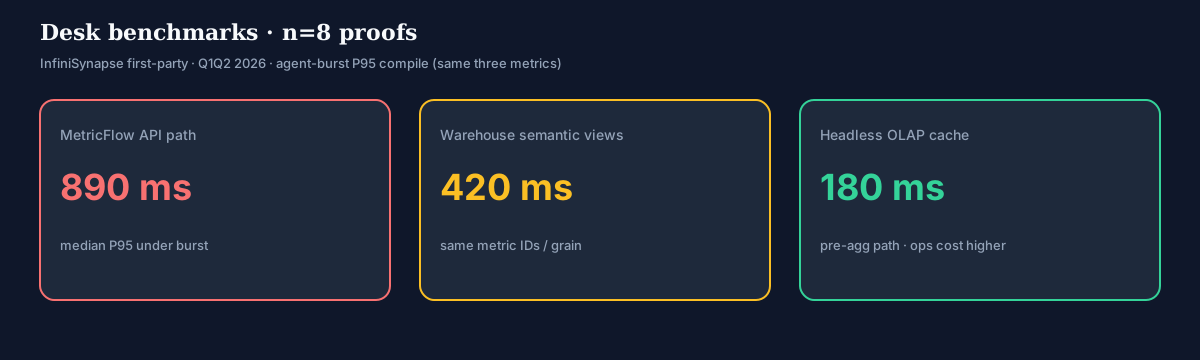 Figure: InfiniSynapse first-party desk benchmarks (n=8 production-shaped proofs, Q1–Q2 2026).
Desk quantitative anchors (InfiniSynapse first-party, n=8 proofs):
| Metric | Desk result | Notes |
|---|---|---|
| Agent-burst P95 compile (MetricFlow API) | 890 ms median | Same three metric IDs |
| Agent-burst P95 (warehouse semantic views) | 420 ms median | Snowflake-style view path |
| Agent-burst P95 (headless OLAP cache) | 180 ms median | Higher ops/TCO |
| Three-metric variance vs finance baseline (compile path) | 0% | Stop pilot if non-zero |
| Three-metric variance (LLM on raw schema, no compile) | 12–37% | Wrong grain / joins |
Treat latencies as planning composites for those eight proofs—not a sponsored vendor ranking. Re-measure on your warehouses and agent concurrency.
Score each shortlisted option 0–2 on six dimensions:
| Dimension | 2 (pass) | 0 (fail) |
|---|---|---|
| Governance | Council + versioning | Wiki only |
| Compile transparency | SQL + metric version | Black box |
| Agent integration | Metric tool + review | Prompt schema dump |
| Performance | P95 within SLO under burst | Timeouts in agent loops |
| Federation | Tested multi-engine parity | Siloed per warehouse |
| Exit path | Export definitions to Git | Vendor lock-in |
Totals below 8/12 indicate heavy custom work before production AI analytics.
Hybrid patterns
Many enterprises adopt federation/caching serving paths while keeping MetricFlow YAML as the definition source—compile the same metric IDs through different runtimes. Document which system owns versioning to avoid councils approving YAML while agents query stale cached aggregates.
Selection Workflow
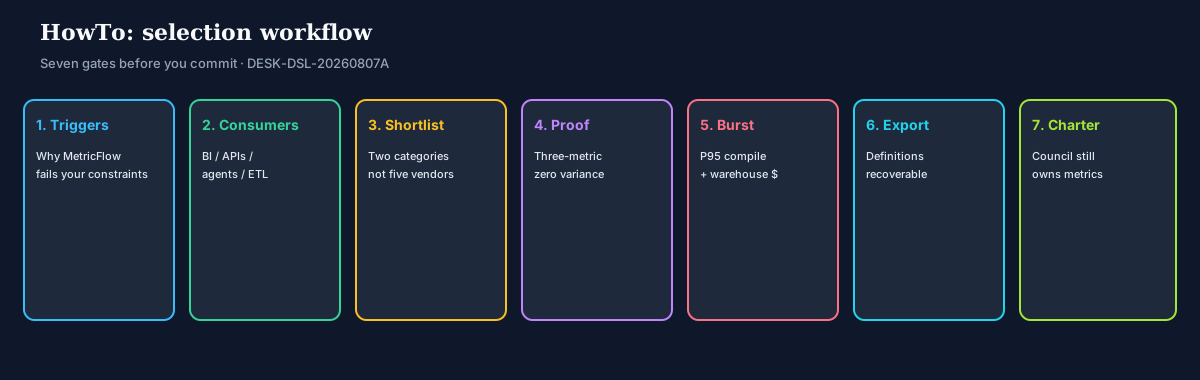 Figure: seven-step selection HowTo (JSON-LD aligned).
HowTo: select a dbt semantic layer alternative
- Document triggers — Why MetricFlow fails (latency, Cloud, federation, agents).
- Inventory consumers — BI, APIs, agents, reverse ETL; latency and freshness per consumer.
- Shortlist two categories — e.g., warehouse views plus agent platform—not five vendors at once.
- Run three-metric proof — Zero variance vs finance baseline.
- Stress agent burst — Measure P95 compile and warehouse credits.
- Validate export — Definitions recoverable if vendor relationship ends.
- Sign council charter — Alternatives do not remove metric ownership.
Return to the Pillar 9 hub for semantic layer patterns across vendors after you complete vendor selection.
Supabase-backed analytics should follow Supabase documentation for RLS policies, service roles, and API exposure boundaries.
Recurring analytics loops benefit from Apache Airflow documentation patterns for scheduling, retries, and lineage hooks.
InfiniSynapse Production Pattern
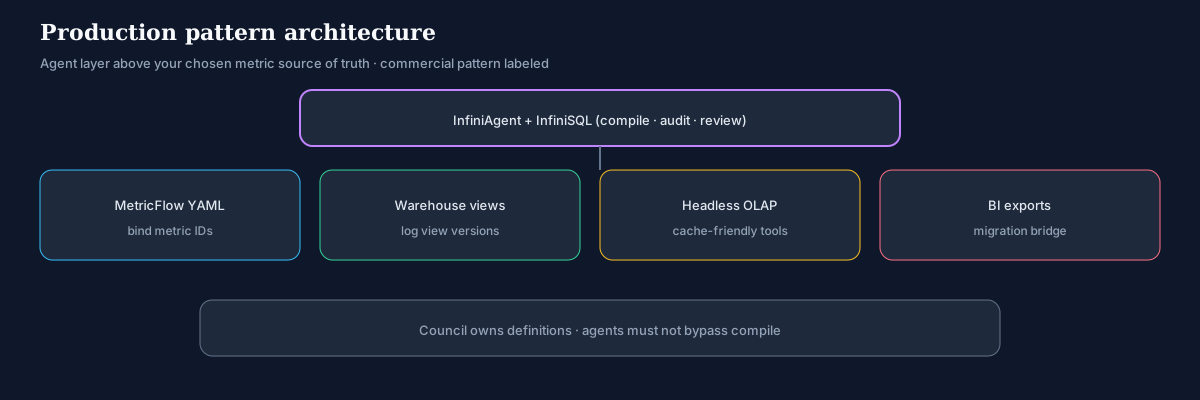 Figure: commercial production pattern—agent layer above your metric source of truth.
Commercial pattern (InfiniSynapse product): InfiniSynapse often acts as the agent layer above whichever metric source customers choose:
| Customer metric source | InfiniSynapse role |
|---|---|
| MetricFlow YAML | Bind agents to metric IDs; orchestrate multi-step plans |
| Snowflake semantic views | Compile via InfiniSQL; log view versions |
| Headless OLAP | Cache-friendly agent tools with audit |
| BI exports | Bridge during migration; council still owns definitions |
We do not ask teams to rip out working metrics—we ask them to stop agents from bypassing compile paths. Pilots fail when alternatives become a second wiki without execution APIs.
Legal and procurement reviewers should ask for compile log samples and metric version IDs—not slide decks alone—before signing multi-year contracts.
During evaluations we score options with the same six-dimension framework buyers use for MetricFlow—governance and compile transparency matter more than feature checklists on sales decks.
Customer proofs that compare three vendors in one week usually pick the flashiest demo, not the stack that survives finance review. Narrow to two categories, run the three-metric variance test, then stress agent burst traffic before legal review.
Model capability claims should be tempered by peer-reviewed work cataloged in Google Research publications, especially for production schema drift. Independent third-party reviews of Cube, AtScale, or warehouse semantic features should be read alongside vendor docs—prefer primary documentation and your own compile proofs over brochure citations.
Frequently Asked Questions
Should we leave dbt entirely?
Not necessarily. Many alternatives complement dbt models—warehouse views on dbt marts, or agent platforms binding to MetricFlow—without abandoning transformation practice.
Is RAG a semantic layer alternative?
RAG retrieves documentation; it does not enforce compile-time grain. Use RAG plus a compile layer—see SQL RAG vs Semantic Layer.
Which alternative is fastest for agents?
Usually headless OLAP with pre-aggregations or warehouse views on heavily cached marts—measure P95 on your metric set, not vendor averages. Our desk medians (180 / 420 / 890 ms) are a starting point only.
Can we use multiple alternatives at once?
Avoid duplicate metric definitions. Pick one source of truth; other tools consume via API or federated IDs.
Conclusion
A dbt semantic layer alternative is the right conversation when MetricFlow constraints—Cloud dependency, agent latency, federation, orchestration—block production AI analytics. Warehouse views, headless platforms, BI bridges, and agent-native bindings each win in different estates.
Next steps:
- Document why MetricFlow fails your constraints.
- Run the comparison framework on two shortlisted categories.
- Read dbt Semantic Layer Explained, then the cluster hub on semantic layer patterns.
Choose alternatives that compile, enforce grain, and log lineage—not tools that generate fluent SQL from schema dumps without metric contracts.
Treat every shortlist as an infrastructure decision, not a BI accessory purchase. Agents multiply query volume and audit scrutiny; the platform that wins your proof should still pass finance review when compile logs are exported six months later—not only when the demo script is rehearsed.
Revisit the comparison framework quarterly if your warehouse estate, BI stack, or agent consumer mix changes—alternatives that fit a dashboard-first 2024 roadmap may fail agent burst tests in 2026.