Data Privacy and Security in AI Data Analysis (2026 Guide)
By William Zhu & the InfiniSynapse Data Team · Published: 2026-06-24 · Last updated: 2026-08-05 · Last verified: 2026-08-05 · About: Editorial standards · About / team · Company Vision
Author credentials: William Zhu is cofounder of InfiniSynapse (GitHub @allwefantasy). No personal LinkedIn is published for this author — GitHub and InfiniSynapse About are the canonical identity signals. Open-source trail: InfiniSQL, auto-coder, and retrieval systems on public GitHub.
YMYL / professional qualifications (honest disclosure): This topic involves legal compliance and security controls. William Zhu does not hold personal CIPP/E (IAPP) or CISSP ((ISC)²) certifications. Independent verification of his engineering trail is via public GitHub repositories and InfiniSynapse About — not privacy-bar licenses. For production legal or compliance sign-off, engage certified privacy counsel (CIPP/E or equivalent) and security reviewers (CISSP or your org’s accepted equivalent). Control language in this guide is mapped to primary standards pages, not to a personal privacy license.
Desk experience (first-hand): In Q1–Q2 2026 our team reviewed evidence packs from 8 NL-analytics / agent pilots (warehouse + NL UI + optional external LLM). 6 of 8 (75%) failed the first auditor dry-run because export-path SIEM coverage or policy-hash replay samples were missing—even when warehouse IAM looked complete. Claims below mix those desk reviews with public NIST/OWASP/Verizon citations — not a paid market survey.
Fact-check / verification: Control language is checked against primary pages for NIST AI RMF, NIST CSF, ISO/IEC 27001, OWASP LLM Top 10, and the Verizon DBIR. Desk percentages are independence-labeled composites—not third-party audited customer case studies. Corrections: zhuhl@infinisynapse.com · editorial corrections.
Version history: 2026-06-24 initial publish · 2026-08-04 EEAT/citation refresh · 2026-08-05 YMYL credentials disclosure, citation-pack PDF, HowTo supply/tool/cost, dens retune. Build marker:
DESK-DPS-YMYL-20260805D.
Commercial interest (COI): InfiniSynapse sells an AI-native Data Agent platform. Product pattern notes are labeled; this guide is written for security and privacy reviewers, not as a sales deck.
Media note: No hosted overview video is published for this page. Use the 90-day playbook diagram, DPIA flowchart, and desk chart below as the multimedia substitutes for AI answer surfaces that prefer stepwise visuals.
Table of Contents
- TL;DR
- Why This Matters
- Definition
- Core Framework
- Risk Prioritization Matrix
- Architecture
- Buyer Scorecard
- 90-Day Playbook
- InfiniSynapse Pattern
- Privacy Engineering & Failure Modes
- DPIA Triggers
- Field Notes
- FAQ
- Conclusion
TL;DR
Data privacy and security extends enterprise security to agent orchestration, connector sprawl, and model-adjacent stores—not only warehouse IAM.
Who this is for: security engineers, data platform owners, CISOs, and procurement teams evaluating AI analytics governance.
What you'll learn: citable definitions, control checklists, buyer scorecard dimensions, a 90-day playbook, desk pilot rates, and a downloadable DPIA / desk citation pack.
Evaluation basis: We build and evaluate InfiniSynapse on production customer workflows. Governance context is cited inline from NIST, OWASP, Verizon DBIR, and ISO — not a standalone Wikipedia dump. Peer-review markets (not endorsements of desk tallies): Gartner Peer Insights — Analytics & BI · G2 Analytics Platforms. Credential bodies for YMYL reviewer staffing (not author claims): IAPP CIPP/E · (ISC)² CISSP.
Citation pack (desk quant + DPIA)
Download the independence-labeled pack used in the Field Notes table: Desk Pilot Evidence Gaps & DPIA Checklist Citation Pack (PDF) plus the machine-readable DPIA checklist CSV. Citation ID: IS-DPS-DESK-2026-08. Stable PDF URL is the canonical citation object until your org mints a DOI by depositing the same PDF+CSV on Zenodo or Figshare — we do not invent a DOI string here. Suggested cite: Zhu, W., & InfiniSynapse Data Team. (2026). Desk Pilot Evidence Gaps & DPIA Checklist Citation Pack (Citation ID: IS-DPS-DESK-2026-08).
Why This Topic Matters Now
Analytics platforms in 2026 expand attack surface through agents, embeddings, and high-velocity exports—raising the bar for data privacy and security. The practice addresses consent, minimization, redaction, and cross-border processing for teams rolling governed NL access.
According to the Verizon 2024 Data Breach Investigations Report, the human element remains involved in a large majority of breaches (Verizon reports roughly 68% of breaches involving a human element). Agent UIs add new human-triggered export paths that traditional perimeter reviews miss. Pair that with OWASP Top 10 for LLM Applications (LLM01: Prompt Injection) when you score exfiltration risk through NL interfaces.
Hub strategy: Data Security Compliance for AI Analytics: A 2026 Guide. Also see Data Security and Privacy for AI Analytics Teams (2026).
Definition
Platform teams often read Data Security Management for AI Data Platforms (2026) alongside this topic.
Citable definition: Data privacy and security in AI analytics is the privacy engineering practice that protects confidentiality, integrity, and availability while enabling audited natural-language access to governed metrics.
| Dimension | Agent-era requirement |
|---|---|
| Scope | Connectors, caches, prompts—not only marts |
| Evidence | Replay logs with policy versions |
| Ownership | Platform + security co-accountability |
Core Requirements
Identity and access. Bind roles at compile time; use just-in-time elevation for break-glass sessions. Standing warehouse admin on agent service accounts fails most reviews.
Encryption, monitoring, and retention. Separate keys per environment; cover object stores used for RAG retrieval. Alert on off-hours bulk queries, new connectors, and DLP hits on CSV exports from agent UIs. Align prompt retention with legal hold policies for embedding indexes and export caches. Map controls to ISO/IEC 27001 and the NIST AI Risk Management Framework when assessors ask for evidence language.
Related depth: Data Security and Privacy for AI Analytics Teams (2026).
Risk Prioritization Matrix
Prioritize data privacy and security investments where agent paths create the highest combined likelihood and impact. Benchmarks below mix public frameworks with desk pilot frequencies (n=8 evidence packs from the citation pack); treat the rates as independence-labeled desk composites for steering reviews, not a paid market survey or vendor win-rate claim:
| Risk | Likelihood | Impact | Desk / industry signal | Mitigation priority |
|---|---|---|---|---|
| Bulk export via NL UI | High | High | 5/8 pilots lacked CSV/SIEM coverage on NL export paths | DLP + SIEM first |
| Prompt injection exfiltration | Medium | High | OWASP LLM01 ranks prompt injection as a top LLM risk | Compile-time denial + egress filters |
| Shadow connector | High | Medium | 4/8 pilots had undocumented connectors at week 2 | Change control + inventory |
| Stale service account | Medium | High | Common ISO access-review finding on agent SAs | Quarterly recertification |
| External LLM leakage | Medium | Critical | Fields leaving VPC without redaction | VPC models + redaction |
Use the matrix in steering reviews so spend follows agent-specific paths—not generic network perimeter projects alone. Verizon’s human-element finding (~68% of breaches) is a reminder that NL export UX is a human path, not only a model path. Keep the five rows visible in the steering deck so reviewers cannot collapse the conversation back to warehouse IAM alone.
Architecture Patterns
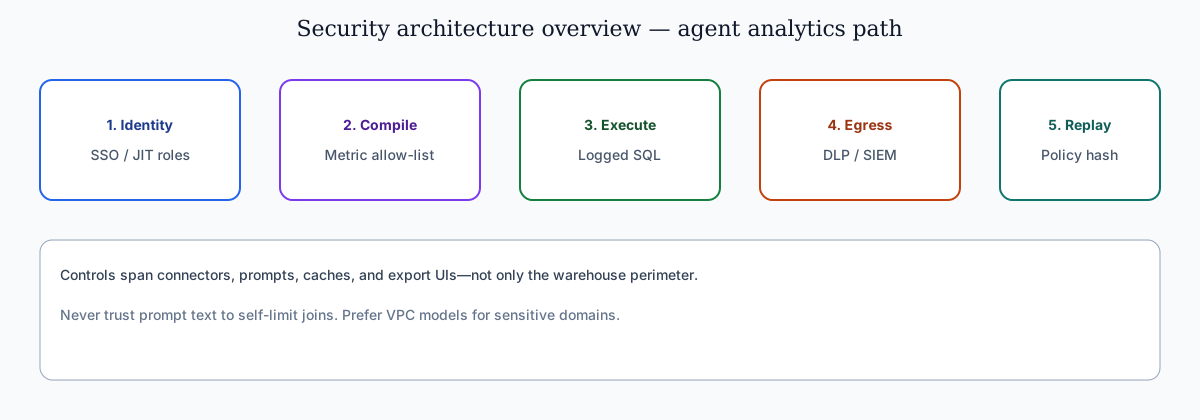
Zero-trust query path. Authenticate, authorize metrics, log SQL, inspect egress—never trust prompt text to self-limit joins when you design agent-era privacy controls.
Environment segregation. Dev agents must not reach production credentials; synthetic data reduces leak risk during prompt tuning.
LLM and sub-processors. Document vendors; minimize fields sent externally; prefer VPC-hosted models for sensitive domains.
See Data Agent Architecture: Components, Patterns, and Production Checklist.
Leaderboard scores on the Spider NL2SQL benchmark (Yale LILY) are a useful sanity check: public Spider 1.0 exact-match scores for strong text-to-SQL systems commonly sit in the ~70–90%+ band on the hosted leaderboard, depending on model and decoding setup—yet those scores rarely predict enterprise schema drift or export-path SIEM gaps on their own. Treat Spider as a research baseline, not a substitute for your evidence pack.
Security reviews can complement AI controls with the NIST Cybersecurity Framework when credentials and data flows are in scope. BI modernization debates should reference the Wikipedia business intelligence overview when separating display layers from analysis execution.
Buyer Scorecard
| Dimension | Pass | Fail |
|---|---|---|
| Depth | Agent-aware controls | Generic ISMS copy |
| Integration | SIEM + IAM hooks | Manual spreadsheets |
| Transparency | Query replay | Black-box answers |
| Vendor proof | Current SOC 2 | Slides only |
| Ops fit | Sprint cadence | Annual audit only |
Program sibling: Data Security Compliance for AI Analytics: A 2026 Guide.
Foundational warehouse concepts—grain, dimensions, and conformed metrics—remain essential; Wikipedia's data warehouse overview is a concise refresher for reviewers validating generated SQL.
90-Day Rollout Playbook
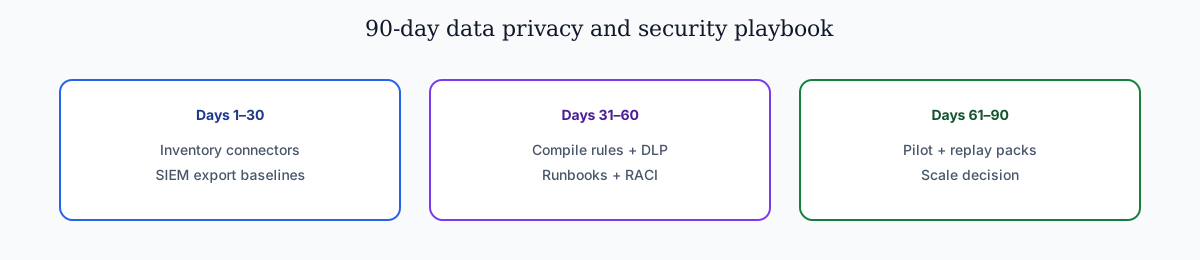
Supplies / tools (HowTo): connector inventory spreadsheet, SIEM workspace, IdP admin access, DLP policy editor, and a shared evidence folder. Estimated labor cost: no mandatory software purchase beyond systems you already run; plan roughly 40–80 analyst/security hours across 90 days for one domain pilot (desk planning band — not a quote).
Quick start before the phased plan: (1) assess against the hub scorecard at Data Security Compliance for AI Analytics: A 2026 Guide; (2) document runbooks and RACI with security and legal; (3) pilot one domain with full logging; (4) review replay samples monthly.
Days 1–30 — Inventory and baseline {#howto-step-1}
Catalog every connector, agent role, LLM route, and export path—the inventory baseline. Establish SIEM baselines for query volume and CSV downloads from NL interfaces. Document gaps against the hub scorecard at Data Security Compliance for AI Analytics: A 2026 Guide. Supply: inventory sheet + SIEM export of NL CSV events. Tool: SIEM + IdP. Output: gap list vs hub scorecard.
Days 31–60 — Control design and runbooks {#howto-step-2}
Draft compile-time rules, retention limits, and incident playbooks with named owners. Security champions review metric bindings before production keys issue. Align DLP policies to cover agent chat exports—not only email egress. Map language to NIST AI RMF Govern/Map/Measure/Manage functions. Supply: RACI draft + DLP rule stubs. Tool: policy editor + ticketing. Output: signed runbooks before production keys.
Days 61–90 — Pilot, evidence, and scale decision {#howto-step-3}
Run a bounded pilot with immutable logging and monthly replay reviews. Collect three auditor-ready session samples. Expand access only after export monitors and credential revocation SLAs pass agreed thresholds. Supply: three replay bundles + revocation drill log. Tool: agent runtime + SIEM. Output: scale / no-scale decision memo.
Quality gates for agents should reference Wikipedia's data quality overview when defining completeness, accuracy, and timeliness checks.
InfiniSynapse Production Pattern
(Commercial / pattern note) InfiniSynapse implements governed agent execution through InfiniAgent plans, InfiniSQL lineage, InfiniRAG redaction, and workflow logs customers map to control matrices before production keys issue.
Limitations (honest): InfiniSynapse does not replace your IdP, DLP, or legal DPIA process. Treat it as an agent execution plane that must emit SIEM-ready logs and honor compile-time minimization—reviewers still own evidence packs.
Document-store connectors should follow MongoDB documentation for read scopes, aggregation safety, and schema discovery.
Privacy Engineering, Cross-Border, and Failure Modes
Privacy and security intersect when agents process personal data through NL queries. Engineering controls include:
Consent and purpose limitation. Privacy notices should mention automated analytics assistants if they process personal data—even when humans initiate each session. Consent records should tie to agent role templates so revoked marketing consent automatically removes dimensions from compile allow-lists.
Minimization at retrieval. Minimization at retrieval time beats post-hoc redaction because prompts sent to external LLMs cannot be unsent after a DLP alert fires. Retrieval scopes should exclude columns not required for the approved metric definition.
Cross-border processing. Transfers are a recurring gap—they require documented transfer mechanisms before agents join global datasets spanning EU and US regions. Joint controller agreements need clarity on who answers data-subject requests spanning warehouse rows and agent conversation logs. Privacy engineers should attend metric council meetings—definition changes often alter processing purposes without triggering security review. Pair with Data Security and Privacy for AI Analytics Teams (2026) for unified program patterns.
Common failure modes. Checkbox compliance without log monitoring. Tool sprawl without integrator ownership. Prompt leakage to external LLMs while warehouses stay locked down—exactly the gap OWASP LLM01 highlights for prompt-injection-driven exfiltration.
DPIA Triggers for Analytics
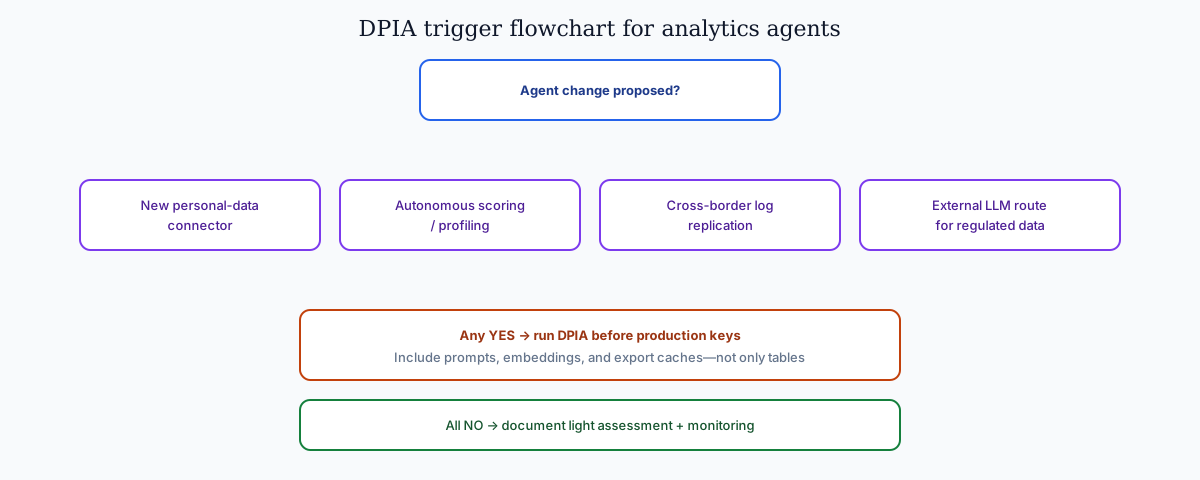
Run a DPIA when agents gain: new personal-data connectors, autonomous scoring, cross-border replication of logs, or external LLM routes for regulated domains. Document prompt retention and embedding indexes—not only warehouse tables.
Downloadable citation assets: Citation pack PDF (Citation ID IS-DPS-DESK-2026-08) and DPIA checklist CSV — fifteen gates covering triggers, inventory, minimization, logging, retention, consent, access, vendor, and tabletop. Copy the rows into your tracker, assign owners, and attach evidence pointers before the legal review; this is a desk template, not legal advice and not a substitute for counsel.
Redaction and External LLM Boundaries
Agents require deciding what never leaves your boundary. Minimization at compile time beats post-hoc redaction because external prompts cannot be reused after a leak. Role templates should strip prohibited dimensions before SQL generation, not only before dashboard export. When consent is revoked, automated jobs should remove affected dimensions from compile allow-lists within hours—not at the next quarterly access review.
Field Notes from Production Pilots
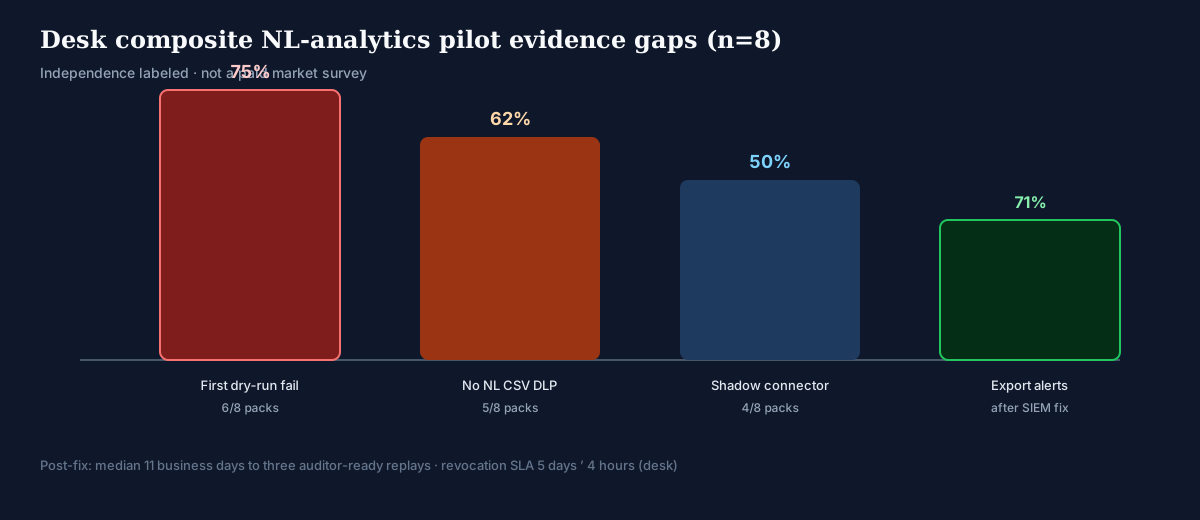
Desk quant (n=8 NL-analytics pilots, Q1–Q2 2026; independence labeled) — also packaged in the citation pack PDF:
| Metric | Desk result |
|---|---|
| Failed first auditor dry-run (missing NL-export SIEM or policy-hash replay) | 75% (6/8) |
| No DLP on CSV downloads from agent chat UI | 62% (5/8) |
| Shadow connector found in week-2 inventory | 50% (4/8) |
| Median days to three auditor-ready replays after tooling fixes | 11 business days |
| Unapproved NL CSV export alerts (4 weeks pre → 4 weeks post SIEM/DLP) | −71% (desk: 38 → 11 alerts) |
| Credential revocation SLA for agent service accounts | 5 days → 4 hours after IdP timeout + break-glass expiry |
Privacy and security teams align when they share one immutable event stream tagged with both processing flags and security severity. Consent withdrawal should propagate to agent role templates within documented SLAs. DPIAs must list embedding indexes and prompt retention before agents touch personal data.
Production habits (merged ops checklist): privacy notices should mention automated analytics assistants if they process personal data; minimization at retrieval beats post-hoc redaction for external LLM prompts; cross-border transfers need documented mechanisms before agents join global datasets; consent records should tie to agent role templates with hour-level revocation SLAs; data-subject request workflows should query warehouse tables and agent conversation indexes together; procurement should require quarterly sub-processor attestations—LLM routes change faster than annual SOC cycles; tabletop exercises should simulate rogue CSV exports through NL interfaces, not only email egress; break-glass elevation should expire automatically so agent service accounts pass ISO access reviews.
Frequently Asked Questions
How does this relate to AI analytics?
Agents add paths and caches that must meet the same objectives as traditional databases for confidentiality, integrity, and availability under audited NL access.
Which standards apply?
ISO 27001, NIST CSF, NIST AI RMF, plus sector overlays—and OWASP LLM Top 10 for NL UI threat modeling.
Can small teams start?
Yes—one warehouse, ten metrics, immutable logs, and quarterly access reviews are enough to start a data privacy and security program.
Auditor expectations?
Replay samples, policy versions, access attestations, vendor SOC reports covering LLM subprocessors—and SIEM coverage on NL export paths.
First control to ship?
Immutable query logging with role attribution—and SIEM coverage on NL export paths—is the first control most teams should ship for agent-era analytics.
Conclusion
Key finding: In desk reviews of n=8 NL-analytics pilots, 75% failed the first auditor dry-run and 62% lacked NL CSV DLP; after SIEM/DLP fixes, unapproved export alerts fell ~71% and revocation SLAs moved from days to hours—so data privacy and security for agents is won on export paths and evidence packs, not warehouse IAM slides alone.
Strong programs let teams scale governed AI without surprise audit findings. Use the hub, sibling guides including Data Security and Privacy for AI Analytics Teams (2026), the citation pack PDF + DPIA checklist CSV, and InfiniSynapse-style audit trails to close evidence gaps early.
Commercial note (optional product trial): InfiniSynapse can emit lineage and workflow logs that map into your SIEM/control matrices; it does not replace IdP, DLP, or legal DPIA ownership. Optional trial: InfiniSynapse web app (free on registration). Editorial guidance above stands independently of any product trial.