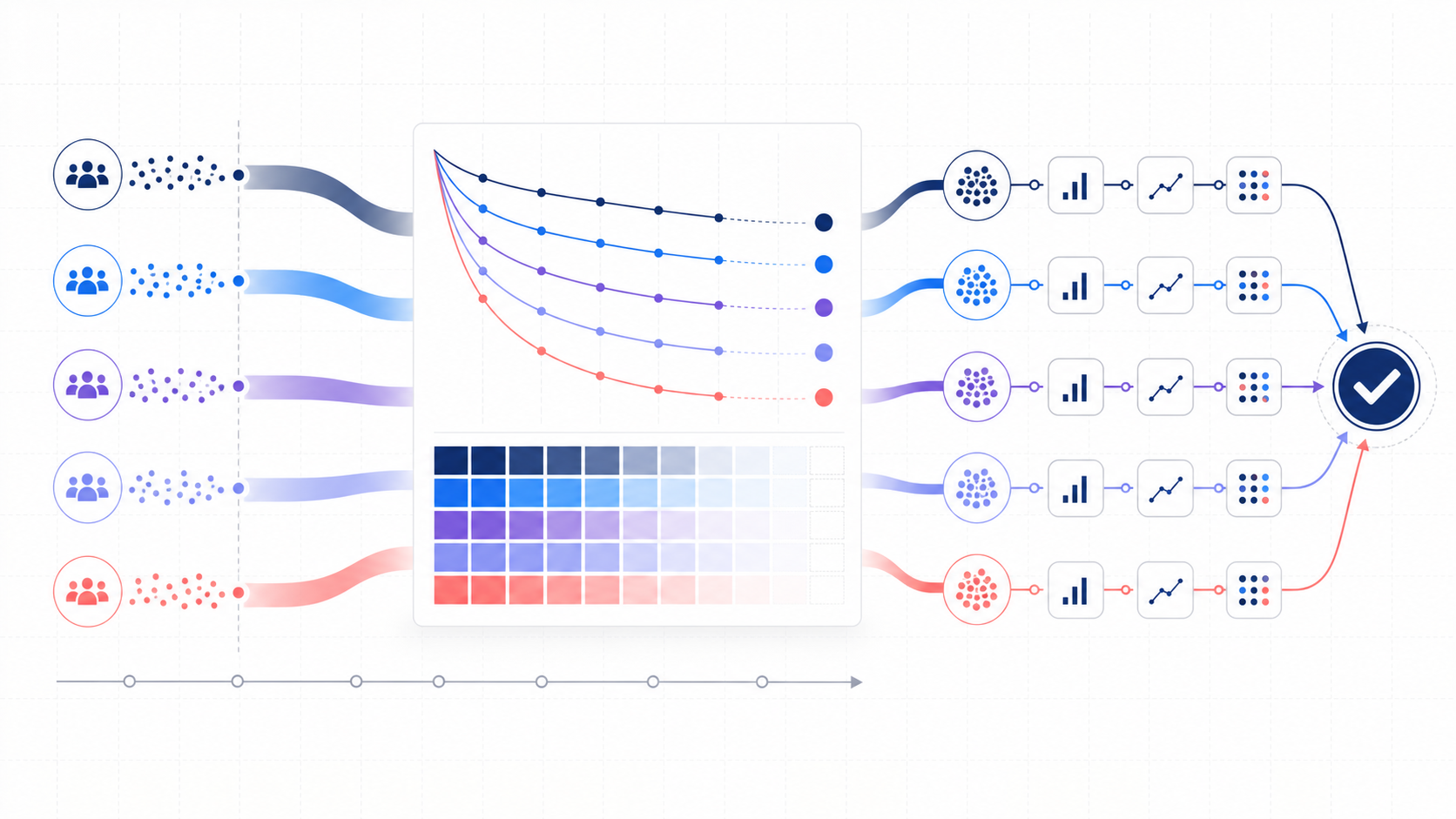
What is customer retention analytics?什么是客户留存分析?
Customer retention analytics is the disciplined use of customer, transaction, subscription, and behavior data to measure who remains active or paying, compare cohorts and segments, diagnose changes, and validate retention decisions. It goes beyond one retention-rate formula: the work requires a stable customer definition, a meaningful retained event, fixed observation windows, mature cohorts, reproducible calculations, and evidence strong enough for the decision.
客户留存分析是规范使用客户、交易、订阅与行为数据,衡量哪些客户仍活跃或付费,比较同期群与分群,诊断变化并验证客户保留决策。它不只是一个留存率公式;完整工作还需要稳定的客户定义、有意义的留存事件、固定观察窗口、成熟同期群、可重复计算,以及与决策强度相匹配的证据。
A useful output is not simply “retention is 72%.” It states who was eligible, what counted as retained, which period and time zone were used, whether every cohort had equal time to mature, where the difference was concentrated, what alternative explanations remain, and how the proposed action will be tested.
有用的输出不只是“留存率为 72%”。它还应说明谁符合条件、什么行为算留存、采用哪个周期与时区、每个同期群是否拥有相同成熟时间、差异集中在哪里、还存在哪些替代解释,以及如何检验拟议行动。
When customer retention analysis is useful—and when it is not客户留存分析何时适用,何时不适用
Subscription renewal, repeat purchase, marketplace supply, product return, contract continuation, and account expansion questions with identifiable customers and repeatable activity.
适合订阅续约、复购、平台供给、产品回访、合同延续和账户扩张等问题,前提是能够识别客户且活动具有重复性。
One-time purchases with no meaningful return event, anonymous traffic without stable identity, or decisions that require immediate causal proof but lack an experiment or credible comparison.
不适合没有合理返回事件的一次性购买、缺少稳定身份的匿名流量,或需要立即证明因果却没有实验与可信对照的决策。
Customer retention and user retention are related but not always interchangeable. In B2B software, the paying customer may be an account while several users act inside it. In ecommerce, a customer may be an individual or household; in a marketplace, buyer and seller retention answer different questions. Select the economic and decision unit first, then use person-level behavior only as supporting evidence.
客户留存与用户留存相关,但并不总能互换。在 B2B 软件中,付费客户可能是账户,而账户内有多名用户;在电商中,客户可能按个人或家庭计算;在平台业务中,买家与卖家留存回答的是不同问题。应先选择与经济结果和决策一致的分析单位,再把个人行为用作辅助证据。
Prepare the data contract before calculating retention计算留存前先准备数据契约
Write the definition in plain language before opening a dashboard or notebook. At minimum, record the analysis unit, qualifying start event, retained event, cohort date, interval, observation window, eligibility and exclusion rules, time zone, late-arriving-data policy, and source owner. For recurring revenue, also record currency treatment, refunds, pauses, downgrades, expansions, and whether reactivated accounts rejoin the original cohort.
打开仪表板或 Notebook 之前,先用自然语言写下定义。至少记录分析单位、合格起始事件、留存事件、同期群日期、间隔、观察窗口、纳入与排除规则、时区、迟到数据政策和来源负责人。若分析经常性收入,还要记录币种处理、退款、暂停、降级、扩张,以及重新激活账户是否回到原同期群。
| Field字段 | Purpose用途 | Common failure常见故障 |
|---|---|---|
| Stable customer or account ID稳定客户或账户 ID | Deduplicate activity and connect sources去重活动并连接数据源 | Guests split, accounts merged, deleted IDs reused访客被拆分、账户被合并、已删除 ID 被复用 |
| Start and activity timestamps起始与活动时间戳 | Assign cohorts and elapsed periods分配同期群与经过周期 | Mixed time zones or ingestion time replacing event time时区混用,或以摄取时间替代事件时间 |
| Status or qualifying event状态或合格事件 | Define active, renewed, purchased, or retained定义活跃、续约、购买或留存 | Login or billing noise counted as delivered value把登录或计费噪声当作已交付价值 |
| Segment properties分群属性 | Compare channel, plan, region, tenure, or behavior比较渠道、套餐、地区、客户年限或行为 | Current value overwrites the historical value当前值覆盖历史值 |
| Revenue or contract facts收入或合同事实 | Calculate GRR, NRR, renewal, or repeat purchase计算 GRR、NRR、续约或复购 | Refunds, credits, tax, and currency handled inconsistently退款、抵扣、税费和币种处理不一致 |
Choose customer retention metrics that match the business model选择匹配业务模式的客户留存指标
No single retention KPI fits every company. Use a small metric set that separates customer count, revenue, cohort behavior, and leading diagnostics. Keep the formula contract beside the result so a label cannot silently change meaning.
没有一个留存 KPI 能适用于所有公司。应使用一组精简指标,分别反映客户数量、收入、同期群行为和领先诊断,并把公式契约与结果放在一起,避免同一标签悄然改变含义。
| Metric指标 | Definition定义 | Best use最佳用途 |
|---|---|---|
| Customer retention rate客户留存率 | (end customers − new customers) ÷ start customers × 100, when “customer” and dates are fixed(期末客户数 − 期内新增客户数)÷ 期初客户数 × 100,前提是客户与日期定义固定 | Period-level portfolio monitoring周期级客户组合监控 |
| Customer churn rate客户流失率 | Eligible customers lost during a period divided by eligible customers at risk周期内流失的合格客户数除以面临流失风险的合格客户数 | Loss monitoring when loss is unambiguous流失定义明确时的损失监控 |
| Cohort retention同期群留存 | Members of one start cohort retained at elapsed period N divided by that mature cohort's original eligible members某起始同期群在第 N 个经过周期仍留存的成员数,除以该成熟同期群最初的合格成员数 | Lifecycle shape and fair cohort comparison生命周期形态与公平同期群比较 |
| Gross revenue retention (GRR)总收入留存(GRR) | Opening recurring revenue less contraction and churn, divided by opening recurring revenue; expansion is excluded期初经常性收入减去缩减与流失后,除以期初经常性收入;不计扩张收入 | Recurring-revenue durability经常性收入的稳定性 |
| Net revenue retention (NRR)净收入留存(NRR) | Opening recurring revenue plus expansion less contraction and churn, divided by opening recurring revenue期初经常性收入加扩张、减缩减与流失后,除以期初经常性收入 | Existing-base growth, not a substitute for logo retention现有客户群增长,不能替代客户数量留存 |
For products used on a natural cadence, “return on day 30” and “return on or after day 30” answer different questions. A customer who returns on day 35 fails the first definition but may pass the second. State whether the rule is exact, bounded within an interval, or unbounded on-or-after retention.
对于具有自然使用节奏的产品,“第 30 天返回”与“第 30 天或之后返回”回答不同问题。客户在第 35 天返回时,不满足前者但可能满足后者。必须说明规则是精确日期、区间内返回,还是某日及之后的无界留存。
How to run customer retention analytics step by step如何逐步执行客户留存分析
- Frame one decision. Write the decision, population, outcome, horizon, and acceptable risks. “Improve retention” is too vague; “test whether guided activation improves 90-day account renewal without increasing support demand” is reviewable.界定一个决策。写明决策、总体、结果、时间范围与可接受风险。“提高留存”过于模糊;“检验引导式激活能否提升 90 天账户续约且不增加客服需求”才可审查。
- Freeze the metric contract. Choose customer versus user, start and return events, exact or unbounded retention, interval, maturity window, exclusions, and time zone before seeing the preferred result.冻结指标契约。在看到偏好结果前,确定客户或用户单位、起始与返回事件、精确或无界留存、周期、成熟窗口、排除项与时区。
- Build mature cohorts. Group customers by acquisition, activation, first purchase, or contract start. Exclude elapsed periods that newer cohorts have not yet had time to complete.构建成熟同期群。按获客、激活、首次购买或合同开始时间分群,排除新同期群尚未经历完整时间的周期。
- Establish the baseline. Calculate customer and revenue retention, display cohort counts beside percentages, inspect the curve or heatmap, and reconcile totals to the source system.建立基线。计算客户与收入留存,在百分比旁显示同期群人数,检查曲线或热图,并把总量与来源系统对账。
- Segment plausible drivers. Compare channel, plan, region, tenure, implementation path, service history, or value behavior. Limit cuts to hypotheses defined before inspecting every possible slice.分解合理驱动因素。比较渠道、套餐、地区、客户年限、实施路径、服务历史或价值行为;只分析预先定义的假设,避免穷举切片。
- Audit and stress-test. Check identity, duplicates, missing events, plan migrations, status backfills, late records, cohort maturity, sample size, and sensitivity to defensible definitions.审计并进行稳健性检查。检查身份、重复、事件缺失、套餐迁移、状态回填、迟到记录、同期群成熟度、样本量,以及结果对合理替代定义的敏感性。
- Validate an action. Translate the diagnosis into an intervention, measurement plan, baseline, guardrails, owner, and review date. Prefer a randomized test; otherwise state the assumptions of the comparison design.验证行动。把诊断转化为干预、测量计划、基线、护栏、负责人和复核日期。优先采用随机测试;否则明确比较设计所依赖的假设。
Retention analysis, churn prediction, and customer research answer different questions留存分析、流失预测与客户研究回答不同问题
| Question问题 | Primary method主要方法 | What it cannot establish alone单独无法证明 |
|---|---|---|
| When and where does retention change?留存在何时、何处变化? | Cohort retention, survival curve, segment comparison同期群留存、生存曲线、分群比较 | Why an individual left某个客户为何离开 |
| Which customers may leave next?哪些客户接下来可能离开? | Churn prediction with time-aware validation and calibration经过时间感知验证与校准的流失预测 | That a proposed intervention will help拟议干预一定有效 |
| What problem or motivation is behind the pattern?模式背后是什么问题或动机? | Interviews, support evidence, surveys, usability research访谈、客服证据、调查、可用性研究 | Population prevalence without representative measurement缺少代表性测量时的总体发生率 |
| Did the retention action cause improvement?客户保留行动是否导致改善? | Randomized experiment or credible quasi-experiment随机实验或可信准实验 | Long-term effects beyond the observed window观察窗口之外的长期影响 |
Example: diagnose a subscription retention decline示例:诊断订阅客户留存下降
Hypothetical example: all numbers below are illustrative, not InfiniSynapse customer data or an industry benchmark.
假设示例:以下数字仅用于说明,不是 InfiniSynapse 客户数据,也不是行业基准。
A B2B subscription team observes that 90-day account retention fell from 78% to 71% between two activation cohorts. The denominator contains activated paying accounts, not trials; an account is retained when its contract is active and at least one designated value action occurs during days 61–90. The newer cohort is fully mature, and counts are shown alongside percentages.
某 B2B 订阅团队观察到,两个激活同期群之间的 90 天账户留存从 78% 降至 71%。分母只包含已激活付费账户,不含试用;若账户合同仍有效且在第 61–90 天至少完成一次指定价值行为,则视为留存。较新同期群已完全成熟,百分比旁同时显示账户数。
Observation: the decline is concentrated among small accounts acquired through one partner after an onboarding workflow change. Support records show more permission-related tickets, and product events show fewer successful team invitations. Inference: the workflow may impede multi-user activation, but channel mix, account size, and implementation support are competing explanations. Action: repair the permission path, validate event coverage, and randomize eligible new partner accounts to the revised onboarding flow. The primary outcome is 90-day account retention; guardrails include support contacts, activation time, invitation delivery, cancellations, and account expansion.
观察:下降集中在通过某合作伙伴获客的小型账户,并发生在引导流程变更之后。客服记录显示权限相关工单增加,产品事件显示团队邀请成功数减少。推断:该流程可能阻碍多用户激活,但渠道结构、账户规模和实施支持也是竞争解释。行动:修复权限路径、验证事件覆盖,并把符合条件的新合作伙伴账户随机分配到修订后的引导流程。主要结果是 90 天账户留存;护栏包括客服联系、激活时长、邀请送达、取消和账户扩张。
Common customer retention analytics mistakes客户留存分析的常见错误
- Moving denominator: adding new customers to a starting-customer denominator can make acquisition changes look like retention changes.分母漂移:把新增客户加入期初客户分母,会让获客变化看起来像留存变化。
- Immature cohorts: recent customers have not had the same chance to reach day 30, month 3, or renewal. Mask incomplete cells rather than treating them as zero.未成熟同期群:新客户尚未拥有相同时间到达第 30 天、第 3 个月或续约节点;应遮蔽不完整单元格,而不是按零处理。
- Weak return event: an automatic email open, background sync, invoice generation, or accidental login may not represent retained value.返回事件薄弱:自动邮件打开、后台同步、账单生成或误登录不一定代表客户仍获得价值。
- Identity leakage: one account split into people or several accounts merged into one customer changes both numerator and denominator.身份泄漏:把一个账户拆成多人,或把多个账户合成一个客户,都会改变分子与分母。
- Survivorship and selection bias: analyzing only customers with complete surveys, active integrations, or current CRM records excludes customers most likely to have left.幸存者与选择偏差:只分析调查完整、集成活跃或 CRM 记录仍存在的客户,会排除最可能已离开的客户。
- Correlation as cause: retained customers may use a feature because they were already larger, better trained, or more motivated. Association alone does not prove the feature caused retention.把相关当因果:留存客户可能因为规模更大、培训更充分或动机更强而使用某功能;关联本身不能证明该功能导致留存。
- Privacy overreach: limit collection, joins, exports, access, and retention to a documented purpose. Pseudonymous IDs can still be sensitive, and requirements vary by market.隐私越界:应按照已记录目的限制采集、连接、导出、访问与保存期限。化名 ID 仍可能敏感,要求也因市场而异。
Analyze customer retention data across databases and files跨数据库与文件分析客户留存数据
Before opening the tool, prepare read-only database or warehouse access—or CSV/Excel files—with stable customer or account IDs, cohort dates, timestamped value events, subscription or transaction status, and relevant historical segment fields. Also prepare the metric contract, source reconciliation totals, and the exact business question.
打开工具前,请准备只读数据库或数据仓库访问权限,或包含稳定客户/账户 ID、同期群日期、带时间戳的价值事件、订阅或交易状态,以及相关历史分群字段的 CSV/Excel 文件。同时准备指标契约、来源对账总量和准确业务问题。
Use the InfiniSynapse online data analysis application to analyze connected databases and files in plain language and review the resulting plan, queries, tables, charts, and explanations. It supports ad hoc analysis; it is not a CRM, tracking SDK, messaging system, churn model, or automatic proof of causality.
使用 InfiniSynapse 在线数据分析应用,以自然语言分析已连接的数据库与文件,并审查生成的计划、查询、表格、图表和解释。它支持临时分析,但不是 CRM、埋点 SDK、消息系统、流失模型,也不会自动证明因果。
Analyze customer retention data online在线分析客户留存数据A suitable first request is: “Using activated paying accounts as the unit, calculate mature 30-, 60-, and 90-day account retention by activation month; compare plan and acquisition source; show cohort sizes, incomplete periods, SQL, and reconciliation totals. Treat any driver relationship as an association.” Review source coverage, joins, generated queries, denominators, and assumptions before acting.
适合的第一个请求是:“以已激活付费账户为单位,按激活月份计算成熟的 30、60 和 90 天账户留存;比较套餐与获客来源;显示同期群规模、不完整周期、SQL 和对账总量;所有驱动关系只按关联解释。”采取行动前,应复核来源覆盖、连接、生成查询、分母与假设。
Validate retention results before making a customer decision作出客户决策前验证留存结果
- Recalculate a small cohort manually and reconcile customer and revenue totals to billing, CRM, or transaction records.手工重算一个小同期群,并把客户与收入总量同计费、CRM 或交易记录对账。
- Confirm start, retained, churned, paused, reactivated, refunded, and excluded states with representative records.用代表性记录确认起始、留存、流失、暂停、重新激活、退款与排除状态。
- Check identity joins across devices, workspaces, subsidiaries, households, guests, and merged accounts.检查跨设备、工作区、子公司、家庭、访客与合并账户的身份连接。
- Display cohort counts, confidence or uncertainty where appropriate, and visibly mark periods that have not matured.显示同期群人数,必要时给出置信度或不确定性,并明确标记尚未成熟的周期。
- Repeat the calculation under defensible alternative windows, return events, grace periods, and account rules; report material ranges.在合理替代窗口、返回事件、宽限期和账户规则下重复计算,并报告实质性范围。
- Separate observation, inference, decision, and unknowns; retain the metric contract, query version, source snapshot, owner, and review date.区分观察、推断、决策与未知项,并保留指标契约、查询版本、来源快照、负责人和复核日期。
- For an intervention, define the assignment method, baseline, primary outcome, guardrails, stopping rule, and follow-up horizon before launch.对于干预措施,在启动前定义分配方法、基线、主要结果、护栏、停止规则与后续观察周期。
Customer retention analytics FAQ客户留存分析常见问题
Customer retention analytics is the disciplined use of customer, transaction, subscription, and behavior data to measure who remains active or paying, compare cohorts and segments, diagnose changes, and validate retention decisions.
客户留存分析是规范使用客户、交易、订阅与行为数据,衡量哪些客户仍活跃或付费,比较同期群与分群,诊断变化并验证客户保留决策。
Track a customer retention rate matched to the business model, customer churn, cohort retention, and—when recurring revenue matters—gross or net revenue retention. Add leading behavior and service indicators only when their definitions and relationship to the outcome are documented.
跟踪与业务模式匹配的客户留存率、客户流失、同期群留存,并在经常性收入重要时跟踪总收入留存或净收入留存。只有在定义及其与结果的关系已记录时,才增加领先行为与服务指标。
Define the customer, start event, retained event, unit, interval, and maturity window; build acquisition or activation cohorts; calculate retention with fixed denominators; segment plausible drivers; audit data quality; then validate proposed changes against a baseline and guardrails.
先定义客户、起始事件、留存事件、单位、周期和成熟窗口;构建获客或激活同期群;使用固定分母计算留存;分解合理驱动因素;审计数据质量;最后用基线与护栏验证拟议变更。
Retention analytics describes and diagnoses observed retention across cohorts and segments. Churn prediction estimates future risk for individual customers or accounts. A prediction can prioritize review, but it does not explain causality or justify an intervention by itself.
留存分析描述并诊断不同同期群与分群中已观察到的留存;流失预测则估计单个客户或账户未来流失的风险。预测可用于安排审查优先级,但不能单独解释因果或证明干预合理。
No. Observational retention data can identify patterns and support hypotheses, but it cannot establish motivation or causality alone. Combine it with support evidence, qualitative research, experiments, or carefully designed quasi-experiments.
不能。观察性留存数据可以识别模式并支持假设,但不能单独确定动机或因果。应结合客服证据、定性研究、实验或精心设计的准实验。
Official retention references and related InfiniSynapse guides权威留存参考与相关 InfiniSynapse 指南
Platform definitions are not interchangeable. Review the Google Analytics retention overview and cohort examples and Amplitude's official retention analysis setup documentation. Preserve each system's event, interval, denominator, and maturity semantics when reconciling results.
不同平台的定义不能直接互换。请参考 Google Analytics 留存概览与同期群示例以及 Amplitude 的官方留存分析设置文档。对账时应保留每个系统的事件、周期、分母与成熟度语义。
Use the related cohort analysis guide when the main task is building and interpreting cohort tables, the retention rate formula guide for denominator and period calculations, and the customer engagement metrics guide when selecting leading behavior signals. These are supporting methods, not duplicate pages for this broader workflow.
当主要任务是构建和解释同期群表时,可使用同期群分析指南;处理分母与周期计算时,可参考留存率公式指南;选择领先行为信号时,可参考客户参与度指标指南。它们是本页广义流程的辅助方法,而不是重复页面。