
What customer insights are—and are not客户洞察是什么,又不是什么
Customer insights are evidence-backed interpretations of customer behavior, language, context, or unmet needs that can change a decision. A useful insight links a pattern to an explanation, shows the evidence and uncertainty behind it, and names an action or test.
客户洞察是基于证据,对客户行为、语言、情境或未满足需求作出的解释,并且这种解释能够改变决策。有用的洞察会把模式与原因相连,展示支持证据和不确定性,并明确下一项行动或测试。
Raw data is not yet an insight. “Trial users opened the permissions page three times” is an observation. “New workspace owners revisit permissions because role names do not match how their teams divide responsibility; clarify the roles before asking them to invite colleagues” is a hypothesis-shaped insight. It becomes decision-ready only after the team checks interviews, support records, event definitions, affected segments, and plausible alternatives.
原始数据还不是洞察。“试用用户三次打开权限页面”只是观察。“新工作区所有者反复查看权限,是因为角色名称与团队实际分工不一致;应在邀请同事前解释清楚角色”则是洞察形态的假设。只有在团队核查访谈、客服记录、事件定义、受影响细分和其他合理解释后,它才适合支持决策。
A recorded signal: an event, response, order, transcript, or ticket.
被记录的信号:事件、回答、订单、访谈文本或工单。
A described pattern in those signals, without claiming why it occurred.
对信号中模式的描述,但尚未声称它为何发生。
An interpretation that connects evidence, meaning, decision relevance, and uncertainty.
把证据、意义、决策相关性与不确定性连接起来的解释。
A change or experiment with an owner, success measure, and review date.
具有负责人、成功指标和复盘日期的改变或实验。
When customer insights help—and when they do not客户洞察适用与不适用的场景
Teams usually search for customer insights when a visible metric is not enough: activation falls but the dashboard does not explain why; survey scores improve while renewal conversations worsen; one segment adopts a feature and another ignores it; or support volume rises after a release. The common need is interpretation across sources, not another isolated chart.
当可见指标不足以解释问题时,团队通常会寻找客户洞察:激活率下降但仪表板没有原因;问卷分数上升而续约对话变差;一个细分群体采用新功能、另一个却忽略;或发布后客服量上升。共同需求不是再做一张孤立图表,而是跨来源解释现象。
| Use case场景 | Useful question有用问题 | Poor substitute不应替代的工作 |
|---|---|---|
| Product discovery产品发现 | What job, barrier, or workaround explains the observed behavior?什么任务、障碍或变通方法解释了已观察到的行为? | Choosing a roadmap by vote count alone只按反馈票数决定路线图 |
| Experience improvement体验改进 | Where does expectation diverge from the actual journey?客户预期与实际旅程在哪里发生偏离? | Treating satisfaction as proof of causality把满意度当作因果证明 |
| Messaging信息表达 | Which outcomes and words recur among successful customers?成功客户反复提到哪些结果和用语? | Copying isolated quotes without context脱离情境复制个别原话 |
| Retention留存 | Which early behaviors and stated frictions precede churn?哪些早期行为与明确摩擦先于流失出现? | Assuming correlation identifies the cause假定相关性已经说明原因 |
Customer insights are a poor fit when the decision is purely technical and already specified, when the available sample excludes the people affected, or when the team cannot act on any likely finding. They also cannot replace legal review, accessibility testing, controlled experiments, financial modeling, or domain expertise. An insight narrows and improves a decision; it does not grant certainty.
当决策纯属技术问题且规格已明确、现有样本排除了真正受影响的人,或团队无法对任何可能发现采取行动时,客户洞察并不合适。它也不能替代法律审查、无障碍测试、对照实验、财务建模或领域专业知识。洞察可以缩小并改善决策范围,但不会带来绝对确定性。
Inputs to prepare before customer insight analysis开展客户洞察分析前需要准备的输入
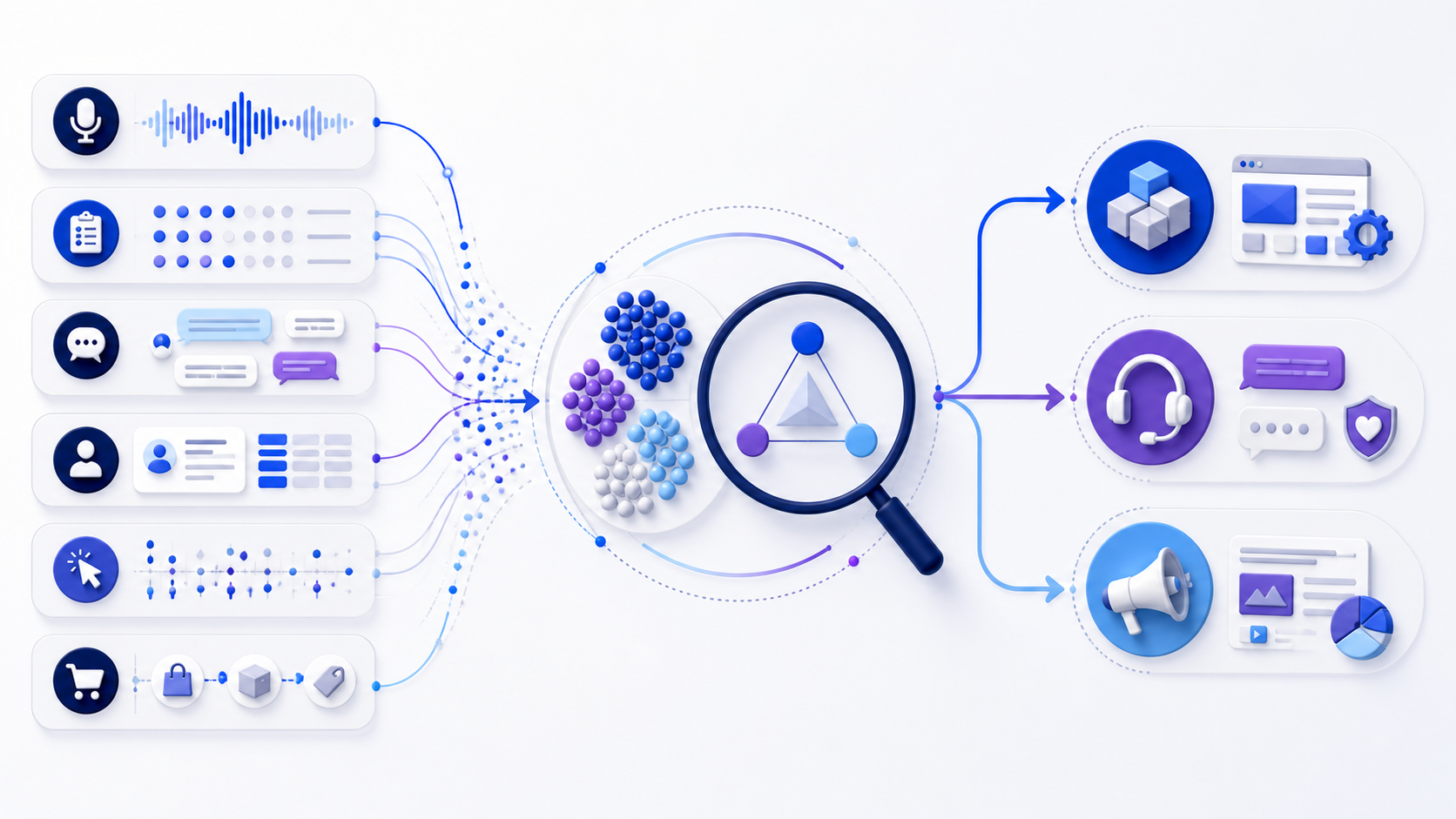
Begin with a decision statement, not a data dump. Write the decision owner, the choice they face, the deadline, and what evidence could change their mind. Then inventory sources by the part of reality each captures. Behavioral data shows what happened; customer language provides context and meaning; commercial records show consequences; research notes reveal situations that instrumentation misses.
先写决策声明,而不是先倾倒数据。明确决策负责人、面临的选择、截止时间,以及什么证据可能改变其判断。随后按每种来源能够捕捉的现实部分建立清单。行为数据说明发生了什么;客户语言提供情境与意义;商业记录显示后果;研究笔记揭示埋点无法捕捉的场景。
| Source来源 | What it contributes提供什么 | Preparation check准备检查 |
|---|---|---|
| Interviews and field notes访谈与现场笔记 | Goals, language, context, constraints, workarounds目标、用语、情境、限制与变通方法 | Consent, recruitment criteria, discussion guide, transcript quality同意、招募条件、访谈提纲、文本质量 |
| Surveys and feedback问卷与反馈 | Stated attitudes at wider scale and open-text themes更大范围的态度表达与开放文本主题 | Question wording, response rate, sampling and nonresponse risk问题措辞、回复率、抽样与未回复风险 |
| Product and web events产品与网站事件 | Observed sequences, frequency, funnels, and cohorts已观察序列、频次、漏斗与群组 | Event dictionary, identity rules, time zone, missing events事件字典、身份规则、时区与缺失事件 |
| CRM, billing, and supportCRM、账单与客服 | Lifecycle stage, value, outcomes, objections, and failure history生命周期、价值、结果、异议与故障历史 | Stable identifiers, status definitions, access controls, retention rules稳定标识、状态定义、访问控制与保留规则 |
Privacy is part of research quality. Record purpose, lawful basis or consent where applicable, access boundaries, retention, and deletion handling before analysis. Remove direct identifiers when they are unnecessary, and do not join sources merely because a technical key exists.
隐私本身就是研究质量的一部分。分析前应记录目的、适用时的法律依据或同意、访问边界、保留期限和删除处理。若无必要,应移除直接身份信息;不要仅因为技术上存在连接键,就随意合并来源。
Choose customer insight methods by uncertainty根据不确定性选择客户洞察方法
The best method depends on what the team does not know. If you do not know the problem or context, use exploratory interviews, observation, or diary research. If you know the behavior but not its prevalence, use event analysis or a carefully sampled survey. If you need to choose between interventions, use usability testing, prototype evaluation, or a controlled experiment. Mixed methods are valuable because they answer different parts of the claim—not because more sources automatically make a conclusion true.
最佳方法取决于团队究竟不知道什么。如果不知道问题或情境,可用探索性访谈、观察或日记研究;如果知道行为但不清楚其普遍程度,可用事件分析或审慎抽样的问卷;如果需要在干预方案中选择,则使用可用性测试、原型评估或对照实验。混合方法的价值在于回答主张的不同部分,而不是因为来源更多就自动使结论为真。
| Question type问题类型 | Strong starting method合适起点 | Main limitation主要限制 |
|---|---|---|
| Why is this happening?为什么会发生? | Interviews plus behavior or support evidence访谈结合行为或客服证据 | Recall, social desirability, and researcher interpretation记忆偏差、社会期许与研究者解释 |
| How common is it?有多普遍? | Representative survey or defined event/cohort analysis代表性问卷或定义清晰的事件/群组分析 | Coverage, missingness, instrumentation, and selection bias覆盖、缺失、埋点与选择偏差 |
| Where does the experience break?体验在哪里中断? | Journey review, usability test, support and funnel analysis旅程审查、可用性测试、客服与漏斗分析 | Lab behavior may differ from real-world behavior测试环境行为可能不同于真实行为 |
| Did our change work?改变是否有效? | Experiment or credible before/after design with guardrails实验或带护栏指标的可信前后对照设计 | Confounding, novelty, spillover, and short observation windows混杂、新奇效应、外溢与观察期过短 |
How to gather customer insights in seven repeatable steps如何用七个可重复步骤获得客户洞察
- Frame the decision.界定决策。 Name the owner, choice, deadline, target customers, and the evidence threshold that would alter the choice. Replace “understand churn” with “decide whether to change first-week setup for new small-team accounts this quarter.”明确负责人、选择、截止时间、目标客户,以及改变选择所需的证据门槛。把“了解流失”改成“决定本季度是否调整小团队新账户的首周设置”。
- Define the population and concepts.定义研究对象和概念。 Specify who counts as a customer, the lifecycle window, segments, successful outcome, and important terms. Document exclusions so the analysis does not quietly shift populations.说明谁算客户、生命周期窗口、细分、成功结果和重要术语。记录排除条件,避免分析过程中悄然更换研究对象。
- Collect complementary evidence.收集互补证据。 Select the smallest set of sources that can describe behavior, context, and consequence. Review consent and access before exporting. Preserve source IDs and dates without exposing unnecessary personal information.选择能够分别描述行为、情境和后果的最小来源集合。导出前审查同意与访问权限;保留来源ID和日期,同时避免暴露不必要的个人信息。
- Clean and audit the inputs.清理并审计输入。 Check missing events, duplicate records, timestamp alignment, response bias, transcript errors, and join coverage. Reconcile totals to source systems. A sophisticated model cannot repair an undefined denominator.检查缺失事件、重复记录、时间戳对齐、回复偏差、转写错误和连接覆盖率,并与源系统总数核对。再复杂的模型也无法修复未定义的分母。
- Find patterns without erasing exceptions.寻找模式但不要抹去例外。 Code recurring themes, compare cohorts, map journeys, and inspect negative cases. Keep verbatim evidence linked to each theme. Separate a high-frequency issue from a high-severity issue; they require different prioritization.编码重复主题、比较群组、绘制旅程并检查反例。让原始证据与各主题保持连接。区分高频问题与高严重性问题,因为两者的优先级逻辑不同。
- Write and challenge the insight.写出并挑战洞察。 Use: “We believe [interpretation] for [segment/context] because [evidence]; confidence is [level] because [limits]; therefore we will [action/test].” Ask what else could explain the pattern and what evidence would disconfirm it.使用结构:“我们认为[细分/情境]中存在[解释],因为[证据];由于[限制],置信度为[等级];因此将执行[行动/测试]。”同时询问还有什么解释,以及什么证据会推翻它。
- Act, measure, and refresh.行动、衡量并刷新。 Assign an owner, ship the smallest responsible change, define primary and guardrail metrics, and set a review date. Record whether the outcome strengthened, weakened, or replaced the insight. Insights expire as customers and products change.指定负责人,发布最小且负责任的改变,定义主要指标和护栏指标,并设置复盘日期。记录结果是增强、削弱还是取代了原洞察。客户和产品会变化,洞察也会过期。
A decision framework for stronger customer insights让客户洞察更可靠的决策框架
Score an insight across four dimensions before it enters a roadmap or operating plan. Evidence asks whether the source is direct, traceable, and sufficiently broad. Explanation asks whether the claim distinguishes observation from interpretation and tests alternatives. Relevance asks whether the affected segment and decision are explicit. Testability asks whether the team can learn from a bounded next step.
在洞察进入路线图或运营计划前,从四个维度评分。证据:来源是否直接、可追溯且覆盖充分;解释:主张是否区分观察与解释,并检验替代原因;相关性:受影响细分与决策是否明确;可验证性:团队能否通过边界清晰的下一步继续学习。
Confidence should be stated, not implied. Use “directional” when evidence comes from a narrow or self-selected sample; “supported” when multiple sources agree and definitions are stable; and “validated for this context” only after a credible intervention or repeated prospective observation. Even validated findings should retain their segment, period, channel, and product-version boundaries.
置信度应明确写出,而不是暗示。当证据来自狭窄或自选择样本时使用“方向性”;当多种来源一致且定义稳定时使用“有支持”;只有经过可信干预或重复前瞻观察后,才使用“在此情境下已验证”。即便是已验证的发现,也应保留其细分、时期、渠道和产品版本边界。
Customer insights example: onboarding friction客户洞察示例:新手引导摩擦
Hypothetical example: all names, thresholds, and values below are illustrative. They do not describe an InfiniSynapse customer or a measured product result.
假设示例:以下名称、阈值和数值仅用于说明,不代表任何 InfiniSynapse 客户或已测量的产品结果。
A collaboration product sees lower 30-day retention among new accounts that never invite a teammate. The event table shows the association but not the reason. Researchers interview accounts from both groups, review onboarding survey text, examine support tickets tagged “permissions,” and replay the aggregate event sequence around role selection. The evidence suggests that small-team owners understand collaboration value but hesitate because the role names imply permanent administrative authority.
某协作产品发现,从未邀请同事的新账户30天留存较低。事件表显示了关联,却没有原因。研究人员访谈两组账户,审查新手问卷开放文本、标记为“权限”的客服工单,并查看角色选择前后的聚合事件序列。证据表明,小团队所有者理解协作价值,却因角色名称暗示永久管理权限而犹豫。
| Layer层次 | Example output示例输出 | What remains uncertain仍不确定什么 |
|---|---|---|
| Observation观察 | Non-inviters revisit role help and mention unclear ownership in interviews.未邀请者反复查看角色帮助,并在访谈中提到所有权不清。 | Whether confusion causes lower retention or merely accompanies it.这种困惑究竟导致低留存,还是仅与其同时出现。 |
| Insight洞察 | For small-team owners, permanent-sounding role labels increase perceived risk at the moment collaboration should begin.对小团队所有者而言,听起来永久有效的角色标签,在应开始协作时提高了感知风险。 | The size of the affected segment and best corrective wording.受影响细分规模和最合适的修正文案。 |
| Test测试 | Explain permissions before invitation and offer a reversible default role.邀请前解释权限,并提供可逆的默认角色。 | Effect on invitations, setup completion, support contacts, and later access mistakes.对邀请、设置完成、客服联系及后续权限错误的影响。 |
The primary measure could be completed invitations among eligible new accounts. Guardrails should include accidental over-permissioning, support contacts, and task completion. If invitation improves while downstream collaboration does not, the intervention changed a click but not the underlying outcome. That result weakens the proposed explanation and requires another round of learning.
主要指标可以是符合条件的新账户完成邀请的比例;护栏指标应包括意外过度授权、客服联系和任务完成。如果邀请上升但后续协作没有改善,干预只改变了点击,没有改变根本结果。这会削弱原解释,并要求进行下一轮学习。
Common mistakes, limits, and risks常见错误、限制与风险
Loud customers, duplicated tickets, and easy-to-name features can dominate. Link requests to jobs, segments, behavior, and consequences.
声音大的客户、重复工单和容易命名的功能会占据视线。应把请求与任务、细分、行为和后果连接。
Questions that explain the desired feature invite agreement. Ask for recent real examples, sequence, context, and trade-offs.
先解释期望功能的问题容易获得迎合性回答。应询问近期真实例子、过程、情境与取舍。
Cross-source matching can misidentify people or exceed the stated purpose. Minimize data, document logic, and restrict access.
跨来源匹配可能误认个人或超出既定目的。应最小化数据、记录逻辑并限制访问。
Topic models and language models can compress evidence but may merge distinct contexts or invent coherence. Review source excerpts and negative cases.
主题模型和语言模型可以压缩证据,却可能合并不同情境或制造虚假一致。必须审查原始片段和反例。
Other failure modes include measuring only current customers when the decision concerns prospects, treating absence of complaints as satisfaction, comparing cohorts with different exposure windows, and refreshing a dashboard without refreshing the question. Accessibility and inclusion matter: recruitment channels, research format, language, device access, and digital skill can systematically exclude the people who face the greatest friction.
其他失败模式包括:决策涉及潜在客户却只研究现有客户;把没有投诉当成满意;比较暴露窗口不同的群组;只刷新仪表板而不刷新问题。无障碍与包容性同样重要:招募渠道、研究形式、语言、设备访问和数字技能,都可能系统性排除摩擦最大的人群。
How to validate customer insights before acting采取行动前如何验证客户洞察
Validation is a chain, not a final checkbox. First validate the records against source totals and definitions. Then validate the interpretation with source excerpts, segment comparisons, negative cases, and a second reviewer. Finally validate the decision through a reversible change, prototype, prospective measure, or experiment that could genuinely fail.
验证是一条链,而不是最后一个复选框。首先对照源系统总数和定义验证记录;随后用原始片段、细分比较、反例和第二位审查者验证解释;最后通过可逆改变、原型、前瞻指标或真正可能失败的实验验证决策。
- Traceability: Can a reviewer move from each claim to the exact records, excerpts, filters, and version used?可追溯性:审查者能否从每项主张追到具体记录、原文、筛选条件和版本?
- Definition stability: Do customer, active, retained, complaint, and segment mean the same thing across sources?定义稳定性:客户、活跃、留存、投诉和细分在不同来源中是否含义一致?
- Coverage: Who is missing because they churned silently, declined research, used another channel, or cannot access the format?覆盖:哪些人因静默流失、拒绝研究、使用其他渠道或无法访问研究形式而缺失?
- Alternative explanations: What product, seasonal, channel, pricing, or measurement change could produce the same pattern?替代解释:哪些产品、季节、渠道、价格或测量变化也可能产生相同模式?
- Decision test: Is the next action bounded, owned, measurable, and safe to reverse if the hypothesis fails?决策测试:下一步是否边界清晰、有人负责、可测量,并能在假设失败时安全撤回?
Keep an insight register with the statement, owner, segment, evidence links, confidence, limitations, action, metrics, review date, and status. Mark an insight as current, challenged, superseded, or expired. This prevents old findings from becoming permanent folklore after the product, market, or customer mix changes.
建立洞察登记表,记录陈述、负责人、细分、证据链接、置信度、限制、行动、指标、复盘日期和状态。将洞察标记为当前、受挑战、已替代或已过期,避免产品、市场或客户结构变化后,旧发现仍被当作永久常识。
Use InfiniSynapse to analyze customer evidence across sources使用 InfiniSynapse 跨来源分析客户证据
InfiniSynapse is an AI Data Analyst for multi-source analysis. Its public product pages describe natural-language analysis across databases and multimodal sources such as documents, audio, and video. For a customer insight workflow, that can support comparing governed CRM or product data with de-identified feedback files, interview notes, or support records. It should not be treated as a survey panel, research participant recruiter, consent manager, legal reviewer, or automatic source of causal truth.
InfiniSynapse 是用于多来源分析的 AI Data Analyst。其公开产品页面说明,它支持通过自然语言分析数据库以及文档、音频、视频等多模态来源。在客户洞察工作流中,可用于把受治理的 CRM 或产品数据,与去标识化的反馈文件、访谈笔记或客服记录进行比较。它不应被视为问卷样本库、研究参与者招募工具、同意管理器、法律审查者或自动提供因果真相的系统。
Before opening the tool, prepare the decision statement, allowed sources, time window, segment and metric definitions, access boundaries, and source reconciliation totals. Then ask InfiniSynapse to compare evidence, surface contradictions, and produce a traceable set of hypotheses for human review.
打开工具前,准备好决策声明、允许使用的来源、时间窗口、细分与指标定义、访问边界及源系统核对总数。随后可让 InfiniSynapse 比较证据、暴露矛盾,并产出可追溯的假设集合,供人工审查。
Analyze prepared data with InfiniSynapse使用 InfiniSynapse 分析已准备的数据For upstream data governance, read the customer data management guide. For campaign, attribution, and acquisition questions, use the marketing data analysis playbook.
Customer insights FAQ客户洞察常见问题
What are customer insights?
什么是客户洞察?
Customer insights are evidence-backed interpretations of customer behavior, language, context, or unmet needs that can change a product, service, marketing, or support decision.
客户洞察是基于证据,对客户行为、语言、情境或未满足需求作出的解释,并且能够改变产品、服务、营销或客服决策。
How do you gather customer insights?
如何获得客户洞察?
Start with a decision question, combine relevant qualitative and quantitative sources, clean and segment the evidence, identify patterns, test alternative explanations, write an evidence-linked insight, and validate the resulting action.
从决策问题开始,组合相关定性与定量来源,清理并细分证据,识别模式,检验替代解释,写出与证据相连的洞察,并验证由此产生的行动。
What is an example of a customer insight?
客户洞察的例子是什么?
A hypothetical example is that new accounts that fail to invite a teammate may leave because ownership transfer is unclear. The claim becomes an insight only when interviews, support records, and product events support it and a controlled change can test it.
一个假设示例是:未邀请同事的新账户可能因所有权转移不清而离开。只有当访谈、客服记录和产品事件共同支持该主张,并能通过受控改变进行测试时,它才成为洞察。
What is the difference between customer insights and customer analytics?
客户洞察与客户分析有什么区别?
Customer analytics measures and models behavior. A customer insight interprets quantitative and qualitative evidence, explains why it matters, states uncertainty, and points to a decision or test.
客户分析衡量并建模行为;客户洞察则解释定量和定性证据,说明其重要性,表达不确定性,并指向决策或测试。
Can AI generate customer insights?
AI 能生成客户洞察吗?
AI can organize mixed evidence, cluster feedback, compare segments, and suggest hypotheses, but people must verify source quality, privacy, definitions, alternative explanations, and the decision before acting.
AI 可以整理混合证据、聚类反馈、比较细分并提出假设,但人在行动前必须验证来源质量、隐私、定义、替代解释和最终决策。
Official sources and further reading权威来源与延伸阅读
These sources support the research, behavioral-data, and privacy practices used in this guide. They do not endorse InfiniSynapse.
以下来源支持本指南采用的研究、行为数据与隐私实践,但不代表它们认可 InfiniSynapse。