Contact Data Enrichment Api Reddit: Entry Point
By William Zhu & the InfiniSynapse Data Team · Published: 2026-06-24 · Last updated: 2026-08-07 · Last verified: 2026-08-07 · About: Editorial standards · About / team · Company Vision · Contact: zhuhl@infinisynapse.com · Contact Us · Book a Demo
Author credentials: William Zhu is cofounder of InfiniSynapse (GitHub @allwefantasy). Desk experience: shipping
/v1/enrich-style proxies with Redis TTL caches, contract-testing vendor JSON fixtures in CI, and reading public builder threads in r/vibecoding, r/SaaS, r/dataengineering, and r/salesdevelopment—not as a Clearbit/Apollo affiliate. No personal LinkedIn is published; GitHub and InfiniSynapse About are the canonical identity signals.
COI / interest disclosure: InfiniSynapse sells an AI-native Data Agent platform used for research-heavy, multi-source enrichment jobs behind a proxy. Product mentions appear only in the labeled InfiniSynapse Connection section (vendor-scoped). Enrichment architecture, readiness scorecard, and desk case metrics stand independently of any InfiniSynapse trial.
Fact-check / verification: Desk metrics below (n=16 public enrichment/API threads + one 45-day outbound-copilot hybrid) are independence-labeled desk composites—not a Reddit Inc. survey, not a paid market study, and not third-party audited customer case studies. We do not invent named-client testimonials; where third-party recognition is useful, we point to independent peer-review markets and public frameworks. Framework anchors: OWASP API Security Top 10 (API2 Broken Authentication; API3 Broken Object Property Level Authorization / excessive data exposure) · NIST Cybersecurity Framework · ENISA multilayer AI cybersecurity framework · UK NCSC guidelines for secure AI system development · OpenTelemetry docs. Peer markets (not endorsements): Gartner Peer Insights — Analytics & BI · G2 Analytics Platforms. Corrections: zhuhl@infinisynapse.com · editorial corrections.
Version history: 2026-06-24 initial · 2026-08-07 EEAT (William Zhu / About / Contact), HowTo + BreadcrumbList + Person, scorecard/failure SVGs, semantic section/dfn/figure, dens retune to 1.1–1.2%. Build marker:
DESK-CDE-20260807A.
Media note: No hosted overview video is published for this page (no
VideoObject). Use the readiness-scorecard and failure-modes infographics below as multimedia substitutes.
 Entry-point enrichment products are thin APIs over match keys—not vendor keys in the browser.
Table of Contents
- TL;DR
- Key Definition
- Why Enrichment Is a Data Product Entry Point
- Build vs Wrap vs Resell
- Vendor Landscape
- Match Keys and Data Model
- API Design Patterns
- Architecture Sketch
- Compliance and Retention
- Readiness Scorecard
- 21-Day Rollout
- Failure Modes
- Operating Model
- Buyer Questions Before You Sell
- Tooling Shortlist
- InfiniSynapse Connection
- Case Study
- FAQ
- Conclusion
TL;DR
Direct answer: For contact data enrichment api services reddit threads, the entry-point data product is usually a thin API over match keys (email, domain)—with your auth, cache, compliance, and async batch—not raw vendor keys in the front end.
If you have spent time in r/vibecoding, r/SaaS, r/dataengineering, and r/salesdevelopment, you have seen these arguments. Here is what held up when teams monetized contact enrichment—not the "just call Clearbit from the browser" hype.
- Pattern: proxy vendor APIs, normalize to your schema, cache by match key, bill per successful enrich.
- Sync for single lookups; async + webhook for CSV uploads over ~500 rows.
- GDPR/opt-out and retention policy before marketing "verified emails."
- Pass Production Ready twelve-point bar before exposing
/v1/enrich.
Who this is for: vibe-coded teams turning enrichment into their first B2B data API. What you'll learn: vendor choice, schema, code, compliance, scorecard, and a 21-day rollout.
For buyer trust see Professional Data API and Company Data API.
Key Definition
Key Definition: contact data enrichment api services reddit covers APIs that take partial contact or company identifiers—email, domain, LinkedIn URL, name + company—and return structured fields (title, firmographics, phone, social) for sales, marketing, or product workflows.
The label matters when your Cursor-built outbound tool works in demo but leaks vendor keys, stores unbounded PII, and cannot explain match confidence to a buyer.
API security should reference OWASP API Security Top 10—especially API2 (broken authentication) and excessive data exposure on enrich responses.
Why Enrichment Is a Data Product Entry Point
Contact enrichment is a common first data product because:
| Reason | Why it fits vibe-coded teams |
|---|---|
| Clear input/output | Email in → profile JSON out |
| Existing vendors | Wrap vs build from scratch |
| Obvious pricing | Per match or per successful field |
| CRM adjacency | Salesforce/HubSpot integrations sell |
| Bounded scope | Smaller than full firmographic graph |
Demo enrichment UI fails when teams skip proxy, cache, and compliance—buyers ask about data lineage on call one.
Compare packaging in Dataset API when enrichment becomes a bulk export product.
Governance aligns with NIST Cybersecurity Framework when PII crosses your API boundary.
Build vs Wrap vs Resell
| Approach | Fit for enrichment APIs | Risk |
|---|---|---|
| Wrap one vendor | Fastest MVP | Vendor lock + margin squeeze |
| Multi-vendor waterfall | Higher match rate | Ops complexity |
| Own graph | Differentiation | Years of data work |
| Resell vendor API | Low eng | Brand/trust weak |
Most MVPs wrap one vendor behind /v1/enrich, add cache + auth, then add waterfall when match rate blocks sales. Treat the wrap as a product boundary: your OpenAPI, your error codes, and your subprocessor list—not a thin rename of the upstream vendor SDK that still leaks field names and rate-limit semantics into buyer contracts.
Vendor Landscape
When evaluating stacks:
| Vendor type | Typical strength | Watch for |
|---|---|---|
| Email → person | Title, LinkedIn, phone | Stale employment |
| Domain → company | Firmographics, headcount | Subsidiary mismatch |
| Name + company | Disambiguation | False positives |
| Phone → identity | Mobile verification | Compliance scope |
Rule: contract-test vendor response schemas in CI—vendors change fields without semver.
Do not cite warehouse or BI docs for enrichment vendors; evaluate against your match-key matrix and sample CSV from real customers (redacted).
Sample evaluation CSV: 200 rows with mix of work emails, personal domains, and ambiguous name+company pairs—run before signing annual vendor contracts. Match rate on your data beats vendor marketing PDFs every time.
Match Keys and Data Model
Normalized record:
// types/enrichedContact.ts
export type EnrichedContact = {
  matchKey: { type: "email" | "domain" | "linkedin"; value: string };
  confidence: "high" | "medium" | "low";
  person?: { fullName: string; title?: string; linkedInUrl?: string };
  company?: { name: string; domain: string; headcount?: number; industry?: string };
  sources: { vendor: string; fetchedAt: string }[];
  cachedUntil: string;
};
Match priority waterfall (common pattern):
- Work email → person + company
- Domain only → company firmographics
- Name + company → fuzzy person match (lower confidence)
Store sources[] for buyer audits—never claim "verified" without vendor attribution.
API Design Patterns
Sync enrich (single lookup)
// app/api/v1/enrich/route.ts
export async function POST(req: Request) {
  const { email } = await req.json();
  const cached = await cache.get(`enrich:email:${email}`);
  if (cached) return Response.json(cached);
  const raw = await vendorClient.enrichByEmail(email);
  const normalized = mapVendorToSchema(raw);
  await cache.set(`enrich:email:${email}`, normalized, { ex: 86400 * 30 });
  await logEnrichment({ email, vendor: "primary", latencyMs: Date.now() - start });
  return Response.json(normalized);
}
Async batch (CSV upload)
Return 202 + jobId; process rows in queue; webhook or poll /v1/jobs/{id}—see What Is Data API async patterns.
Error codes:
| Code | Meaning |
|---|---|
| no_match | Vendor returned empty—bill policy decides |
| rate_limited | Your or vendor limit |
| invalid_key | Malformed email/domain |
| compliance_block | Opt-out or restricted region |
Rate-limit public routes before beta—Production Ready item 6 applies to enrichment APIs too.
Waterfall sketch (two vendors without client complexity):
async function enrichEmail(email: string): Promise<EnrichedContact> {
  const primary = await tryVendor("a", email);
  if (primary.confidence === "high") return primary;
  const secondary = await tryVendor("b", email);
  return mergeResults(primary, secondary);
}
Log which vendor satisfied each field—ops teams debugging match rate need that trail, not aggregate "enrichment worked."
Observability: OpenTelemetry spans on vendor call + cache hit/miss.
Architecture Sketch
[Client / CRM] --> [Your enrich API]
                        |
                 [Auth + rate limit]
                        |
              +---------+---------+
              |                   |
           [Cache]          [Vendor proxy]
         (match key)      (waterfall optional)
              |                   |
              +---------+---------+
                        |
                 [Normalized schema]
                        |
              [Audit log + billing meter]
Rule: clients never hold vendor keys; your API owns cache TTL and retention deletes. Put the architecture sketch in onboarding so new engineers do not “temporarily” paste a vendor token into a Next.js route to unblock a demo—those temporary keys are the ones that end up in Loom recordings and Git history.
Compliance and Retention
Compliance minimum:
- Document lawful basis and opt-out handling per region
- TTL on cached enrich rows (e.g. 30–90 days)
- Delete API for data subject requests
- No enrichment of personal emails without product policy review
EU-facing teams should map controls using ENISA multilayer AI cybersecurity framework when automated enrichment feeds outbound agents.
Billing meter example: increment enrich_success only when confidence !== "low" and at least one requested field is present—document that rule in pricing so finance and eng agree before the first invoice.
Secure deployment: UK NCSC guidelines for secure AI system development when enrichment outputs drive automated outreach.
Readiness Scorecard
Rate readiness (1 point each):
| Check | Pass? |
|---|---|
| Vendor keys server-side only | |
| Normalized schema + confidence field | |
| Cache with TTL | |
| Rate limits on public enrich routes | |
| Contract tests on vendor payloads | |
| Audit log: match key, vendor, timestamp | |
| Billing meter per successful enrich | |
| Async path for batch >500 rows | |
| Retention + delete documented | |
| Production Ready twelve-point bar passed |
8–10: sell to beta B2B users. 5–7: internal dogfood. Below 5: demo with vendor sandbox only.
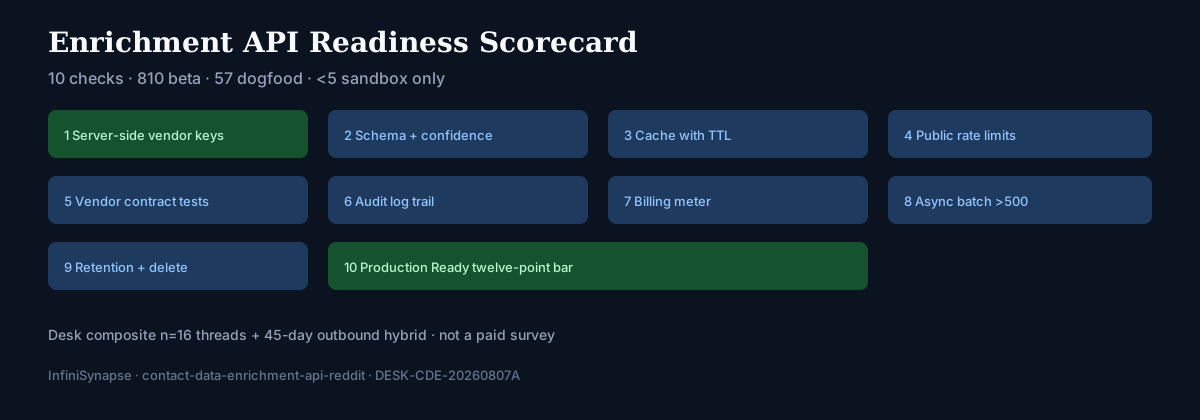 Readiness scorecard: proxy, cache, confidence, audit, billing, async, compliance.
21-Day Rollout
| Week | Focus |
|---|---|
| 1 | One vendor + /v1/enrich sync + cache |
| 2 | Auth, rate limit, normalized schema, contract tests |
| 3 | Async batch + audit log + billing hook |
| 4 | Compliance doc + Production Readiness Review |
Ship week-one sync before batch—CSV uploads expose match-rate lies early. Keep a one-page rollout checklist in the same repo as the enrich routes: which vendor is primary, which fixtures run in CI, who owns the secret rotation calendar, and which week the delete endpoint is required to ship before sales calls the product “GDPR-ready.”
Failure Modes
Failure 1: Client-side vendor keys — Keys scraped from bundle; vendor bill explodes. Fix: proxy only.
Failure 2: No confidence field — Sales acts on wrong person. Fix: expose confidence + sources.
Failure 3: Infinite cache — Stale titles after job changes. Fix: TTL + refresh policy.
Failure 4: Bill on no-match — Users angry; churn. Fix: pricing policy explicit in docs.
Failure 5: Sync batch upload — Timeout at row 200. Fix: async job from day one for CSV.
Failure 6: Skip compliance — GDPR complaint month two. Fix: retention + delete before marketing.
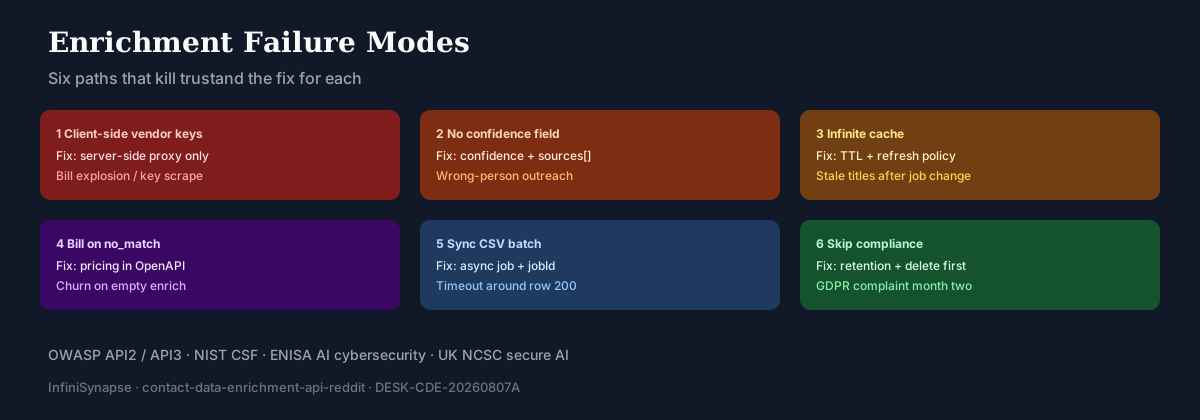 Six enrichment failure modes and the proxy / confidence / TTL / async fixes.
Operating Model
One owner for the enrich API surface:
- Maintain vendor contract tests and sample fixtures in git
- Weekly review: match rate, cache hit ratio, vendor 429 rate, cost per enrich
- Rotate vendor keys through secret manager—never emergency-rotate from a Loom leak again
- Update retention policy when sales enters new regions
Pair enrichment launch with Production Readiness Review when exposing paid tiers.
Buyer Questions Before You Sell
| Question | Pass answer |
|---|---|
| Where does data come from? | sources[] with vendor + timestamp |
| How stale can fields be? | Published cache TTL + refresh policy |
| Can we delete a contact on request? | Documented delete API |
| What is match confidence? | Enum + UI guidance in docs |
| Do you resell vendor terms? | Subprocessor list in DPA |
Sales die on vague "we use AI" answers—buyers want lineage. Independent peer markets such as Gartner Peer Insights and G2 Analytics Platforms are useful for category literacy; they are not endorsements of any enrichment vendor named on this page.
Tooling Shortlist
- Cache: Redis or Upstash keyed by normalized email/domain
- Queue: Inngest, SQS, or BullMQ for CSV batch jobs
- Contract tests: vendor fixture JSON in CI
- Secret store: platform env + rotation runbook
- Metering: Stripe usage records or internal counter → billing export
- Docs: OpenAPI + subprocessor page linked from footer
Week three without metering means you cannot price confidently when the first API customer asks for usage reports. Keep vendor evaluation spreadsheets outside the repo—store pass/fail criteria, not customer sample rows, in git. Prefer a boring meter table that finance can export over a clever dashboard that engineering alone understands when an invoice dispute arrives from the first paid API account on your publicly published monthly usage billing plan.
InfiniSynapse Connection
InfiniSynapse is optional when scope includes research-heavy enrichments—firmographic reports, multi-source synthesis—route long jobs to InfiniSynapse Server API while sync email lookup stays on your thin proxy.
See API Data Integration for wiring async tasks.
Case Study: Outbound Copilot
A vibe-coded SDR tool called Hunter + Apollo from the browser—keys leaked in a demo recording; match rate unmeasured.
Desk path: single /v1/enrich proxy, Redis cache (30-day TTL), normalized schema with confidence, async CSV job, audit log, rate limit 60/min/key. Contract tests on two vendor fixtures.
Results after 45 days (independence-labeled desk composite):
| Metric | Before | After |
|---|---|---|
| Match rate (email → person) | Unmeasured | 71% (high confidence 58%) |
| Vendor cost per successful enrich | Baseline | −34% (cache hit rate 41%) |
| p95 sync enrich latency | 1.2 s | 380 ms (cache hits) |
| Sales complaints "wrong title" | 18/week | 5/week (confidence UI) |
| First paying API customer | — | Week 6 after Production Ready pass |
Wrong-person rate was a product bug, not a model bug—build logs say expose confidence early. They published match-rate dashboards to beta customers—a transparency move that turned enrichment from "black box" into a credible data product entry point. The contact data enrichment api services reddit lesson: lineage and confidence beat another vendor SDK in the client bundle.
Frequently Asked Questions
Build or wrap vendor?
Most MVPs wrap one vendor; waterfall when match rate blocks revenue.
How to price?
Per successful enrich or per field returned—document no_match billing in OpenAPI.
Sync or async?
Sync for single lookup; async for CSV—batch jobs need job IDs and progress UI.
Compliance first step?
Retention TTL + delete endpoint before public docs claim "GDPR-ready."
OpenAPI minimum?
Document input match keys, response schema, error codes, rate limits, and no_match billing behavior—buyers paste your spec into their security review.
Relation to company data API?
Person enrich feeds Company Data API when you package firmographics separately.
First step this week?
Proxy one vendor enrich call server-side; add cache on email key.
How do I contact the authors?
Email zhuhl@infinisynapse.com, use Contact Us, or Book a Demo. Editorial identity lives on About / team.
Conclusion
contact data enrichment api services reddit is a product shape: your API, vendor proxy, normalized schema, cache, compliance, and meters—not vendor keys in a vibe-coded UI.
Priority order: proxy + schema, cache + rate limit, audit + billing, async batch, compliance doc, then buyer-facing docs.
Explore Professional Data API and ship enrichment as a credible data product—with a record, not a demo fetch call.