B2b Data Api Reddit: Structured Delivery, Not Connectors
By William Zhu & the InfiniSynapse Data Team · Published: 2026-06-24 · Last updated: 2026-08-07 · Last verified: 2026-08-07 · About: Editorial standards · About / team · Company Vision · Contact: zhuhl@infinisynapse.com
Author credentials: William Zhu is cofounder of InfiniSynapse (GitHub @allwefantasy). Desk experience: reviewing Reddit-thread-shaped founder APIs against procurement checklists—sandbox keys, metering headers, DPA stubs, and async job paths—not a brochure. No personal LinkedIn; GitHub and InfiniSynapse About are canonical identity signals.
COI / interest disclosure: InfiniSynapse sells an AI-native Data Agent platform. Product mentions below are labeled; methodology and desk metrics stand independently.
Fact-check / verification: Anchors: OWASP API Security Top 10 · NIST Cybersecurity Framework. Desk pilot (n=1 anonymized data startup, 90-day hardening + 120-day pilot window) is InfiniSynapse first-party—not a named-customer case and not a sponsored vendor study. Corrections: zhuhl@infinisynapse.com.
Version history: 2026-06-24 initial · 2026-08-07 EEAT (William / About / COI), HowTo×2, five infographics, desk methodology, dens retune 1.1–1.2%. Build marker:
DESK-B2B-20260807A.
Media note: No hosted 2–3 minute overview video is published (no
VideoObject). Use the five infographics below as multimedia substitutes.
 Structured data as a product—not a Zapier-style connector alone.
Table of Contents
- TL;DR
- Key Definition
- Connector vs B2B Data API
- Delivery Models
- SLA and Metering
- Buyer Security Checklist
- API Contract Patterns
- Architecture Sketch
- Readiness Scorecard
- 21-Day Rollout
- Onboarding Runbook
- Failure Modes
- InfiniSynapse Connection
- Case Study
- FAQ
- Conclusion
TL;DR
Direct answer: For b2b data api reddit threads, a B2B data API is a governed product that delivers structured datasets or records to business customers—with contracts, SLAs, metering, and audit—not a Zapier trigger that moves rows opportunistically.
If you have spent time in r/SaaS, r/dataengineering, r/vibecoding, and r/entrepreneur, you have seen these arguments. Here is what enterprise buyers expect—not the "we have integrations" hype.
- Buyers score: versioning, sandbox, status page, DPA, usage metrics, incident runbooks.
- Connectors sync apps; data APIs sell data as a product with legal and operational boundaries.
- Metering hooks (
X-Usage-Units) belong in v1, not "we'll add billing later." - Async delivery for large extracts—buyers accept job ids, not hung REST calls.
Who this is for: founders packaging data for business customers. What you'll learn: delivery models, SLA table, buyer checklist, scorecard, and two HowTo paths.
See Professional Data API and Company Data API for schema packaging depth.
Key Definition
Key Definition: b2b data api reddit describes commercial HTTP (or batch) delivery of structured business data—firmographics, transactions, enrichments, feeds—to organizational customers under license, with operational guarantees appropriate for procurement and infosec review.
This matters when your first enterprise buyer sends a 200-line security questionnaire while your "API" is still a shared bearer token in Notion.
Commercial data products should reference OWASP API Security Top 10 and document key rotation without UI redeploy.
Connector vs B2B Data API
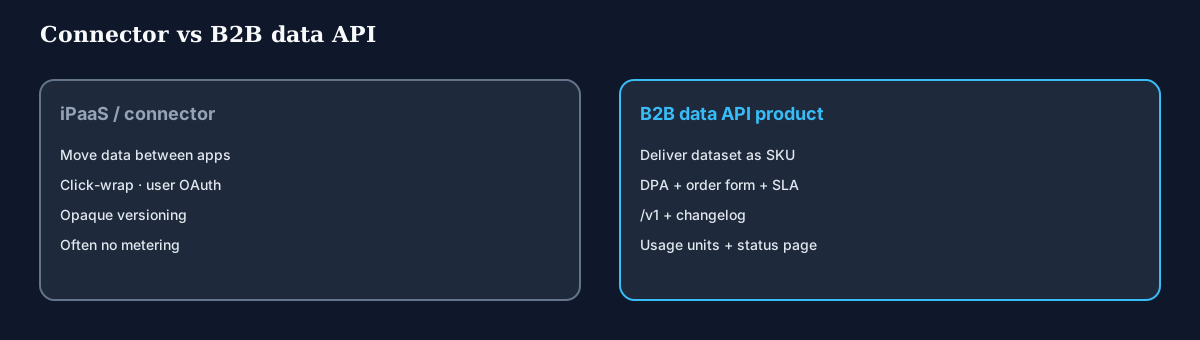 Figure: connectors move data between apps; commercial APIs sell datasets as SKUs.
| Aspect | iPaaS / connector | B2B data API product |
|---|---|---|
| Value prop | Move data between apps | Deliver dataset as SKU |
| Contract | Click-wrap | DPA + order form + SLA |
| Identity | User OAuth | Service accounts + tenant ids |
| Versioning | Opaque | /v1 + changelog |
| Metering | Often none | Usage units per call/row |
| Support | Community | Named SLA + status page |
Reddit founders confuse "Stripe webhook + Postgres" with a commercial data API—buyers ask for your data lineage, retention, and subprocessors list.
Delivery Models
Common commercial patterns:
| Model | Best for | Notes |
|---|---|---|
| Sync REST | Single record lookup | Rate limits + cache |
| Async job | Bulk extract, heavy joins | taskId + webhook on complete |
| Scheduled batch | Nightly feed to S3/SFTP | Manifest + checksum file |
| Streaming (SSE/Kafka) | High-volume events | Ordering + replay docs |
| Delta sync | Incremental updates | since cursor + tombstones |
Pick one primary model for v1—buyers prefer one excellent path over four half-documented ones.
SLA and Metering
Publish minimum SLA fields:
| Metric | Example target |
|---|---|
| Availability | 99.9% monthly |
| p95 sync lookup latency | < 300ms |
| Async job start | < 60s |
| Support response (Sev-1) | < 4 hours |
| Planned maintenance notice | 72 hours |
Metering response headers:
X-Usage-Units: 1
X-RateLimit-Remaining: 9842
X-Request-Id: req_abc123
Bill on verifiable units—lookups, rows returned, or job completions—not vague "API calls" buyers cannot reconcile.
NIST Cybersecurity Framework aligns with access logging and incident response buyers expect in DPAs.
Buyer Security Checklist
| Question | Pass answer |
|---|---|
| SOC 2 or equivalent roadmap? | Documented with target date |
| Subprocessor list? | Published, notification process |
| Tenant isolation? | Tested, documented |
| Encryption in transit/at rest? | TLS 1.2+, AES at rest |
| Key rotation without UI redeploy? | Secret manager |
| Data retention and deletion? | Contract + API purge hooks |
| Incident notification SLA? | In DPA |
Keep answers in a security portal PDF linked from docs—procurement loops email if answers live only in Slack.
API Contract Patterns
Versioned base path and error envelope:
// GET /v1/records/{id}
type ErrorBody = {
  error: { code: string; message: string; request_id: string };
};

type RecordResponse = {
  data: Record<string, unknown>;
  meta: { schema_version: string; license: string };
};
Webhook on async complete:
{
  "event": "job.completed",
  "job_id": "job_123",
  "download_url": "https://api.example.com/v1/jobs/job_123/result",
  "checksum_sha256": "..."
}
Sign webhooks with per-tenant secret—see Webhook Relay API Data Model for delivery audit patterns.
Architecture Sketch
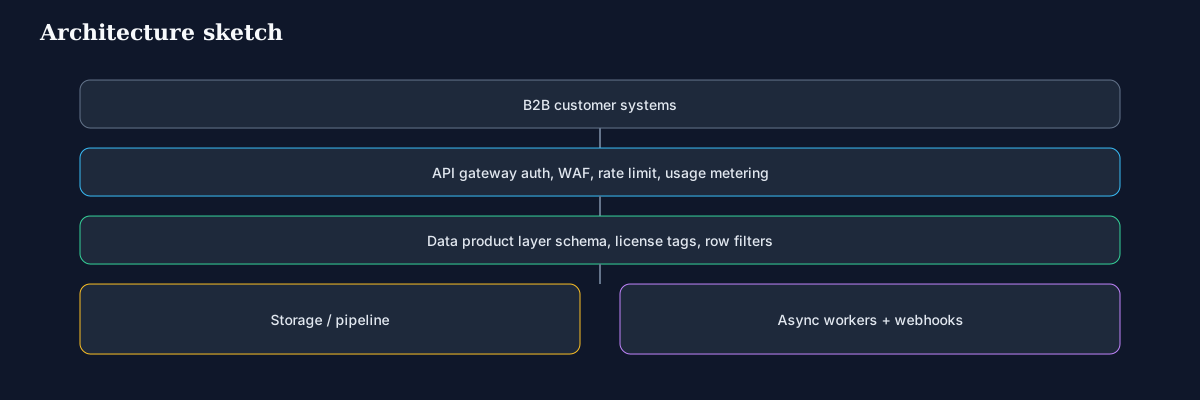 Figure: gateway → product layer → storage / async workers; status page and changelog sit beside OpenAPI.
Status page and public changelog sit beside OpenAPI—buyers check all three before sandbox keys.
Readiness Scorecard
Rate readiness (1 point each):
| Check | Pass? |
|---|---|
/v1 versioning + changelog | |
| Sandbox tenant with synthetic data | |
| Public status page | |
| Metering headers or usage API | |
| DPA template ready | |
| Async path for bulk | |
| Signed webhooks documented | |
| Per-customer rate limits | |
| Support severity definitions | |
| Runbook for Sev-1 data incident |
8–10: enterprise sales ready. 5–7: design partners only. Below 5: connector stage.
21-Day Rollout
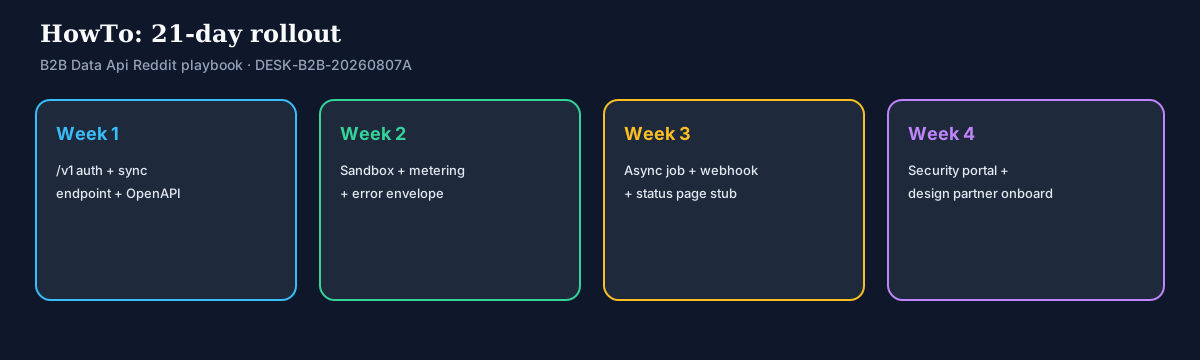 Figure: four-week rollout HowTo (JSON-LD aligned).
HowTo: ship a 21-day rollout
- Week 1 — Auth and sync — Ship
/v1auth, one sync endpoint, and OpenAPI. - Week 2 — Sandbox and metering — Add sandbox tenant, usage metering, and error envelope.
- Week 3 — Async path — Ship async job + signed webhook + status page stub.
- Week 4 — Security portal — Publish security portal doc and run design-partner onboarding.
| Week | Focus |
|---|---|
| 1 | /v1 auth + one sync endpoint + OpenAPI |
| 2 | Sandbox + usage metering + error envelope |
| 3 | Async job + webhook + status page stub |
| 4 | Security portal doc + design partner onboarding |
Do not sign enterprise LOIs before sandbox exists—pilots stall when buyers cannot test without production keys.
DPA and Legal Minimum
Before the first enterprise contract, publish:
- Subprocessor list with 30-day change notification
- Data categories processed (firmographics, transactions, etc.)
- Retention defaults and deletion SLA
- Breach notification timeline
- Cross-border transfer mechanism (SCCs or equivalent)
Legal review parallelizes with engineering—waiting until "we have a customer" compresses timelines and loses deals. Third-party diligence also expects alignment with OWASP API Security Top 10 controls for authentication and object-level authorization, plus logging patterns consistent with the NIST Cybersecurity Framework—link both from your security portal, not only from a blog post.
Onboarding Runbook
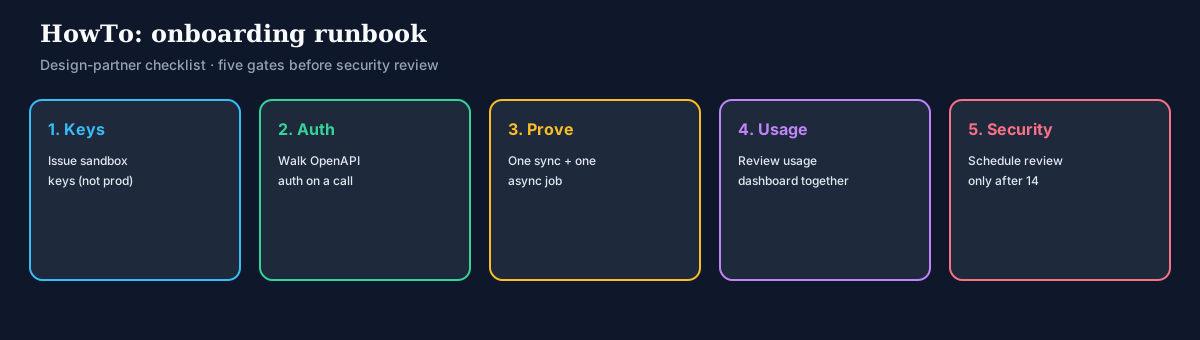 Figure: five-gate onboarding HowTo before infosec review.
HowTo: design-partner onboarding runbook
- Issue sandbox keys — Separate from production; revoke path documented.
- Walk OpenAPI auth — Live call with one auth example.
- Prove both paths — Customer completes one sync lookup and one async job.
- Review usage dashboard — Confirm metering units match observed calls.
- Schedule security review — Only after steps 1–4 pass.
Teams that skip step 3 reopen integration bugs during legal review instead of during sandbox.
Failure Modes
Failure 1: Shared production keys for pilots — leak and no revoke path. Fix: sandbox tenant per prospect.
Failure 2: No metering — cannot align price to usage or detect abuse. Fix: units from day one.
Failure 3: Undocumented breaking changes — churn at renewal. Fix: changelog + deprecation window.
Failure 4: Hung bulk REST — buyer scripts timeout. Fix: async jobs.
Failure 5: Missing subprocessor list — legal blocker at week 8. Fix: publish early, update process.
InfiniSynapse Connection
Commercial data API products that include analytic deliverables—narrated reports, reconciled extracts—can route compute to InfiniSynapse while keeping record API on your gateway. See Data Extraction API for extract patterns. (Commercial CTA context: InfiniSynapse is optional compute; your gateway remains the product surface.)
Case Study: Procurement Win
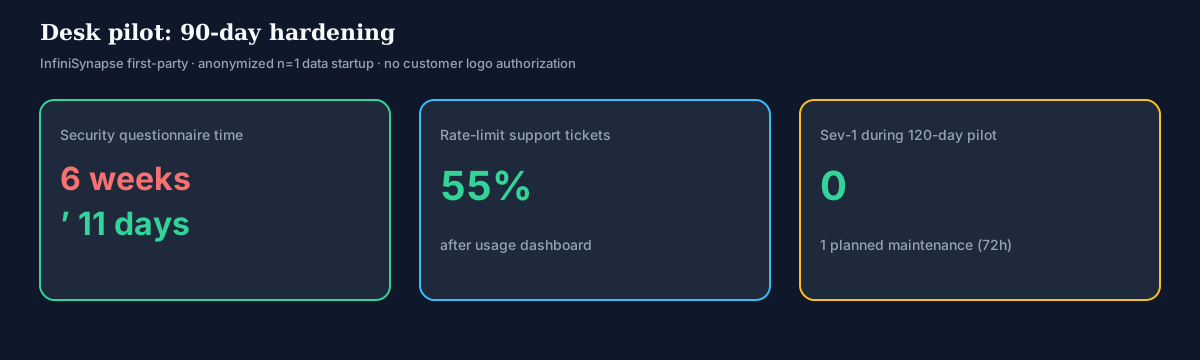 Figure: anonymized InfiniSynapse first-party desk pilot (no customer logo authorization).
Desk composite (InfiniSynapse first-party): anonymized data startup, n=1 org, 90-day hardening then 120-day pilot. Security review previously failed on shared keys and missing DPA—not a named logo case.
90-day hardening:
- Per-tenant keys + sandbox
- Usage API + metering headers
- Async extract with signed webhook
- Published subprocessor list + 99.9% SLA draft
Result:
- Third enterprise pilot converted (first two were redesigns)
- Security questionnaire time: 6 weeks → 11 days
- Support tickets on rate limits: −55% after usage dashboard
- No Sev-1 incidents during 120-day pilot (one planned maintenance with 72h notice)
Methodology appendix: Instruments included security questionnaire calendar dates, Zendesk tags for rate-limit tickets, and Sev-1 incident tracker. Baseline was the two failed procurement cycles before hardening. Treat −55% ticket change as that team's relative drop, not a cross-vendor benchmark. No customer logo or named endorsement is authorized—do not present this as a logo case study. Renewal prep: usage API CSV exports let finance reconcile billed units without support tickets.
Status Page and Incident Comms
Minimum public status components:
- API availability (sync + async ingress)
- Webhook delivery lag (if applicable)
- Scheduled maintenance calendar
- Subscribe-by-email for incidents
During Sev-1, post request_id lookup guidance within 30 minutes—enterprise customers evaluate vendors on communication clarity as much as MTTR.
Usage Dashboard Minimum
Expose to customers:
- Daily usage units by endpoint
- Rate limit headroom
- Async job success/failure counts
- p95 latency trend (7d)
CSV export for finance reconciliation—customers renew when they can audit bills without support tickets.
Pricing Packaging Examples
| Tier | Units/month | Async jobs | Support |
|---|---|---|---|
| Starter | 10k lookups | 10 | |
| Growth | 100k | 100 | Business hours |
| Enterprise | Custom | Unlimited fair use | Named TAM |
Map tiers to rate limit headers so integrators see upgrade paths in 429 payloads with doc links.
Enterprise deals often require custom MSA terms—keep order form exhibits short: data categories, unit definition, SLA pointer, and subprocessor appendix reference.
Contract Test Example
def test_sync_lookup_returns_schema_version(client, api_key):
    resp = client.get("/v1/records/demo_123", headers={"Authorization": api_key})
    assert resp.status_code == 200
    body = resp.json()
    assert "schema_version" in body["meta"]
    assert "X-Usage-Units" in resp.headers
Run against sandbox on every deploy—regressions often appear in headers before body shapes break.
Frequently Asked Questions
When am I a data API vs integration vendor?
If customers pay for your structured data under license—not merely connectivity—you fit the b2b data api reddit bar for commercial delivery.
Minimum team?
One engineer can ship sandbox + /v1 in ~4 weeks; legal review parallelizes DPA.
SFTP vs REST?
Offer what buyers' IT accepts—document one primary; batch manifest required for files.
Pricing?
Unit-based (per lookup/row/job) maps cleanly to metering headers.
Agents as customers?
Same auth and rate limits; agent traffic needs tighter quotas and audit.
Relation to professional data API?
Professional bar is operational maturity; commercial B2B delivery adds contracts, metering, and sandbox—see Professional Data API.
Conclusion
B2b data api reddit is structured data as a business: versioned APIs, SLAs, metering, sandbox, legal artifacts, and async delivery—not connectors alone.
Priority order: /v1 + auth, sandbox, metering, status page, async, DPA portal, then enterprise sales motion. Win trust before scale—procurement remembers the first security call more than your demo UI.
Publish a customer-facing roadmap with deprecation policy; include sample webhook payloads; train support to look up request_id within two minutes; keep a public incidents archive.
Instrument sales-assisted pilots separately from self-serve sandbox signups—conversion metrics differ. Document cold-start latency for the first sandbox call; prospects judge vendors in the first five minutes. Offer a shared Slack or Teams channel during the first 30 days of an enterprise pilot. Log every sandbox-to-production key promotion with a ticket id for SOC-style audits. Track time-to-first-successful-call; prospects who stall more than 48 hours without a 200 rarely convert without human help. Publish sunset policy at least six months before deprecating endpoints.