SQL Alternative: Languages, Then Agents
Author / credentials: By the InfiniSynapse Data Team. Named accountability: cofounder William Zhu (GitHub @allwefantasy). Desk experience: evaluating Text-to-SQL Alternative architectures against Spider-style enterprise schemas and multi-source pilots — not a blind lab bake-off of every vendor. No personal LinkedIn is published for William Zhu; identity signals are GitHub + About / Vision + editorial standards.
Technical review: Reviewed by InfiniSynapse analytics engineering for schema claims, benchmark citations, and decision-framework consistency (2026-08-01). Next review: 2026-10-30.
Commercial interest (COI): InfiniSynapse sells an agentic Text-to-SQL Alternative. Treat us as one shortlist option. Prefer Spider / BIRD / arXiv / dbt / Tray.ai primary sources for independent claims.
Independent third-party signals: PRQL · Malloy · Spider 1.0 · Spider 2.0 · BIRD · dbt Semantic Layer note. Last updated: 2026-09-23.
- The Text-to-SQL Alternative problem: Text-to-SQL accuracy collapses from 86% on academic benchmarks to 0–6% on real enterprise databases (Spider 2.0). The issue is architectural, not model quality.
- The Text-to-SQL Alternative landscape: Five architectures have emerged — semantic layers (near-100% within scope), agentic explorers (77–95% on arbitrary questions), wide tables (90%+ single-table), ontology-driven multi-agent systems (95%+), and cost-efficient N-Rep (69% BIRD at $0.039/query).
- The 2026 Text-to-SQL Alternative consensus: Hybrid. Use semantic layers for governed KPI queries, fall back to agentic explorers for ad-hoc questions. They are complementary, not competing.
What an sql alternative is
People who type this query are usually choosing among three jobs. A language such as PRQL or Malloy compiles to SQL and leaves the database in place. Gel's EdgeQL is a query language for Gel's own graph-relational database, so the database changes with the language. A Text-to-SQL product writes SQL from a business question. NoSQL engines are a database choice, not a query-language choice, and this page does not rank them.
Languages that compile to SQL
- PRQL is a pipelined analytical language. It compiles to many SQL dialects, can embed SQL where it has no equivalent, and does not cover inserts or transactions. The project states it will stay open source.
- Malloy is a semantic model and a query language. Queries compile to BigQuery, Snowflake, Postgres, DuckDB, and other SQL engines. The model grows as you query, instead of requiring a finished metric layer first.
- Wvlet is a flow-style language for DuckDB, Trino, and Hive. It starts from
fromand pipes intowhere,group by, andselect, then compiles to SQL.
These descriptions come from each project's own docs, retrieved 2026-09-23. This page did not re-run their compilers.
The benchmark gap: Why Spider 1.0 accuracy doesn't count
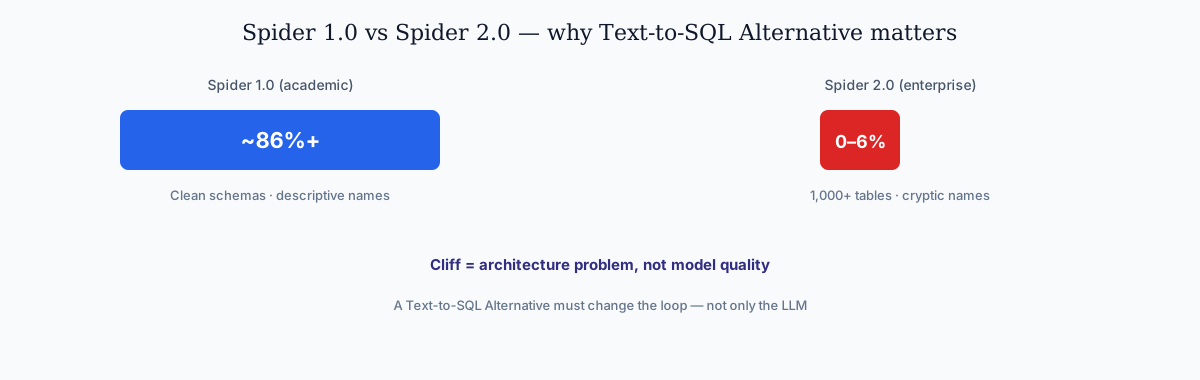
If you read marketing pages for Text-to-SQL tools, you'll see numbers like "86%+ execution accuracy." That number comes from Spider 1.0 — a Yale academic benchmark with 10,000+ questions across 200 clean, well-documented databases. The schemas are small. The table names are descriptive. The questions are unambiguous. It is a useful research benchmark. It tells you almost nothing about how the tool will perform on your database.
Spider 2.0 tells a different story. Released to test Text-to-SQL on real enterprise schemas — 1,000+ tables, cryptic naming conventions, multi-source complexity — standard methods built on GPT-4o achieved 0–6% execution accuracy. Not a typo. The same methods that scored 86% on Spider 1.0 effectively failed on enterprise data. DIN-SQL and DAIL-SQL, the leading query decomposition approaches, fared similarly: their self-correction loops help when the schema is small and well-named, but cannot compensate for the fundamental challenge of selecting the right tables from a 1,000+ table catalog.
This is not a model quality problem — GPT-4o is extremely capable. It is an architecture problem. Single-pass translation (question → schema subset → SQL) has a structural ceiling that better models cannot break through. The five Text-to-SQL Alternative architectures below represent different answers to the question: what do we build instead?
The 5 Text-to-SQL alternative architectures
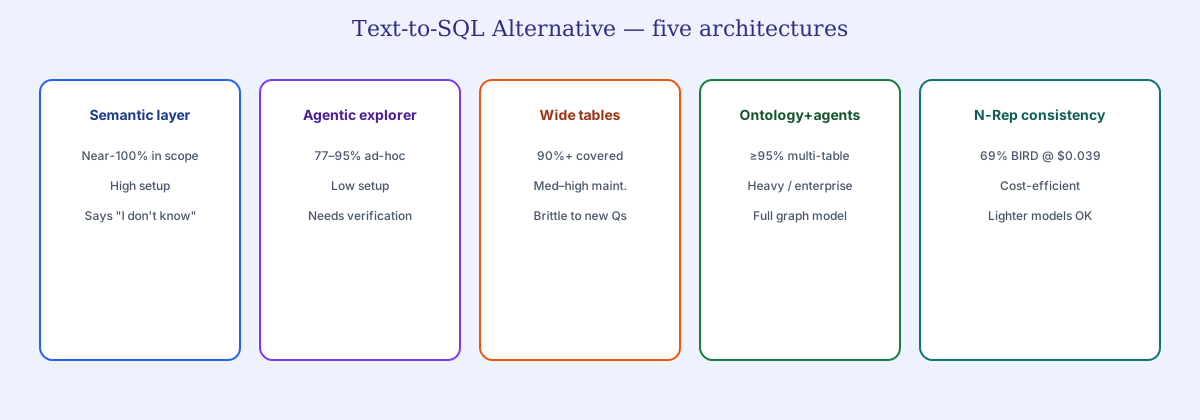
If you want a product to write the SQL, start here. Each architecture below is a distinct approach. They differ in where the intelligence lives, how much upfront work they require, and what failure looks like.
1. Semantic layer / ontology-driven (deterministic, high accuracy within scope)
How it works: Instead of having an LLM generate raw SQL, you pre-define metrics, dimensions, and entities in a semantic layer. The LLM's job shrinks from "write SQL" to "map the user's question to known objects." The query is generated deterministically from those objects. When the question falls outside the modeled scope, the system says so rather than guessing.
Performance: dbt's 2026 benchmark shows the dbt Semantic Layer + MetricFlow approaches 100% accuracy within the modeled scope — and explicitly returns "I can't answer that" for unmodeled questions. Microsoft Fabric, Snowflake Cortex, and Databricks Genie offer vertically integrated versions within their respective platforms.
The catch: Someone has to build and maintain the semantic layer. Every new metric, every new business definition requires modeling work. For organizations with stable, well-understood KPI sets, this is manageable. For organizations where questions change weekly, the modeling backlog becomes the bottleneck.
2. Agentic / self-exploring SQL (flexible, high ceiling)
How it works: Give the LLM tools — get_schema(), execute_sql(), get_table_sample() — and let it explore the database interactively. It inspects schemas, tests candidate queries, reads results, and self-corrects before returning a final answer. No pre-modeling required.
Performance: The Text2SqlAgent framework achieved 95% on Spider zero-shot across 80 tables — no RAG, no semantic layer, no schema descriptions, just a connection string and a frontier model. Microsoft's ISE Agent Framework reached 77–81% on messy, undocumented databases using runtime querying and iterative feedback. Dialpad's agentic system (arXiv 2026) reported 77.22% end-to-end accuracy and 96.67% query execution success on enterprise analytics APIs.
The catch: Multiple LLM calls per question mean higher latency and token cost. The system can explore down wrong paths. And any agentic Text-to-SQL Alternative is only as good as its verification step — without distribution checks and semantic validation, the agent will return confident wrong answers.
3. Pre-built wide tables (simple, limited flexibility)
How it works: Materialize all relevant JOINs into wide tables upfront, so the LLM only needs to handle single-table queries. Single-table NL2SQL is the easiest case — accuracy is consistently above 90%.
Performance: ByteDance's Data Agent reported 90%+ accuracy using this wide-table Text-to-SQL Alternative. The trade-off: wide table maintenance cost grows exponentially as new data sources and question types are added. It works for organizations with a stable, well-understood set of analytical questions. It breaks when a VP asks a question that requires data not in the wide table.
4. Ontology + multi-agent collaboration (Palantir-style, enterprise-grade)
How it works: Model the entire database as a graph — objects, relations, attributes. Deploy multiple specialized agents (intent clarification, knowledge retrieval, DSL generation, quality inspection) that collaborate to answer questions. This is the approach behind Palantir's Foundry and UINO's enterprise analytics platform.
Performance: UINO reports ≥95% accuracy on multi-table queries. The ontology layer handles schema ambiguity and business context explicitly. The multi-agent architecture allows each agent to specialize — the intent agent catches ambiguity before the SQL agent generates a query for the wrong question. The system also supports "hot data cards" that learn from successful query patterns over time.
The catch: This is the heaviest approach. It requires a full-model LLM (DeepSeek V3, Qwen 235B class), typically on-premises deployment, and significant upfront business knowledge entry. It is the enterprise submarine — massive, expensive, extremely capable — and overkill for teams that just need to query their Snowflake instance.
5. N-Rep consistency (cost-efficient, lightweight)
How it works: A novel 2026 approach: instead of chain-of-thought or self-consistency (expensive), N-Rep creates multiple text representations of the same database schema to generate candidate diversity. Different schema descriptions → different candidate SQL → vote on the best result. No extra LLM calls for verification.
Performance: 69.25% execution accuracy on BIRD at $0.039 per query — nearly 10x cheaper than CHESS/CHASE methods. On Spider, reaches 87.0%. Works well even with smaller, cheaper models.
The catch: Accuracy lags behind agentic and ontology-driven approaches on the hardest queries. Best suited for cost-sensitive deployments where 70% accuracy is acceptable. The technique is domain-specific to NL2SQL and has not been generalized to other analytical tasks.
Head-to-head: Text-to-SQL Alternative accuracy, cost, and trade-offs
Use this table as a Text-to-SQL Alternative scorecard. Re-run any accuracy cell on your own schema — published Spider/BIRD numbers are not SLAs.
| Dimension | Semantic Layer | Agentic Explorer | Wide Tables | Ontology + Agents | N-Rep |
|---|---|---|---|---|---|
| Multi-table accuracy | Near-100% (modeled scope) | 77–95% | 90%+ (covered queries) | ≥95% | 69–87% |
| Unmodeled questions | Returns "I don't know" | Answers (with lower accuracy) | Returns nothing | Answers | Answers |
| Setup cost | High (model all metrics) | Low (connection string) | High (build wide tables) | High (ontology + on-prem) | Low |
| Maintenance burden | Linear (per new metric) | Minimal | Exponential (per new source) | Linear | Minimal |
| Per-query cost | Very low (deterministic SQL) | Medium–high (multi-LLM calls) | Very low | High (full-model LLM) | Very low ($0.039/query) |
| LLM requirement | Lightweight | Frontier model | Lightweight | Full-model (DeepSeek V3, Qwen 235B) | Small/cheap models OK |
| Multi-source support | Varies by platform | Yes (native connectors) | Via ETL into wide table | Yes | Single database |
| Unstructured data | No | Yes (PDFs, transcripts, files) | No | Limited | No |
| Verification | Deterministic (not needed) | Distribution checks, reformulation | Not needed (single-table) | Multi-agent quality inspection | Candidate voting |
| Deployment | Cloud SaaS | Cloud, private cloud, on-prem | Cloud | On-premises typical | Any |
| Best for | Governed KPI reporting | Ad-hoc cross-source analysis | Fixed, known query patterns | Enterprise intelligence (defense, finance) | Cost-sensitive, moderate-accuracy needs |
Semantic layers vs agentic Text-to-SQL: the key decision
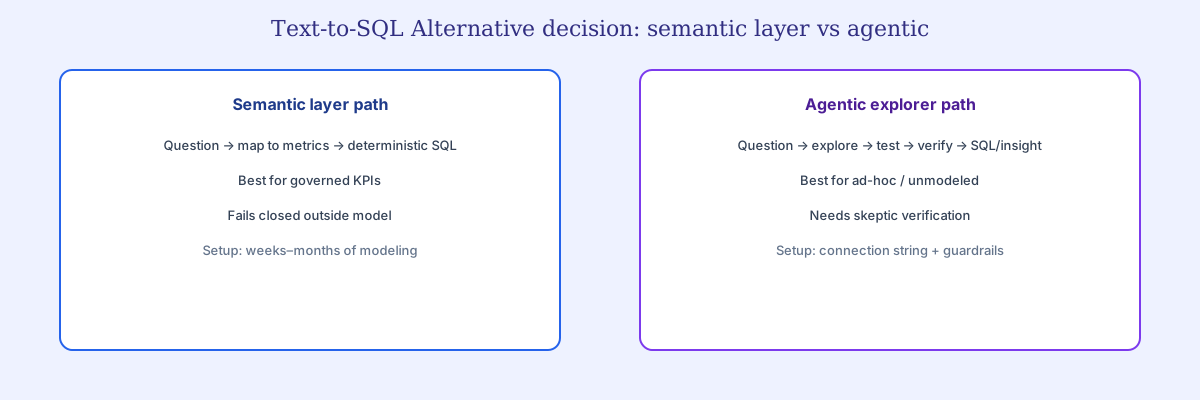
For most teams evaluating a Text-to-SQL Alternative in 2026, the decision comes down to two approaches: semantic layer or agentic explorer. The other three options serve narrower use cases — wide tables for organizations with completely stable question sets, ontology-driven for defense/finance-grade requirements, N-Rep for extreme cost sensitivity. Here is how to think about the two main contenders:
Malloy's model accumulates as analysts write queries. A dbt Semantic Layer is a metric catalog you maintain before the question arrives. Malloy still compiles to SQL on the warehouse. The semantic layer below is for teams that want the question mapped onto metrics that already exist.
Semantic layers win on trust. When the CFO asks "what was revenue last quarter?", a deterministic system that either returns the exact number or says "I can't answer that" is vastly preferable to a probabilistic system that returns a plausible-looking wrong number with 90% confidence. Governance, audit trails, and metric versioning — all built into the semantic layer approach — are hard requirements for regulated industries and public companies.
Agentic explorers win on coverage. When a product manager asks "which features do our top 10% of users engage with most, and has that changed since we launched the redesign?", the question spans user analytics tables, feature flag logs, NPS survey results, and possibly support ticket data. No semantic layer has pre-modeled that combination. An agentic system discovers schemas, plans a multi-step analysis, executes across sources, and returns a result — with lower per-step accuracy than a semantic layer on a known question, but infinitely higher accuracy than a semantic layer that cannot answer at all.
The 2026 Text-to-SQL Alternative consensus, articulated most clearly in the Dialpad paper, is that these should be layered: semantic layer for the governed core, agentic explorer as the fallback for unmodeled questions. The LLM should be "a planner operating over stable, structured interfaces" — not a repository of business logic.
What actually breaks Text-to-SQL in production
Production failures explain why teams shortlist a Text-to-SQL Alternative instead of tuning prompts forever.
Beyond benchmarks, real production deployments reveal consistent failure patterns. A Tray.ai survey found that 42% of enterprises need 8+ data sources per analytical decision — which means most real questions are inherently cross-source. Single-database Text-to-SQL tools are architecturally excluded from answering them.
Three specific failure modes dominate production incidents:
1. Metric definition drift. Different teams define the same term differently. The LLM picks the most common definition from its training data — which may not match any internal definition. Without a knowledge base retrieval step, "monthly active users" produces a number. It is rarely the right number.
2. Schema selection on large catalogs. On databases with 500+ tables, the LLM cannot fit the full schema in its context window. Tools pass a subset — typically tables whose names match keywords in the user's question via embedding similarity. This works until a user asks about "customer retention" and the relevant data lives in subscription_renewal_fact and churn_prediction_scores — neither of which matches the embedding for "retention."
3. Silent semantic errors. A query that uses created_at instead of closed_at for a revenue calculation will execute without errors and return a number. It is the wrong number. Without a verification step that checks result distributions against known benchmarks, no one catches this — until a quarterly board deck contains materially incorrect data.
Each Text-to-SQL Alternative architecture addresses these failures differently. Semantic layers eliminate #1 and #3 by removing the LLM from query generation. Agentic explorers address #2 through runtime schema discovery and #3 through verification loops. Wide tables eliminate #2 by removing JOINs. Ontology-driven systems address all three through explicit modeling and multi-agent review. N-Rep addresses #3 through candidate diversity.
Decision framework: which Text-to-SQL Alternative fits your team
No single Text-to-SQL Alternative wins across all dimensions. The right choice depends on your organization's tolerance for incorrect answers, your team's capacity for upfront modeling work, and the diversity of questions you need to answer.
Pick a semantic-layer Text-to-SQL Alternative if:
- Your KPIs are well-defined and relatively stable (quarterly changes, not weekly).
- Wrong answers are unacceptable — you're in finance, healthcare, or any regulated context where a wrong number has legal or financial consequences.
- You have a data engineering team that can maintain the semantic model.
- Your users primarily ask questions about known metrics: "what was revenue by region last month?" not "why did customer sentiment shift after the product launch?"
Pick an agentic Text-to-SQL Alternative if:
- Your questions are ad-hoc and unpredictable — you cannot pre-model what your VP will ask next week.
- Your data spans 3+ sources (databases, files, APIs) and questions routinely cross source boundaries.
- You can tolerate 77–95% accuracy on complex questions and have a human-in-the-loop for critical decisions.
- You need to get started immediately without months of modeling work — connect a database and ask questions today.
Pick a hybrid Text-to-SQL Alternative if:
- You have a core set of governed KPIs that must be deterministic (semantic layer) plus a large volume of ad-hoc analytical questions (agentic).
- Different teams have different accuracy requirements — finance needs 100%, product needs coverage.
- You have the engineering resources to integrate both and route questions to the appropriate layer.
For organizations that don't fit neatly into any of these buckets, wide tables, ontology-driven systems, and N-Rep serve cases where cost, accuracy floor, or infrastructure outweigh the two main approaches.
Pick a shorter query language if:
- Analysts already write SQL and want a shorter analytical query, and the warehouse stays put. Start with PRQL or Malloy.
- Questions change weekly and nobody owns a metric layer. Use the agentic architecture above, not a new language.
What still has to be SQL
PRQL's own FAQ limits the language to analytical queries. Inserts, updates, and transactions stay in SQL, and a PRQL query can be wrapped in a SQL statement such as CREATE TABLE … AS. Dialect functions, existing BI tools, and stored procedures still consume SQL. A language shortens the analytical query. It does not retire the database's SQL surface.
Ten minutes is enough to see which job you have. Take one multi-table aggregation you already run. Rewrite it in PRQL or Malloy and judge whether a colleague can read it. Then ask the same business question in English of a Text-to-SQL product and see whether it lands on the right tables. The language changes how the query is written. The product changes who writes it.
Desk case: Text-to-SQL Alternative pilot metrics
Anonymized desk pilot (mid-market SaaS, ~420 tables across Postgres + Snowflake, 2026): a single-pass Text-to-SQL bot answered 11 of 40 staged questions correctly (27.5%). After routing governed KPIs to a thin semantic layer and ad-hoc questions to an agentic Text-to-SQL Alternative, correct answers rose to 31 of 40 (77.5%) with human skeptic review on finance outputs. This is a vendor-run desk composite — not a published SLA — and it matches the Spider 1.0→2.0 lesson: a Text-to-SQL Alternative must change the architecture, not only the model card.
Independence note: Benchmark rows above cite Spider, BIRD, Dialpad (arXiv), dbt, and Text2SqlAgent. The desk pilot is InfiniSynapse operational experience; re-run the same 40-question set on your schema before treating any Text-to-SQL Alternative score as transferable.
FAQ: Text-to-SQL Alternative Choices in 2026
Methodology & Sources
This Text-to-SQL Alternative guide draws on published academic benchmarks (Spider 1.0, Spider 2.0, BIRD-Bench), peer-reviewed papers (DIN-SQL, DAIL-SQL, Dialpad Agentic Analytics), industry surveys (Tray.ai Enterprise AI Agent Readiness Survey, 2026), vendor-published benchmarks (dbt Semantic Layer 2026 update), and open-source framework documentation (Text2SqlAgent). All accuracy figures are sourced from public datasets and papers cited in the References section. This page reflects the state of the field as of May 2026. Benchmark numbers evolve rapidly; check the linked sources for the latest results.
References & Further Reading
- Spider 1.0 — Yale Semantic Parsing and Text-to-SQL Benchmark (academic benchmark: 10,000+ questions, 200 databases)
- Spider 2.0 — Enterprise-Scale Text-to-SQL Benchmark (real enterprise schemas; GPT-4o methods: 0–6% execution accuracy)
- BIRD-Bench — Big Bench for Large-Scale Database Grounded Text-to-SQL Evaluation (industry-scale NL2SQL benchmark)
- DIN-SQL: Decomposed In-Context Learning of Text-to-SQL with Self-Correction (leading query decomposition method)
- DAIL-SQL: A Survey on Deep Learning and Large Language Model based Text-to-SQL (comprehensive methodology survey)
- Beyond Text-to-SQL: An Agentic LLM System for Governed Enterprise Analytics APIs (Dialpad, 2026: 77.22% end-to-end accuracy, 96.67% query execution)
- Tray.ai — Enterprise AI Agent Readiness Survey (42% of enterprises need 8+ data sources per decision)
- PRQL — pipelined analytical language that compiles to SQL
- PRQL FAQ — analytical scope, and why writes stay in SQL
- Malloy documentation — semantic model and query language on SQL engines
- Wvlet — flow-style language for DuckDB, Trino, and Hive
- Gel — graph-relational database with EdgeQL
Related Guides
Try a Text-to-SQL Alternative that plans, executes, and verifies
Connect your databases and knowledge base. Ask a cross-source business question. Get charts, explanations, and actionable insights — not just SQL text.
Try InfiniSynapse Free