
Healthcare Data Integration: quick answer医疗数据集成:快速回答
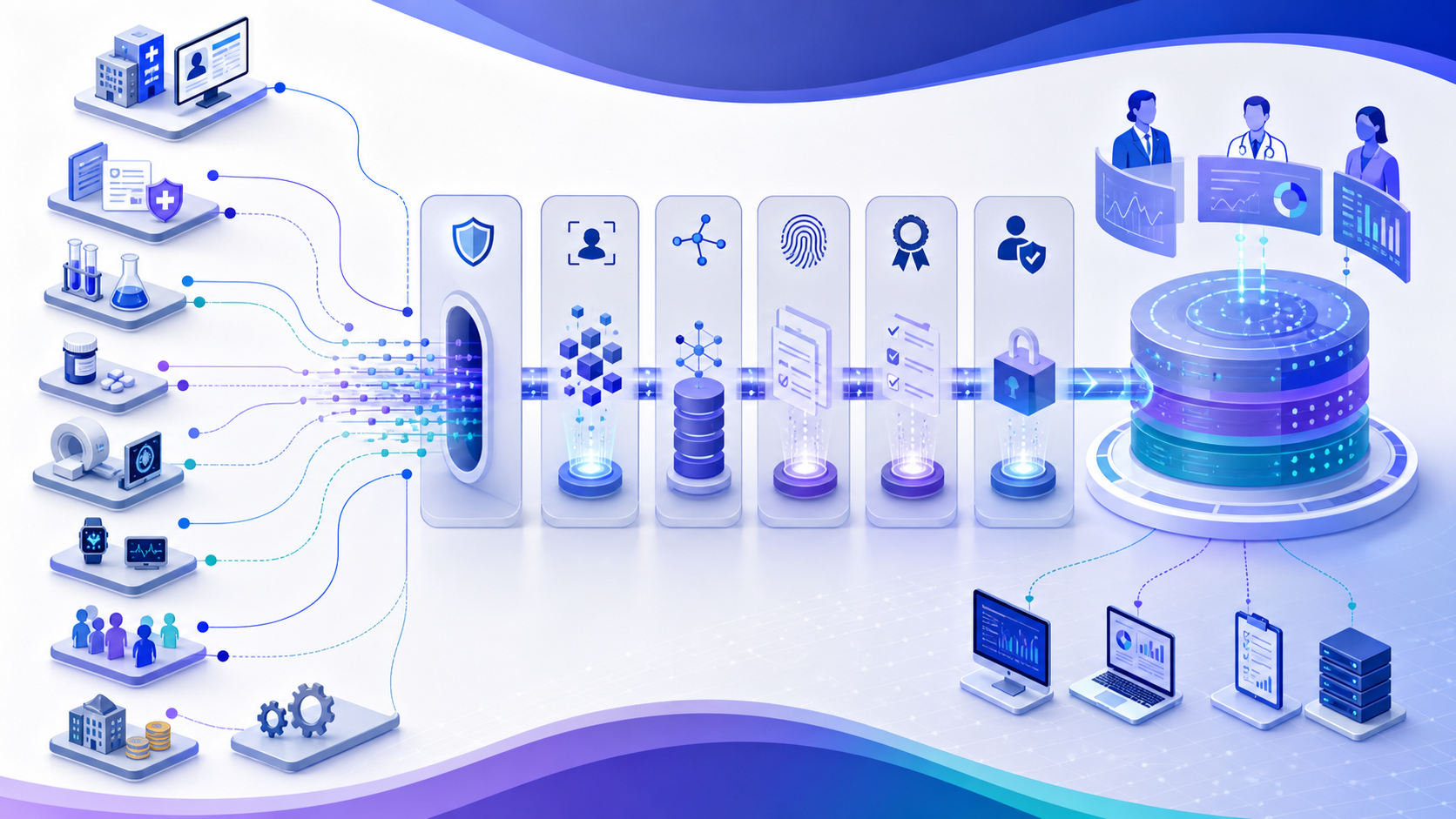
Healthcare data integration is the enterprise layer across clinical, administrative, financial, and consumer systems. Clinical data integration is narrower: it prioritizes semantic fidelity and usability inside direct care and clinical review workflows.
医疗数据集成连接电子病历、理赔、检验、药房、影像、设备、登记、财务、人力和运营等企业级系统。相关资料应保留来源、时间和待确认问题,诊断或治疗判断仍由医疗专业人员负责。
Where healthcare data integration fits医疗数据集成的适用范围
Healthcare enterprise architects, integration engineers, data-platform teams, governance leads, and vendors use healthcare data integration to connect cross-organizational healthcare data through governed transport, identity, terminology, lineage, quality, and access controls. The working evidence includes EHR, claims, laboratory, pharmacy, imaging, device, registry, financial, and operational feeds plus identity and terminology services. These boundaries determine what a useful output must contain and which conclusions require professional review.
医疗数据集成由相应临床、数据、信息管理和治理人员共同参与。相关资料需组织成可追溯、可复核的结果,并明确数据边界、不确定性、待确认问题与最终责任人。
Healthcare enterprise architects, integration engineers, data-platform teams, governance leads, and vendors.
应由具有相应职责和专业范围的人员完成最终解释与确认。
Connect cross-organizational healthcare data through governed transport, identity, terminology, lineage, quality, and access controls.
输出应保留来源、时间、不确定性、待确认问题和处置责任。
Evidence model for healthcare data integration医疗数据集成所需证据模型
Healthcare data integration connects an enterprise portfolio of EHR, claims, laboratory, pharmacy, imaging, device, registry, finance, workforce, and operational systems. The evidence model must describe interfaces, payloads, identity domains, organizational hierarchies, event and receipt time, terminology services, master data, lineage, consent or authorization, retention, and correction behavior. A successful transport is not sufficient: the receiving platform must know what the event means, which version it represents, and where it came from.
医疗数据集成连接电子病历、理赔、检验、药房、影像、设备、登记、财务、人力和运营等企业级系统。证据模型应描述接口、载荷、身份域、组织层级、事件与接收时间、术语服务、主数据、血缘、同意或授权、保留和纠错行为。仅传输成功并不够;接收平台必须知道事件含义、所代表的版本以及来源。
How to carry out healthcare data integration如何执行医疗数据集成
- Step 1. Inventory source and consuming systems with owners, purpose, coverage, and criticality.
- Step 2. Define a data contract for identity, events, status, codes, units, updates, deletions, and provenance.
- Step 3. Implement transport and terminology mapping while preserving raw payloads and source identifiers.
- Step 4. Reconcile counts, identities, late events, corrections, and semantic exceptions across boundaries.
- Step 5. Operate the integration with monitoring, access review, change control, incident response, and replay capability.
- 第 1 步。盘点来源和消费系统,记录责任人、目的、覆盖与关键程度。
- 第 2 步。为身份、事件、状态、编码、单位、更新、删除和来源定义数据合同。
- 第 3 步。实施传输和术语映射,同时保留原始载荷与来源标识。
- 第 4 步。跨边界核对数量、身份、延迟事件、纠错和语义例外。
- 第 5 步。通过监控、访问复核、变更控制、事件响应和重放能力持续运行集成。
Working note 1. Begin by making the first action operational: inventory source and consuming systems with owners, purpose, coverage, and criticality. Name the person who can confirm scope, the time cutoff, the source systems that count, and the conditions that place a record outside the enterprise health-data review. For healthcare data integration, a clear entry rule prevents a convenient dataset from silently replacing the intended population or clinical question. Preserve rejected records with a reason code so receiving professionals can distinguish a deliberate exclusion from a missing or failed import.
Working note 2. The second action is evidence control: define a data contract for identity, events, status, codes, units, updates, deletions, and provenance. Register when each item happened, when it became available, who entered or supplied it, whether it is preliminary or final, and how corrections are represented. The relevant material may include EHR, claims, laboratory, pharmacy, imaging, device, registry, financial, and operational feeds plus identity and terminology services. Do not collapse two values merely because their labels look alike. A reviewer must be able to return from a normalized field to the original record and understand every transformation in between.
Working note 3. At the third action, implement transport and terminology mapping while preserving raw payloads and source identifiers. Specify the expected intermediate artifact before processing starts: a compared list, time-aligned cohort, mapped event, scored observation, or another output appropriate to healthcare data integration. Carry forward conflicts and uncertainty visible. When a source is incomplete, the process must say whether the item is excluded, retained with a flag, estimated under a declared rule, or sent for clarification; silent imputation can make a clean result clinically misleading.
Working note 4. The fourth action requires contextual interpretation: reconcile counts, identities, late events, corrections, and semantic exceptions across boundaries. Separate what the records directly show from what the multidisciplinary group infers, and record plausible alternative explanations. The objective is to connect cross-organizational healthcare data through governed transport, identity, terminology, lineage, quality, and access controls, not to convert a pattern into an unsupported diagnosis, causal claim, or treatment instruction. Reviewers must see the denominator, comparison point, timing assumptions, and exceptions that could change the meaning of the resulting record before any operational or clinical response is considered.
Working note 5. Close the cycle through the fifth action: operate the integration with monitoring, access review, change control, incident response, and replay capability. Assign every unresolved item to a named role, define the response time, and record the final disposition without deleting the earlier state. The handoff must include the source cutoff, version, material exceptions, validation status, and next review date. This makes healthcare data integration reproducible when another qualified member of healthcare enterprise architects, integration engineers, data-platform teams, governance leads, and vendors needs to reconstruct why the resulting record was accepted, challenged, corrected, or left unresolved.
执行说明 1。首先把第一项行动落实为可执行规则:盘点来源和消费系统,记录责任人、目的、覆盖与关键程度。需要明确谁有权确认范围、资料截止时间、哪些来源有效,以及什么条件会让记录不进入复核。对于医疗数据集成,清晰的入口规则可以防止方便取得的数据悄然替代真正的人群或临床问题。被排除的记录仍应保留原因代码,使复核者能够区分主动排除、资料缺失和导入失败。
执行说明 2。第二项行动关注证据控制:为身份、事件、状态、编码、单位、更新、删除和来源定义数据合同。每项资料都要记录事件发生时间、可用时间、录入或提供者、初步或最终状态,以及修订如何表示。相关资料必须覆盖医疗数据集成所需的来源、时间、状态、编码、单位和上下文。不能因为标签相似就合并两个数值;复核者应能从规范化字段回到原始记录,并理解中间每一步转换。
执行说明 3。第三项行动是实施传输和术语映射,同时保留原始载荷与来源标识。处理开始前,应先定义符合医疗数据集成需要的中间成果,例如对照清单、时间对齐人群、映射事件或带来源的观察结果。冲突和不确定性必须可见。来源不完整时,流程应说明是排除、带标记保留、按已声明规则估计,还是转交确认;静默填补可能让整洁结果产生错误临床含义。
执行说明 4。第四项行动要求结合背景解释:跨边界核对数量、身份、延迟事件、纠错和语义例外。应区分记录直接显示的事实和团队作出的推断,并保留其他合理解释。目标是支持医疗数据集成所界定的资料整理、分析和复核任务,而不是把模式直接写成未经支持的诊断、因果结论或治疗指令。在采取运营或临床响应前,复核者需要看到分母、比较点、时间假设和可能改变结论的例外。
执行说明 5。第五项行动用于闭环:通过监控、访问复核、变更控制、事件响应和重放能力持续运行集成。每个未解决项目都要分配给明确角色,规定响应时间,并在不删除先前状态的情况下记录最终处置。交接材料应包含来源截止时间、版本、重要例外、验证状态和下次复核日期,使另一位合格人员能够重建为何结果被接受、质疑、纠正或继续保持未解决。
Review gates for healthcare data integration医疗数据集成复核关口
| Review gate复核关口 | Topic-specific question本主题问题 | Expected evidence预期证据 |
|---|---|---|
| Identity and scope身份与范围 | Does the record match the intended people, setting, and time window for healthcare data integration?记录是否符合医疗数据集成所需的人群、场景和时间范围? | Source register and dated inclusion rules来源登记与带日期的纳入规则 |
| Meaning含义 | Can the team distinguish the evidence needed to connect cross-organizational healthcare data through governed transport, identity, terminology, lineage, quality, and access controls?团队能否区分完成本主题任务所需的不同证据? | Field definitions, status, provenance, and sampled source records字段定义、状态、来源和抽样原始记录 |
| Professional review专业复核 | Are uncertainty, exceptions, and the accountable reviewer visible?不确定性、例外和责任复核者是否清晰? | Review note, disposition, and unresolved-question list复核记录、处置意见和待确认问题清单 |
| Acceptance验收 | Do the topic-specific measures show that the workflow is usable and reproducible?本主题指标能否证明流程可用且可复现? | Versioned result, validation sample, and correction log版本化结果、验证样本和纠错日志 |
Validation and operating measures for healthcare data integration医疗数据集成的验证与运行指标
Monitor interface availability, message rejection, latency, duplicate events, unmatched identities, terminology failures, unit anomalies, correction propagation, and consumer reconciliation. Validate with end-to-end test cases that begin in the source and finish in each critical use case. Compare source and destination counts by event type and time, then inspect sampled records for meaning. Recovery tests should prove that teams can replay a bounded period without duplicating or losing downstream state.
应监测接口可用性、消息拒绝、延迟、重复事件、身份未匹配、术语失败、单位异常、纠错传播和消费方核对情况。端到端测试应从来源开始并覆盖每个关键使用场景;按事件类型和时间比较源端与目标端数量,再抽样检查含义。恢复测试还应证明团队能够重放限定时间段,而不会重复或丢失下游状态。
A worked healthcare data integration scenario医疗数据集成工作示例
A health system creates a longitudinal dataset from EHR, laboratory, pharmacy, and claims feeds. The integration records source identifiers, effective times, mapping versions, consent constraints, and unresolved identity conflicts. This is a hypothetical workflow example, not an individual clinical recommendation or a product-performance claim.
假设示例:某健康系统连接电子病历、实验室和理赔数据。团队发现实验室修订结果会以新消息到达,而理赔撤销采用不同机制,因此分别定义版本和删除规则,并保留来源标识。上线验收不仅检查接口返回成功,还从源系统抽样追踪到分析层,确认身份、单位、状态和纠错都正确传播。该示例只说明工作流,不构成个体化临床建议或产品效果声明。
Interpret healthcare data integration without losing context在不丢失背景的情况下解释医疗数据集成
Design for change rather than a one-time migration. Source systems alter fields, code sets, workflow states, and correction patterns; organizations merge and facilities move; records arrive late or out of order. Version contracts and mappings, quarantine records that violate critical expectations, and give consumers a way to distinguish preliminary, corrected, deleted, and final data. Keep raw and normalized representations so an error can be traced and replayed after correction.
集成应面向持续变化设计,而不是一次性迁移。来源系统会改变字段、编码、工作流状态和纠错方式,机构会合并、科室会调整,记录也可能延迟或乱序到达。应对合同和映射进行版本管理,隔离违反关键预期的记录,让消费方能够区分初步、修订、删除和最终数据,并同时保留原始与规范化表示,以便追踪错误并在修正后重放。
Failure modes and limits of healthcare data integration医疗数据集成的失败模式与限制
Integration cannot make incompatible concepts equivalent by renaming fields. Enterprise identity matching can create severe harm through false merges or split histories. A warehouse may be current for one feed and stale for another, and broad access can exceed the minimum necessary purpose. Separate transport success from semantic fitness, require manual review for ambiguous identity matches, and do not assume an integrated dataset is suitable for clinical use without use-case-specific validation.
集成不能通过重命名字段就让不兼容概念等价。企业身份匹配中的错误合并或历史拆分可能造成严重后果;数据仓库也可能对某个来源最新、对另一个来源滞后,广泛访问还可能超过最小必要目的。必须区分传输成功与语义适用,对身份歧义进行人工复核,并且未经特定用途验证不能假设集成数据适合临床使用。
Organized records and tool output support trend recognition and professional decisions. Drug interactions, risk predictions, diagnoses, and treatment conclusions require qualified medical review.
整理后的资料和工具输出仅用于趋势识别和专业决策辅助。药物相互作用、风险预测、诊断与治疗结论必须由合格医疗专业人员审核。
Operate healthcare data integration as a controlled workflow把医疗数据集成作为受控工作流运行
Turn healthcare data integration into a written operating brief before configuring a dashboard, rule, model, or review queue. Name the intended users—healthcare enterprise architects, integration engineers, data-platform teams, governance leads, and vendors—and state the decision, time available, acceptable uncertainty, and consequence of a delayed or incorrect result. The brief must use the bounded objective to connect cross-organizational healthcare data through governed transport, identity, terminology, lineage, quality, and access controls. Requests such as “show insights” or “find risk” are not testable until the population, event, time window, owner, and permitted action are explicit.
Create a source register for EHR, claims, laboratory, pharmacy, imaging, device, registry, financial, and operational feeds plus identity and terminology services. For every source, document its steward, collection process, event time, availability time, status model, code or unit system, revision behavior, coverage, and known gaps. Then connect the first two workflow actions—inventory source and consuming systems with owners, purpose, coverage, and criticality and define a data contract for identity, events, status, codes, units, updates, deletions, and provenance—to named fields and documents. This prevents a familiar label from being treated as equivalent across systems when the underlying event or meaning is different.
Build test records before full use of healthcare data integration. Include ordinary cases, missing fields, duplicate identities, conflicting sources, late events, corrected values, unusual but valid states, and records that must not enter the process. Use the middle action, implement transport and terminology mapping while preserving raw payloads and source identifiers, to define expected results for each case. Carry forward the expected professional explanation beside the technical expectation so a passing transformation does not conceal an interpretation error.
Separate technical acceptance from domain acceptance. Technical review shows that inputs arrive, mappings run, calculations reproduce, permissions work, and failures are visible. Domain review asks whether the information has the correct meaning for healthcare data integration, reaches the intended professional at the right moment, and supports a safe response. The later workflow actions—reconcile counts, identities, late events, corrections, and semantic exceptions across boundaries and operate the integration with monitoring, access review, change control, incident response, and replay capability—must be demonstrated in the real interface rather than inferred from a data extract.
Specify correction, escalation, and change control before launch. Users need a route to challenge a result, repair a source or mapping, annotate an exception, and determine which prior outputs are affected. Version the source contract, terminology, logic, thresholds, display, and review policy. When any material element changes, compare new and previous results on representative records, decide whether earlier healthcare data integration outputs remain valid, and document who approved the release and who can roll it back.
The final healthcare data integration handoff must let another qualified reviewer understand and reproduce the resulting record without relying on undocumented team knowledge. Include the purpose, inclusion rules, source inventory, data cutoff, original evidence links, transformations, workflow state, exceptions, validation results, reviewer disposition, and unresolved questions. Add the specific evidence used to connect cross-organizational healthcare data through governed transport, identity, terminology, lineage, quality, and access controls, identify which statements are observed versus inferred, and state the next review date. Sensitive details must remain only in approved systems with role-appropriate access and retention.
在配置仪表板、规则、模型或复核队列前,应先把医疗数据集成写成运行说明。明确目标用户、支持的决策、可用时间、可接受不确定性,以及延迟或错误结果的后果。说明中必须写清人群、事件、时间窗口、责任人和允许采取的行动;“寻找洞察”或“发现风险”等宽泛要求无法直接测试和验收。
针对医疗数据集成所需资料建立来源登记表。每个来源都应记录数据责任人、采集过程、事件时间、可用时间、状态模型、编码或单位体系、修订方式、覆盖范围和已知缺口。随后把前两个工作步骤——盘点来源和消费系统,记录责任人、目的、覆盖与关键程度和为身份、事件、状态、编码、单位、更新、删除和来源定义数据合同——落实到具体字段和文档,防止把名称相似但事件含义不同的数据直接视为等价。
全面使用医疗数据集成前应建立测试记录,覆盖普通情况、字段缺失、身份重复、来源冲突、事件延迟、数值修订、少见但有效的状态,以及本来不应进入流程的记录。围绕“实施传输和术语映射,同时保留原始载荷与来源标识”为每个测试病例写出预期结果,并把专业解释与技术预期放在一起,避免技术转换通过却隐藏解释错误。
技术验收和领域验收必须分开。技术复核证明输入到达、映射运行、计算可复现、权限有效且失败可见;领域复核则确认信息对医疗数据集成含义正确、在合适时间到达目标专业人员并支持安全响应。后两个步骤——跨边界核对数量、身份、延迟事件、纠错和语义例外和通过监控、访问复核、变更控制、事件响应和重放能力持续运行集成——应在真实界面和工作流中演示,不能只从数据抽取结果推断。
上线前定义纠错、升级和变更控制。使用者需要能够质疑结果、修复来源或映射、标注例外,并判断哪些既往输出受到影响。来源合同、术语、逻辑、阈值、显示和复核制度都应进行版本管理;任何重大变化后,都要在代表性记录上比较新旧结果,判断既往医疗数据集成输出是否仍有效,并记录批准者和回滚责任人。
最终医疗数据集成交接包应让另一位合格复核者无需依赖团队未记录的知识,就能理解并复现结果。材料应包含目的、纳入规则、来源清单、数据截止时间、原始证据链接、转换过程、工作流状态、例外、验证结果、复核处置和待确认问题;还要区分观察与推断、说明下次复核日期,并把敏感详情限制在具有适当访问和保留控制的获批系统中。
Prepare healthcare data integration evidence with 医数智析用医数智析准备医疗数据集成资料
Before opening the workspace, prepare EHR, claims, laboratory, pharmacy, imaging, device, registry, financial, and operational feeds plus identity and terminology services. 医数智析 can help organize those materials into a longitudinal record, expose missing or conflicting entries, and make cross-time patterns available for professional review. Final clinical interpretation remains with qualified professionals.
打开工作区前,请准备与医疗数据集成直接相关的原始资料、日期和来源。医数智析可帮助整理纵向记录、暴露缺失或冲突,并把跨时间变化呈现给专业人员复核;最终临床解释仍由合格专业人员负责。
View the 医数智析 tool page查看医数智析工具页 Open the live experience打开实际体验页Healthcare Data Integration questions医疗数据集成常见问题
No. Integration also requires identity matching, semantic mapping, provenance, time alignment, quality checks, access control, and a process for corrections and late-arriving data.
医疗数据集成覆盖临床、运营、理赔、财务和其他企业系统;临床数据集成更强调直接照护工作流中的临床语义、时间和状态。
Define event meaning, identifiers, timestamps, status, codes, units, corrections, deletions, expected volume, latency, provenance, security, and ownership.
应定义事件含义、标识、时间戳、状态、编码、单位、纠错、删除、预期数据量、延迟、来源、安全和责任。
Retain event and receipt times, define allowed lateness, update affected outputs deterministically, and record which downstream results were recalculated.
应保留事件时间和接收时间,定义允许延迟,按确定规则更新受影响输出,并记录哪些下游结果被重新计算。
Primary source for healthcare data integration医疗数据集成的主要参考来源
Use the cited primary or official source together with current organizational policy and the professional standards that apply in the intended setting.
实施时应把下列第一方或权威来源与当前机构制度及适用专业标准结合使用。