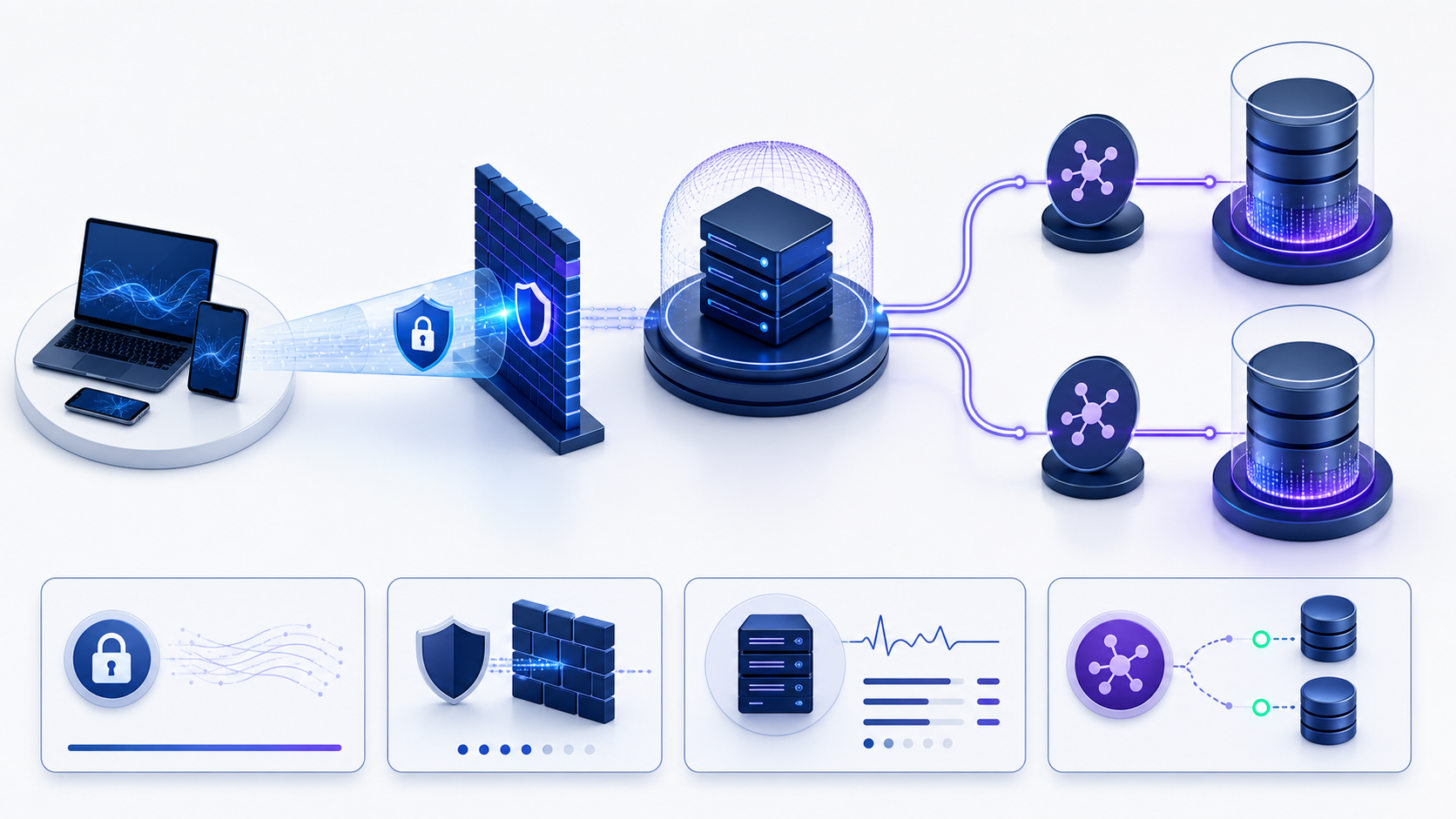
What does port 1521 mean?
Port 1521 is the default TCP port commonly used by an Oracle Net listener. Opening it does not prove service registration or login. A usable session still needs the correct connect descriptor, a registered service, and identity. A green TCP test only shows that something accepted the transport.
Troubleshoot from the client context that actually fails. Record time, source network, endpoint, driver and version, sanitized effective configuration, exact error, first failing stage and recent changes. Do not paste passwords, tokens, private keys or complete production connection strings into tickets or public tools.
Trace Oracle Net beyond port 1521
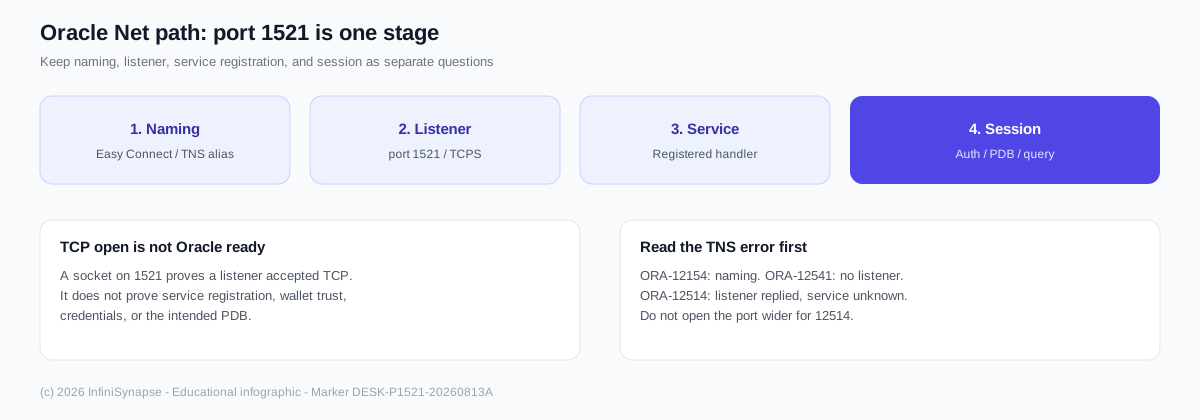
Port 1521 is commonly associated with an Oracle Net listener, but the listener is a broker rather than the database service itself. A client first resolves a connect descriptor, reaches a listener address, and requests a service. The listener then determines whether that service is registered and hands the connection to an appropriate database handler. A green TCP test—see Test-NetConnection for the socket stage—proves only that something accepted the transport; it does not prove that the requested service name exists, has a ready handler or can authenticate the user. Layer the rest of the path with the database connection model.
Document the complete connect descriptor as separate fields: protocol, host, port, service name, optional server mode and any failover addresses. Do not reduce it to “1521 is open.” Two applications can reach the same listener while requesting different services, using different naming sources or resolving the host to different SCAN addresses. Preserve the exact TNS error and the descriptor after secrets are removed.
| Oracle Net layer | Question to answer | Evidence |
|---|---|---|
| Naming | Which descriptor did the client actually resolve? | Easy Connect string, TNS alias resolution and active configuration directory. |
| Listener | Is the requested address accepting Oracle Net traffic? | Listener status, bound addresses and listener log. |
| Service registration | Does the listener know the requested service and a ready handler? | Registered services, instance status and registration timing. |
| Database session | Can the intended identity enter the intended pluggable database and perform the operation? | Authentication result, service context, role and bounded query. |
Desk lab: two sanitized Oracle Net packets
These notes are sanitized composites from InfiniSynapse engineer reviews of authorized Oracle tickets in 2026 H1 (marker DESK-P1521-20260814A). Hosts and services are masked. They are first-hand reading notes, not audited customer SLAs. Re-run on your approved path before changing production controls.
Case A: TCP on port 1521 succeeded, login still failed
A jump host reached the listener. TcpTestSucceeded was True. The application still returned ORA-12514 because the Easy Connect string requested prod.example while the listener had registered prod_pdb1.example. Opening the firewall would not have helped. The fix was the service name, confirmed with a bounded SELECT SYS_CONTEXT('USERENV','SERVICE_NAME') FROM dual after the correct descriptor.
Case B: ORA-12154 before any listener test
A laptop used a TNS alias that resolved against a different tnsnames.ora than the application service account. Teams spent a change window on security groups. The first evidence should have been the active naming method. Official ORA-12154 guidance matches this order.
Visual path: naming, listener, service, session
Use this infographic with the layer table. There is no hosted walkthrough video on this page. The diagrams plus the six-gate HowTo are the multimodal evidence. Official error pages remain the authoritative walkthroughs: ORA-12154, TNS-12514, TNS-12541.

Desk composite: where first failure sat (n=18)
We reviewed 18 sanitized Oracle Net packets. Raters were InfiniSynapse engineers. Percentages are decision aids, not vendor performance claims.
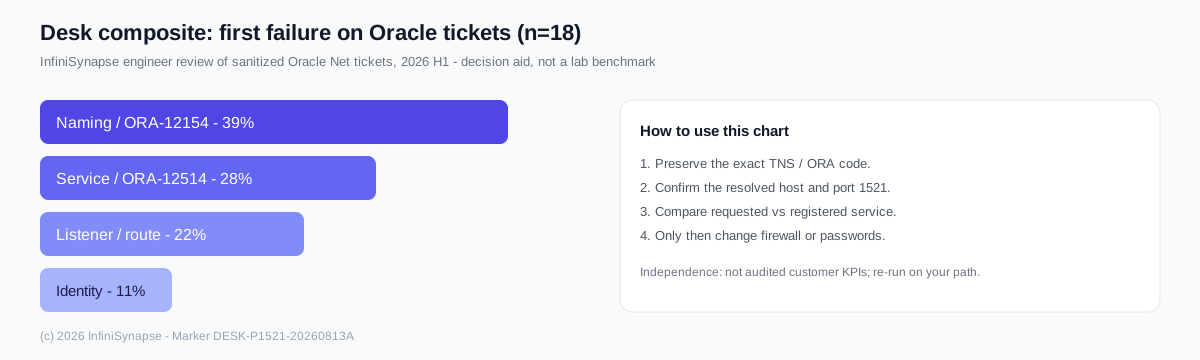
Independence: InfiniSynapse also sells analysis software. This desk composite does not depend on using the DB Compatibility Checker. Educational diagnosis can stop at listener and service evidence.
Independent benchmarks for listener exposure
Desk percentages above are first-party composites from port 1521 tickets. For independent authority, use published control catalogs—not invented market-share numbers.
- IANA registers
ncube-lm/ TCP 1521. Registration does not prove your listener uses that port, and it is not a license to publish it on the internet. - The CIS Oracle Database Benchmark is a third-party hardening catalog. Treat an internet-facing listener as a control exception that needs an owner, not as a default.
- NIST SP 800-53 Rev. 5 control SC-7 (Boundary Protection) expects database listeners to sit behind a defined boundary. A green TCP test from the public internet is usually a failed control, not a successful health check.
- Concept background: Wikipedia: Oracle Net. Prefer Oracle’s own Net Services guides for operational steps.
These sources do not publish a “percent of Oracle outages caused by listener exposure.” Use them to decide exposure policy; use the desk packet to decide which layer failed first.
Glossary of Oracle Net terms
Cross-links stay on this page so each term maps to the section that defines how port 1521 actually fails.
- port 1521
- Default TCP port commonly used by an Oracle Net listener. Opening it does not prove service registration or login.
- Oracle Net listener
- A broker that accepts client requests and hands them to a registered database service handler.
- Service name
- Logical database service that one or more instances can offer. Distinct from an SID.
- SID
- Identifier for a particular instance. Reaching port 1521 does not select an SID for you.
- SCAN
- Single Client Access Name. Can resolve to several addresses; one success does not prove every path.
- ORA-12154
- The client could not resolve the connect identifier. Collect naming evidence first.
- ORA-12514 / TNS-12514
- A listener answered but did not know the requested service.
- ORA-12541 / TNS-12541
- No listener answered at the resolved host and port.
- TCPS
- Encrypted Oracle Net. Confirm the secure listener port; do not assume it uses the default TCP port.
Distinguish Oracle service names from SIDs
A service name identifies a logical database service that can be offered by one or more instances; an SID identifies a particular instance. Reaching port 1521 does not choose the service for you. Modern application connections generally target a service because services support workload placement, pluggable databases and failover more naturally. Treating a service name as an SID—or copying a legacy descriptor without understanding its syntax—can reach the listener yet request the wrong registration target.
Confirm the expected service with the database owner and compare it with the service list visible to the listener. In multitenant environments, verify that the service maps to the intended PDB rather than the container root. During migrations, preserve service semantics even when the host or instance changes; otherwise applications may appear connected while entering a different database context. Validate with a harmless query that reports database and service context, not just a login banner.
Safe handoff format: record host class, port, service name, naming method, client version and wallet/trust configuration separately. Redact passwords and private wallet material; do not paste a complete production connect descriptor into a public analyzer.
Let the TNS error identify the failing layer
Oracle Net errors are most useful when preserved exactly. ORA-12154 indicates that the client could not resolve the supplied connect identifier, so changing a firewall is premature. ORA-12541 means no listener answered at the resolved address, which directs attention to host, port, listener state and route. ORA-12514 means a listener answered but did not currently know the requested service; this moves the investigation to service spelling, dynamic registration and instance state.
| Error | First evidence to collect | Do not start with |
|---|---|---|
| ORA-12154 | The naming method, alias, active tnsnames.ora location and resolved descriptor. | Changing listener registration; the client has not located it. See ORA-12154. |
| ORA-12541 | Resolved host/port, listener process, bound interface and network policy. | Resetting the database password. See TNS-12541. |
| ORA-12514 | Requested service versus currently registered services and handler status. | Opening the listener port more broadly; the listener already replied. See TNS-12514. |
| ORA-01017 | Identity, secret delivery, case behavior, account status and target service. | Reconfiguring DNS. |
Test port 1521 across RAC and SCAN paths
In Oracle RAC, a SCAN name can resolve to multiple addresses and direct clients to SCAN listeners that route sessions to local listeners. One successful address does not prove that every advertised path works. Test repeated fresh resolutions and connections from the real application network, retain which address was selected, and correlate failures with listener and service registration state. DNS caching, address-family preference and firewall asymmetry can make failures intermittent.
A failover test must verify service continuity rather than transport alone. Confirm how the driver receives alternate addresses, how quickly dead connections are detected, whether in-flight work is retried safely and whether the new session lands on a service that permits the required transaction. Use bounded retries with jitter, protect non-idempotent operations, and monitor reconnect volume so an instance loss does not become a connection storm.
If encrypted Oracle Net uses TCPS, confirm the actual secure listener port rather than assuming port 1521. Validate wallet location, trust chain, server identity and certificate renewal with the deployed client runtime. Keep TCP and TCPS test results separate because success on one protocol says nothing about the other.
Prove an Oracle service path, not only port 1521
The acceptance record should connect the client-side descriptor to listener and database evidence. Capture the naming method, resolved descriptor, selected listener address, requested service, client version and exact connection time. On the server side, correlate the attempt with listener registration and service status. After login, use an approved read-only check to confirm database identity, service context, instance and container or PDB. This prevents a successful connection to the wrong service from being reported as a fix.
For RAC or multi-address descriptors, run enough fresh attempts to exercise each advertised path and retain the chosen address. Add a controlled service relocation or instance stop in a safe environment, then measure detection, reconnection and transaction behavior. State whether TCPS, wallet rotation, application continuity features and write transactions were included. The final sign-off should name the tested client artifact and driver version because an SQL client on an administrator host is not equivalent to the production application runtime.
Retain the listener and database timestamps in the same timezone so teams can correlate one client attempt across logs. If clocks differ, note the offset rather than guessing. This small discipline is especially important when registration changes rapidly during startup or failover.
A repeatable port 1521 diagnostic workflow
Move from observed runtime context to the first failing stage of this port 1521 path, then validate the smallest safe correction.
- Capture the exact contextRecord time, runtime identity, source network, driver/version, sanitized configuration, endpoint, database and error.
- Resolve the effective destinationVerify DNS answers, route, proxy and the exact 1521 used by the process.
- Test transport and TLSMeasure socket and handshake stages separately; verify trust chain and server identity.
- Test identity and target scopeValidate listener reachability, service registration, service name or SID resolution and database authentication, database or service selection and effective permissions.
- Run a minimal safe operationUse a deterministic, bounded, read-only operation before representative workload testing.
- Correct, retest and monitorChange one controlled variable, preserve rollback, retest from the failing context and watch recurrence.
Prepare port 1521 evidence for compatibility review
Prepare sanitized engine and version, client runtime, driver and version, source environment, endpoint, 1521, database or service, TLS mode, authentication method, effective non-secret properties, exact error, first failing stage and recent changes. Never include passwords, tokens, private keys or unredacted production strings.
Review port 1521 compatibility
Use the InfiniSynapse DB Compatibility Checker to organize engine, driver, endpoint, protocol and TLS questions from sanitized evidence. Treat the output as guidance, then validate the real workload path, permissions, performance and failure behavior in an approved environment.
Commercial association: InfiniSynapse publishes this educational guide and also offers the checker as a product. You do not need the product to complete the Oracle Net diagnosis on this page.
Open DB Compatibility Checkerport 1521 FAQ
What is port 1521 used for?
Port 1521 is used for the Oracle Net listener—the default TCP port clients use to reach a listener address. It is not the database session itself.
What is TCP port 1521?
TCP 1521 is the common listener port. A TCP connect proves only that a process accepted the socket. Service registration and login are later stages.
What is port 1521?
Port 1521 is the default TCP port for the Oracle Net listener. Opening it does not prove the requested service is registered or that login works.
What does no listener at host localhost port 1521 mean?
Nothing accepted Oracle Net at that host and port (often ORA-12541). Confirm the listener is running on the intended address, then check service registration—do not treat an open socket as a login.
How do I test port 1521?
Test from the failing runtime in stages: configuration, DNS, route, transport, TLS, protocol, authentication, database selection and a minimal safe operation.
Why does port 1521 connect but login fail?
Transport success reaches the listener, while login depends on identity, secret, authentication method, source rule, account state and target database context.
Should port 1521 be open to the internet?
Normally no. Prefer private connectivity and narrowly scoped allowlists. If public exposure is unavoidable, require verified TLS, strong identity, monitoring and explicit risk approval.
What information is safe to share when troubleshooting port 1521?
Share sanitized versions, endpoint class, port, driver, TLS mode, authentication type, exact error and stage timing. Never share passwords, tokens, private keys or full production strings.
How can I avoid port 1521 outages during change?
Inventory consumers, test compatibility, canary the change, keep overlap and rollback, monitor new and old paths, and remove temporary access only after traffic proves completion.
Official port 1521 references
- Oracle Database Net Services Administrator’s Guide
- Oracle Database Net Services Reference
- Oracle Database Error Help: TNS-12541
- Oracle Database Error Help: TNS-12514
- Oracle Database Error Help: ORA-12154
- IANA Service Name and Transport Protocol Port Number Registry
- IANA search: TCP 1521
- CIS Oracle Database Benchmark
- NIST SP 800-53 Rev. 5
- Wikipedia: Oracle Net