What belongs in a cost benefit analysis template?
A decision-ready cost benefit analysis template connects one defined decision to a baseline, comparable options, traceable assumptions, complete lifecycle costs, non-duplicated benefits, timed cash flow, financial metrics, uncertainty, risks, owners, and approval thresholds. It should reveal where the recommendation is strong, where evidence is weak, and which change would reverse the result.
This page provides the fields, formulas, review rules, and workflow for an AI data or automation project. It is deliberately broader than a basic ROI spreadsheet: a positive ratio is not useful if the options are incomparable, control costs are missing, time savings cannot be reused, or the proposed workflow fails a quality or security threshold.
Use the template when a choice has material trade-offs
Use cost-benefit analysis when decision-makers must compare feasible ways to achieve an outcome and when costs, benefits, timing, risk, and uncertainty differ materially across those choices. It is appropriate for a pilot, platform purchase, workflow automation, data modernization, build-versus-buy decision, production expansion, contract renewal, or project redesign.
For reversible, low-cost tests with limited data or operational exposure. Keep the same fields but use proportionate evidence.
For high cost, difficult exit, sensitive data, broad adoption, safety impact, or long-lived commitments.
When benefits cannot credibly be monetized but options can be compared on cost per accepted outcome.
When legal, safety, privacy, security, or continuity requirements create non-negotiable constraints.
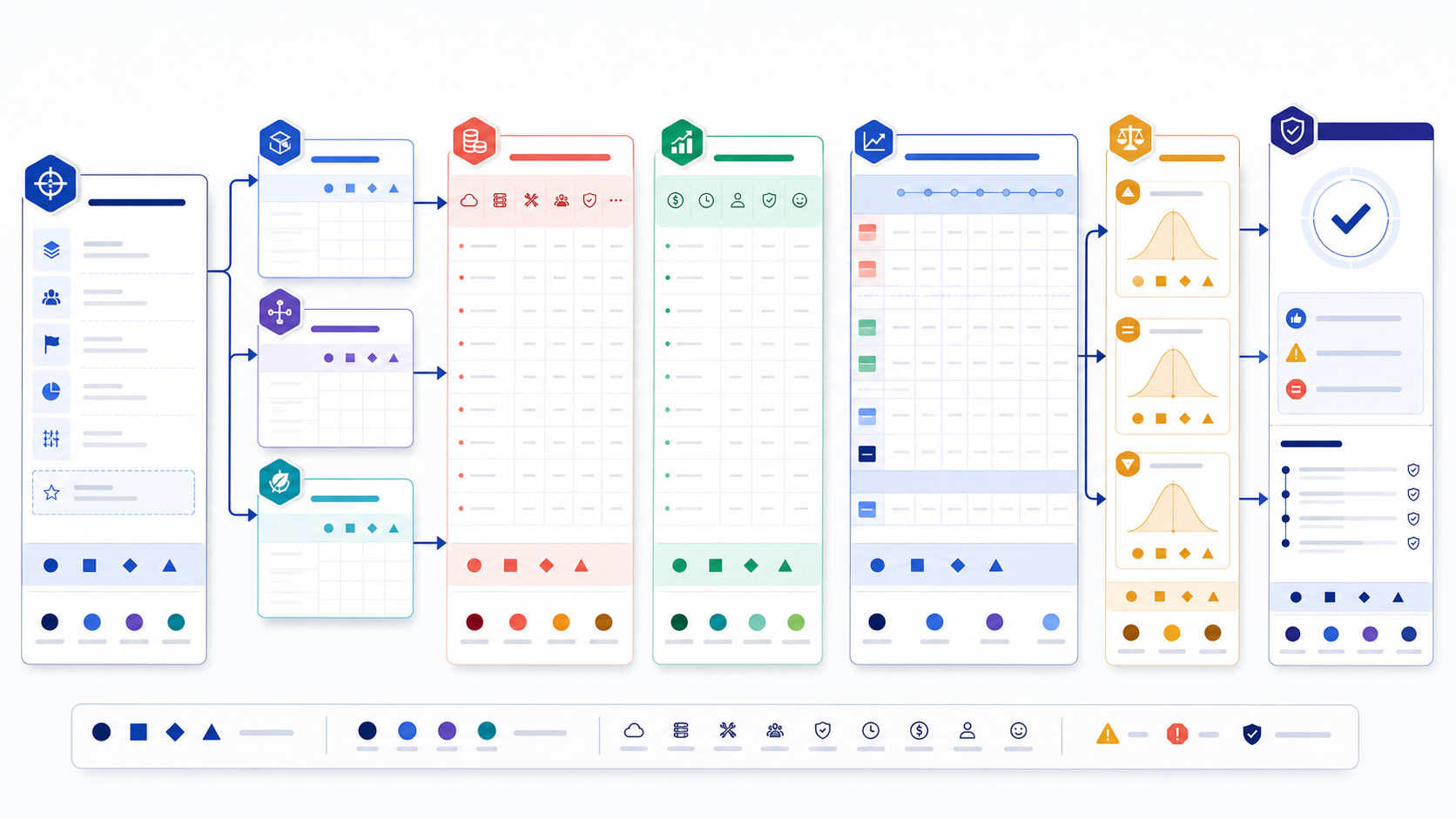
Organize the model as ten connected registers
Whether you implement the template in a spreadsheet, planning system, or financial model, separate the inputs into registers that can be reviewed independently and reconciled through stable IDs. Every cost and benefit should point to an option, period, source, owner, and assumption. Summary outputs should reference those registers rather than contain manually typed totals.
| Register | Purpose | Minimum output |
|---|---|---|
| 1. Decision record | Scope, owner, date, objective, constraints | Exact approval question |
| 2. Baseline | Business-as-usual performance and cost | Comparable counterfactual |
| 3. Options | Feasible approaches and critical success factors | Shortlist with exclusions explained |
| 4. Assumptions | Source, confidence, owner, test, dependency | Traceable evidence map |
| 5. Costs | Incremental lifecycle resources by period | Complete cost profile |
| 6. Benefits | Mechanism, attribution, adoption, utilization | Realized, non-duplicated value |
| 7. Cash flow | Costs and benefits by month, quarter, or year | Net and cumulative values |
| 8. Risk and impact | Controls, residual risk, non-monetized effects | Constraints and adjustments |
| 9. Sensitivity | Scenarios and switching values | Recommendation robustness |
| 10. Decision summary | Results, evidence gaps, gates, recommendation | Approve, pilot, defer, redesign, or reject |
Start the template with the decision, not the solution
A model cannot be evaluated if the question keeps moving. Record the decision owner, approval date, affected workflow, population, time horizon, currency, price basis, funding constraint, objective, quality threshold, risk threshold, exclusions, and alternatives that remain open. State what happens under business as usual and when delay begins to have a cost.
| Decision field | Entry prompt | Review test |
|---|---|---|
| Decision requested | Approve which option, amount, period, and authority? | Can the owner answer approve or reject? |
| Outcome and threshold | What must improve, by when, without violating what? | Is success observable and time-bound? |
| Scope boundary | Which users, tasks, data, systems, locations, and exclusions? | Do costs and benefits use the same boundary? |
| Model basis | Currency, horizon, nominal or real prices, tax, discount rate | Has finance approved the convention? |
Use one comparison frame for every option
Measure business as usual with the same population, output definition, quality threshold, time window, and cost basis that will be used for future options. For an AI-assisted data workflow, baseline fields may include annual volume, eligible task categories, active labor by role, review and correction time, cycle time, queue time, first-pass acceptance, incidents, external spend, capacity constraints, and unmet demand.
Include at least business as usual, process improvement without new AI, a limited controlled pilot, and scaled implementation when each is feasible. Do not give the preferred option a longer benefit horizon, lower quality standard, broader demand pool, or more optimistic adoption rule than its alternatives.
| Option field | What to record |
|---|---|
| Option ID and description | Stable ID, scope, delivery model, start date, end state |
| Critical success factors | Outcome, affordability, quality, security, continuity, feasibility |
| Dependencies | Data, access, integration, people, policy, supplier, training |
| Exclusion reason | Which objective or constraint the option cannot meet, with evidence |
Make every assumption traceable and testable
A number without provenance is not an input; it is an unsupported assertion. Give each assumption an ID and record the statement, value, unit, option, period, source, observation date, population, owner, confidence, affected calculation, sensitivity, validation method, due date, and status. Avoid hiding assumptions inside formulas because reviewers cannot see what changed.
| Confidence level | Definition | Required treatment |
|---|---|---|
| Observed | Measured in the target workflow with consistent definitions | Document coverage, exclusions, and data quality |
| Representative test | Measured in a sample including ordinary and difficult cases | Show sample selection and confidence range |
| Comparable evidence | Measured elsewhere and adjusted for known differences | State the adjustment and residual limitation |
| Expert estimate | Reasoned range from an accountable specialist | Use a range and an update trigger |
| Unverified | Planning placeholder without direct support | Stress-test; do not present as a result |
Capture the complete incremental lifecycle cost
Record costs caused by each option relative to the counterfactual, across implementation, operation, change, control, and exit. For each line, include cost ID, option, category, description, cash or internal resource, quantity, unit, unit price, period, one-time or recurring status, escalation rule, tax basis, uncertainty range, source, owner, and linked risk or assumption.
| Lifecycle category | Typical AI project entries | Common omission |
|---|---|---|
| Design and implementation | Discovery, workflow design, engineering, integration, migration | Internal subject-matter time |
| Platform and infrastructure | Licenses, usage, compute, storage, environments, logs | Volume-based price growth |
| Data and access | Quality remediation, schemas, permissions, lineage, retention | Ongoing stewardship |
| Evaluation and control | Test sets, human review, security, privacy, monitoring, audit | Regression tests after model change |
| Adoption and operation | Training, support, process ownership, incident response | Manager and reviewer workload |
| Contingency and exit | Risk allowance, fallback, portability, contract exit, decommissioning | Dual-running and data export |
Cost rule: distinguish cash expenditure, allocated internal labor, and economic opportunity cost. State the accounting treatment once and apply it consistently so the same resource is not omitted or counted twice.
Record benefits by mechanism, realization, and owner
A benefit register should explain how an output changes an outcome. Record benefit ID, option, affected population, baseline, future value, unit, eligible share, adoption, attribution, utilization, ramp-up, duration, evidence source, confidence, owner, first realization date, financial treatment, overlap with other benefits, and the operational metric that will verify realization.
| Benefit class | Template calculation | Evidence test |
|---|---|---|
| Cash saving | Approved spend avoided or reduced | Budget, contract, invoice, payroll, or hiring plan changes |
| Capacity value | Eligible volume × adoption × time saved × labor rate × utilization | Recovered hours are reassigned to named work |
| Quality and rework | Avoided failures × cost per failure | Comparable acceptance, correction, incident, and loss data |
| Speed and service | Value of earlier accepted outcome, not time saved again | Cycle time linked to a distinct business outcome |
| Risk reduction | Change in probability × consequence, adjusted for control cost | Loss history, control tests, and residual risk review |
| Revenue or mission outcome | Incremental outcome attributable to the option | Counterfactual, lag, margin, displacement, and confidence |
Benefit rule: recovered time is not automatically cash. Do not count one mechanism as capacity value, contractor avoidance, faster service, and revenue at the same time. Use overlap IDs to remove double counting.
Place every cost and benefit in the period it occurs
Choose monthly periods for short pilots or uneven contracts, quarterly periods for staged programs, and annual periods only when timing within the year does not affect the decision. Each period should calculate incremental cost, realized benefit, net cash flow, cumulative cash flow, and discounted value. Do not place full steady-state benefits in the first period if implementation, training, adoption, or operational learning creates a ramp.
| Period | Implementation cost | Recurring cost | Realized benefit | Net flow | Cumulative |
|---|---|---|---|---|---|
| Period 0 | Enter | Enter | Usually zero | Benefit − cost | Net flow |
| Period 1 | Enter | Enter | Apply ramp | Benefit − cost | Prior cumulative + net |
| Later periods | Milestones only | Usage and support | Realized value | Benefit − cost | Continue series |
| Exit period | Decommissioning | Final obligations | Residual value if supported | Benefit − cost | Final cumulative |
Use a small set of reconciled formulas
Keep inputs separate from calculated cells and protect formulas from manual override. Every metric should reconcile to the same cash-flow schedule. Define whether the model uses nominal or real values, whether tax is included, how partial periods are treated, and which discount rate finance has approved.
| Metric | Formula | Interpretation |
|---|---|---|
| Net benefit | Total realized benefits − total incremental costs | Undiscounted value over the chosen horizon |
| ROI | Net benefit ÷ total incremental cost × 100 | Return per unit of cost; does not show timing |
| Payback | First period cumulative net flow becomes non-negative | Liquidity and timing; ignores later value |
| NPV | Sum of each net flow ÷ (1 + discount rate)period | Time-adjusted net value |
| BCR | Present value of benefits ÷ present value of costs | Value per discounted cost unit |
| Break-even adoption | Required benefit ÷ benefit at 100% adoption | Adoption level that changes the decision |
A metric can be mathematically correct and still misleading if its inputs use different scopes. Reviewers should trace the numerator and denominator back to the same option, population, currency, price basis, and horizon. Never compare three-year benefits with first-year cost or use gross time saving while recurring control work is excluded.
Keep risk, control cost, and non-monetized impact together
For each material risk, record cause, affected outcome, likelihood, consequence, preventive control, detective control, owner, response, control cost, residual exposure, monitoring signal, and stop threshold. Link the control cost back to the cost register and link any probability-adjusted expected loss to the benefit or risk-adjustment calculation.
Do not force every important effect into money. Record quality, privacy, fairness, security, continuity, employee impact, supplier dependency, environmental effect, and distribution across affected groups with a scale, direction, evidence, owner, and threshold. An option that fails a non-negotiable requirement should not win because of a high ROI.
| Impact field | Entry | Decision treatment |
|---|---|---|
| Direction and scale | Positive/negative; minor/moderate/major | Compare consistently across options |
| Affected group | Users, employees, customers, partners, public | Show who receives value and who bears cost |
| Threshold | Minimum acceptable or maximum tolerable condition | Reject, redesign, or add control if breached |
| Evidence and owner | Source, confidence, monitoring metric, accountable role | Refresh at each gate |
Test downside, base, upside, and switching values
Start with high-impact, low-confidence assumptions: eligible workload, adoption, total human time after change, usable capacity, error reduction, implementation duration, recurring usage cost, control workload, and benefit ramp. Define downside and upside values from evidence ranges rather than arbitrary percentage changes.
| Sensitivity field | Downside | Base | Upside | Switching value |
|---|---|---|---|---|
| Eligible share | Lower evidence bound | Expected | Upper evidence bound | Minimum for approval |
| Adoption | Observed low | Pilot estimate | Supported high | Break-even adoption |
| Total human work | More review/rework | Representative median | Validated low | Maximum acceptable time |
| Recurring cost | High usage and control | Expected volume | Contracted low | Maximum cost for positive value |
| Go-live date | Delayed | Planned | Earliest credible | Latest acceptable date |
Show the recommendation under every scenario. If a small plausible change turns approval into rejection, the correct next step may be a representative pilot or another measurement—not a larger commitment. Record which evidence would most reduce decision uncertainty and how much it costs to obtain.
Summarize the model in one reviewable decision table
The final summary should make comparison possible without hiding the supporting registers. Include each option's objective performance, total cost, realized benefit, net benefit, ROI, payback, NPV or BCR when appropriate, cash requirement, key non-monetized impacts, residual risks, evidence confidence, dependencies, and recommendation. Use the same metric definitions across all columns.
| Summary field | Option A | Option B | Option C |
|---|---|---|---|
| Meets objective and constraints? | — | — | — |
| Lifecycle cost | — | — | — |
| Realized benefit | — | — | — |
| Net benefit / ROI / payback | — | — | — |
| Downside result | — | — | — |
| Evidence confidence | — | — | — |
| Residual risk and impact | — | — | — |
| Recommendation and gate | — | — | — |
Rankings are not sufficient. An option must first meet the objective and non-negotiable constraints. The preferred option should optimize value in a balanced judgement that considers monetized and non-monetized effects, affordability, delivery, risk, uncertainty, and evidence—not merely the highest BCR or ROI.
Write a conditional recommendation that can be enforced
Record the preferred option, amount, funding source, accountable owner, approved period, required controls, expected benefits, unresolved assumptions, evidence to collect, next review date, scale conditions, and stop conditions. A staged approval can authorize discovery, pilot, limited production, and scale separately, allowing evidence quality to rise before commitment becomes difficult to reverse.
Copyable recommendation pattern: Approve [option] up to [amount] for [scope and period], owned by [role], subject to [prerequisites]. Proceed to [next stage] only if [quality], [adoption], [cost], [risk], and [financial] thresholds are met during [measurement window]. Stop, redesign, or return for approval if [conditions] occur.
Fill the template in evidence order, not spreadsheet order
- Lock the decision frame. Agree on scope, objective, counterfactual, options, horizon, and finance conventions.
- Measure the baseline. Reconcile operational, quality, demand, risk, and cost data with stable definitions.
- Create the assumption register. Expose sources, confidence, owners, tests, and affected calculations before forecasting.
- Build cost and benefit registers. Use unique IDs, remove overlaps, and link every line to an option and period.
- Schedule cash flow. Model implementation, ramp, steady state, renewal, contingency, and exit when they occur.
- Reconcile financial metrics. Calculate net benefit, ROI, payback, NPV, and BCR from the same timed series.
- Test uncertainty and risk. Run evidence-based scenarios, calculate switching values, and apply constraints.
- Review across functions. Finance, workflow, data, security, privacy, legal, procurement, and delivery owners challenge the model.
- Issue a versioned decision. Record approval, conditions, evidence gaps, next gate, monitoring, and model-refresh triggers.
Keep one source of truth from forecast to realization
Give the model a version, owner, review status, approval history, change log, source index, and protected calculation layer. Record who may edit inputs, formulas, or decision thresholds. Preserve the version that supported each approval; do not silently overwrite it when actual results become available.
Approves accounting basis, price treatment, funding, discounting, and reported metrics.
Owns operational realization, adoption, capacity reuse, measurement, and corrective action.
Validates control design, evidence, residual exposure, monitoring, and incident response.
Maintains IDs, formulas, sources, versions, reconciliation, and review responses.
After implementation, add actual cost, usage, adoption, quality, incidents, time, and benefit realization beside the forecast. Explain variance by mechanism, update the remaining periods, and revisit the decision when a threshold or dependency changes. Evaluation is not an afterthought; its data and resource requirements belong in the original template.
Avoid template errors that create false confidence
This narrows options before the outcome and counterfactual are established.
Different populations, quality standards, or periods make ratios incomparable.
Recovered time needs a credible reuse or budget mechanism.
Evaluation, review, security, monitoring, fallback, and exit require resources.
Manual summaries break traceability and scenario recalculation.
A single precise forecast disguises evidence gaps and decision fragility.
Turn the completed registers into an ROI scenario
Before opening the InfiniSynapse ROI Calculator, prepare total investment, recurring cost, expected realized benefit, horizon, and scenario assumptions from the template. Use separate base, downside, and upside cases. Keep the detailed source, owner, confidence, timing, and overlap controls in your working model because a calculator summarizes economics; it does not replace evidence governance.
Calculate a documented project scenario
Use reviewed template inputs to compare cost, benefit, horizon, and return—then carry the result back into the decision summary.
Open ROI CalculatorDo not enter credentials, personal data, or confidential project information.Frequently asked questions
What should a cost benefit analysis template include?
Include the decision and scope, business-as-usual baseline, comparable options, assumptions and evidence, lifecycle costs, realized benefits, timed cash flow, financial metrics, sensitivity, risks, non-monetized effects, owners, and approval gates.
How do I fill out a cost benefit analysis template?
Define the decision first, measure the baseline, compare feasible options, record each cost and benefit with source and owner, schedule cash flows, calculate consistent metrics, test switching values, and write a conditional recommendation.
What is the difference between a cost-benefit template and a business case?
The cost-benefit template is the analytical model for options, costs, benefits, timing, and uncertainty. A business case adds strategic fit, procurement, affordability, governance, delivery, and the complete approval narrative.
Should time savings be entered as cash savings?
No. Recovered time is capacity value unless payroll, contractor, overtime, or hiring expenditure actually changes. Record the utilization assumption and keep capacity, cash, quality, speed, and risk benefits separate.
How often should the template be updated?
Update it at every decision gate and whenever scope, price, adoption, performance, control cost, schedule, or risk changes materially. After launch, replace forecasts with actual costs and realized benefits while preserving the approved version.
Sources, scope, and adaptation notes
This template is an original organizational worksheet structure informed by official appraisal, cost-estimating, business-case, and AI risk guidance. It is not a substitute for the accounting, tax, legal, procurement, safety, or public-sector appraisal rules that apply to a specific decision.
HM Treasury, The Green Book (2026) — official guidance on rationale, options, lifecycle costs and benefits, uncertainty, discounting, sensitivity, switching values, and balanced value-for-money judgement.
HM Treasury, Guidance on Developing Business Cases — the Five Case Model and staged development of decision-ready spending proposals.
U.S. GAO Cost Estimating and Assessment Guide — best practices for scope, assumptions, source data, time-phased estimates, sensitivity, risk, documentation, and updates using actual cost.
NIST AI Risk Management Framework — voluntary guidance for governing, mapping, measuring, and managing AI risk throughout the lifecycle.
Apply the structure proportionately. Use the organization's approved currency, price basis, tax treatment, discount rate, accounting policy, approval thresholds, and control standards. Public-sector social cost-benefit analysis may require a wider perspective, prescribed discounting, distributional analysis, and statutory duties beyond this organizational ROI model.