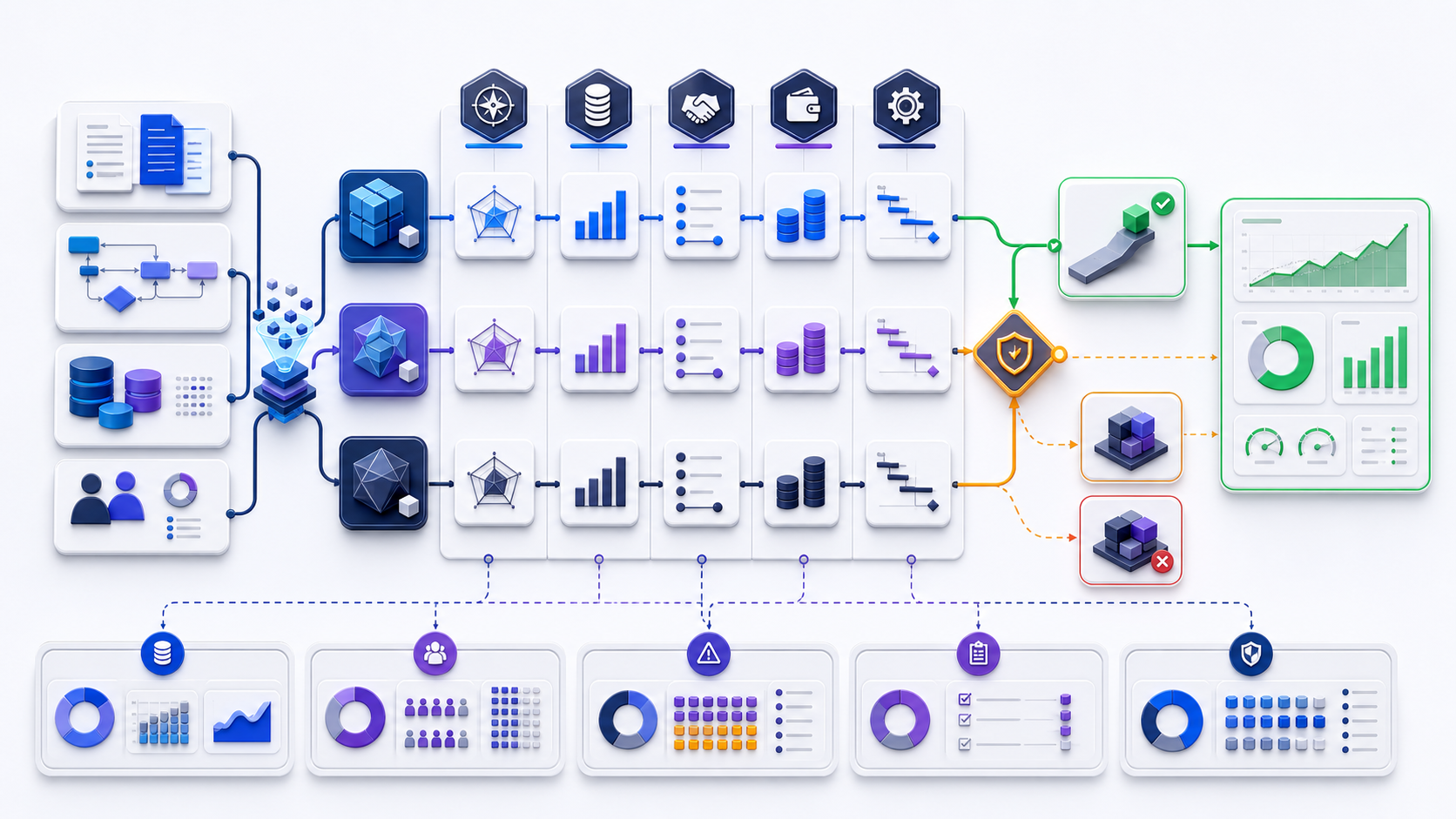
What belongs in an AI project business case?
A decision-ready business case explains why change is needed, compares credible options, shows total cost and measurable benefit, makes risk and uncertainty visible, and proves that the preferred option is affordable and deliverable. For an AI data project, it must also document data readiness, human review, adoption, evaluation, monitoring, security, and the conditions that would stop or redesign the initiative.
Treat the document as a decision system, not a sales narrative. A reviewer should be able to approve, reject, defer, fund a smaller experiment, or request specific missing evidence. If every section points only toward approval, the document is advocacy rather than analysis.
Start with the approval decision, not the preferred tool
Write the decision in operational terms: who decides, by what date, which budget and workflow are in scope, and which choices remain open. “Approve an AI analytics platform” is too narrow because it assumes the answer. A stronger question is: “Which option should the data operations team fund for the next twelve months to reduce recurring request lead time while maintaining agreed quality and control thresholds?”
Name the person or governance body with budget and risk authority.
Set the evidence cutoff and the date when delay begins to have a cost.
Define workflows, users, data, locations, systems, and exclusions.
State minimum outcome, quality, privacy, security, and continuity thresholds.
Use five connected views of the same investment
HM Treasury's Five Case Model offers a useful audit-friendly structure: strategic, economic, commercial, financial, and management. It is official UK public-sector guidance, not a universal rule for every company, but the separation helps private teams avoid mixing “why this matters,” “which option is best,” “can we buy it,” “can we afford it,” and “can we deliver it.” Adapt the terminology to the organization's approval process.
Problem, affected users, case for change, objectives, constraints, and strategic fit.
Longlist, shortlist, counterfactual, costs, benefits, wider effects, and preferred option.
Market capacity, build-versus-buy, contracts, data rights, exit, and supplier dependency.
Funding, cash-flow timing, affordability, accounting treatment, ROI, and payback.
Owners, milestones, adoption, controls, measurement, benefits realization, and change.
Develop the five views iteratively. A new security requirement may change cost, timetable, vendor choice, and expected benefit. A weak adoption plan may invalidate the financial case. The sections should reconcile to one set of assumptions rather than behave as independent essays.
Fill this business case template with evidence
Use the following structure as the one-page executive summary, then attach the analysis that supports each answer. Keep fields blank when evidence is missing; do not convert uncertainty into confident prose.
| Template field | Required answer | Evidence to attach |
|---|---|---|
| Decision requested | Approve, reject, defer, or fund which option and amount? | Named owner, date, authority, funding source |
| Problem and baseline | What observable performance gap affects whom? | Volume, time, quality, backlog, cost, incident data |
| Objectives and thresholds | What must improve, by when, without violating what? | SMART measures and safety constraints |
| Options | What happens under business as usual and feasible alternatives? | Eligibility, capability, feasibility, dependencies |
| Costs and funding | What is the complete cash and internal-resource requirement? | Work breakdown, estimates, contracts, contingencies |
| Benefits | Which outcomes are cash, capacity, quality, speed, or risk reduction? | Baseline, pilot, adoption, attribution, utilization |
| Risk and control | What can fail, who owns it, and what is residual exposure? | Control design, test results, monitoring, response cost |
| Delivery and adoption | Who delivers, uses, supports, measures, and governs the change? | Milestones, owners, capacity, training, rollback plan |
| Recommendation | Why is this option preferred, and under which conditions? | Decision table, sensitivities, open assumptions |
Prove the problem before pricing the solution
Describe the current workflow from trigger to accepted outcome. Include request intake, clarification, access approval, preparation, analysis, review, correction, delivery, and follow-up. Measure volume, end-to-end cycle time, active labor across roles, queue time, acceptance rate, rework, incidents, external spend, and unmet demand over a representative period.
Separate symptoms from mechanisms. “Analysts are slow” is a conclusion. The mechanism may be incomplete requirements, fragmented data access, repeated SQL drafting, manual reconciliation, review bottlenecks, or shifting priorities. A tool that accelerates only one non-bottleneck step can produce impressive demos without changing the business outcome.
Baseline rule: use the same task definition, quality threshold, population, and observation window when comparing current and future performance. If definitions change, show a reconciliation rather than calling the numbers comparable.
Compare credible options against business as usual
At minimum, compare business as usual, process improvement without new technology, a limited pilot, and scaled implementation. Add build, buy, or hybrid variants only when they are feasible. Use the same horizon and outcome standard for every option; otherwise the preferred option may win because it received a more favorable definition.
| Criterion | Question | Scoring safeguard |
|---|---|---|
| Outcome fit | Can it change the defined business mechanism? | Evidence from comparable tasks |
| Data readiness | Are access, lineage, quality, and permissions adequate? | Assess current state, not planned remediation |
| Control fit | Can privacy, security, review, audit, and fallback rules be met? | Price every required control |
| Adoption feasibility | Will eligible users use it in the real workflow? | Use task-level pilot behavior |
| Value for cost | Does risk-adjusted benefit exceed full lifecycle cost? | Use common financial assumptions |
| Deliverability | Are owners, skills, capacity, dependencies, and timing credible? | Name people and constrained resources |
Record both score and rationale. A weighted total is a navigation aid, not proof. Preserve veto conditions—such as prohibited data use or inability to meet an acceptance threshold—even if an option scores well elsewhere.
Estimate the complete cost of approval and operation
Build cost from a work breakdown rather than applying a convenient percentage to license price. Include discovery, process redesign, data preparation, integration, evaluation, security review, procurement, implementation, migration, training, change support, human oversight, infrastructure, monitoring, maintenance, incident response, renewal, and exit. Show internal labor even when it does not create an invoice.
For each estimate, record unit, quantity, rate, timing, source, estimator, confidence, and dependency. GAO cost-estimating guidance emphasizes scope, a technical baseline, work breakdown, assumptions, data, methods, sensitivity, risk, documentation, and updates with actual costs. Those disciplines are useful even for a smaller internal AI project.
Trace features to outcomes before monetizing benefits
Build an outcome chain: capability enables a workflow change; the workflow change alters an operational measure; that measure affects a business outcome; and only then is value assigned. “AI writes queries” is a capability. “Accepted recurring requests require fewer analyst minutes at the same defect threshold” is an operational outcome that can support valuation.
A budgeted cost is removed, avoided, or contractually reduced.
Recovered time is assigned to additional accepted work or shorter queues.
Correction, review, incident, or decision-error consequences decline.
Exposure, control effort, recovery time, or probability of loss changes.
Assign a benefit owner, baseline, target, measurement source, start date, ramp-up curve, attribution rule, and review cadence. Discount benefits for unsupported task volume, adoption, rework, utilization, and uncertainty. Do not count the same recovered hour as both contractor reduction and added capacity unless both outcomes can occur.
Show ROI, payback, net benefit, and cash timing
No single metric answers every approval question. ROI shows benefit relative to cost; net benefit shows absolute value; payback shows how quickly upfront investment is recovered; a cash-flow schedule shows affordability. Use benefit-cost ratio or net present value when the organization's appraisal policy requires them. For a worked cost benefit analysis example with a cash-flow table, start there, then return to this template for the approval document.
Net benefit =
  total realized benefits − total costs

ROI (%) =
  net benefit ÷ total costs × 100

Benefit-cost ratio =
  total benefits ÷ total costs

Payback month =
  first month cumulative net cash flow becomes non-negative

Risk-adjusted benefit =
  eligible benefit × adoption × utilization
  − expected rework and failure cost
Use one time horizon and place cash in the periods when it occurs. Do not compare a three-year benefit with a one-year cost. Keep recovered capacity separate from cash unless an approved utilization rule converts it to value. If the investment has a long life or material timing differences, apply the organization's approved discount rate rather than inventing one.
Compare three options in a worked business case
Consider a hypothetical data operations team handling 30,000 recurring requests per year. The decision is whether to retain the current process, run a controlled AI-assisted pilot, or scale an integrated workflow. Every option is assessed over two years with the same acceptance threshold. These figures illustrate the template; they are not InfiniSynapse performance claims.
| Measure | Business as usual | Controlled pilot | Scaled workflow |
|---|---|---|---|
| Eligible coverage | 0% | 20% | 70% |
| Expected adoption | 0% | 65% | 75% |
| Two-year total cost | $420,000 | $155,000 | $510,000 |
| Two-year realized benefit | $0 | $185,000 | $710,000 |
| Net benefit | Baseline only | $30,000 | $200,000 |
| ROI | Not applicable | 19.4% | 39.2% |
| Evidence confidence | High baseline confidence | Medium, representative sample | Low-to-medium, adoption uncertain |
The scaled option has the highest expected value, but the pilot may still be the rational approval if the organization has not validated adoption, integration reliability, review burden, or security controls. A conditional decision could fund the pilot and authorize scale only if acceptance exceeds 92%, task adoption reaches 65%, severe incidents remain zero, and the updated payback stays below eighteen months.
Put AI risk, control cost, and residual exposure together
A risk register is useful only when it changes the design or decision. For each material risk, record the affected outcome, cause, likelihood, consequence, preventive control, detective control, owner, response, control cost, residual exposure, and monitoring signal. Examples include unreliable output, unauthorized data access, privacy leakage, prompt injection, hidden bias, weak explainability, supplier outage, model change, and loss of human capability.
The NIST AI Risk Management Framework organizes work around govern, map, measure, and manage. Use it as a risk-management reference, not as a certification claim. Controls such as evaluation, human review, logging, monitoring, incident response, red-team testing, and rollback require budget and delivery capacity; they cannot sit in an appendix with zero cost.
Decision rule: a high expected ROI does not override a safety, legal, privacy, or continuity threshold. Record non-negotiable constraints separately from risks that can be traded against cost or schedule.
Make the preferred option executable after approval
A business case is incomplete if value depends on work that has no owner or capacity. Name the accountable executive, product owner, workflow owner, data owner, security reviewer, finance partner, evaluator, support owner, and benefit owner. Show constrained skills and competing commitments rather than assuming every role is available when needed.
- Confirm prerequisites. Data access, quality, identity, logging, environments, contracts, and policies are ready.
- Run a representative pilot. Include ordinary, difficult, exception, and prohibited cases across real user groups.
- Measure adoption and quality. Track eligible-task use, acceptance, review time, correction, fallback, incidents, and abandonment.
- Release by decision gate. Move from pilot to limited production and scale only when named thresholds are met.
- Verify realized value. Compare forecast with actual cost, usage, quality, risk, capacity reuse, and cash flow.
Expose assumptions and grade evidence confidence
Create an assumption register with a unique ID, statement, source, owner, affected calculation, confidence, sensitivity, test plan, due date, and status. Typical assumptions include eligible volume, adoption, automated task time, review load, loaded labor value, capacity utilization, error reduction, integration effort, vendor price, and ramp-up duration.
Measured in the target workflow with consistent definitions and adequate coverage.
Measured elsewhere with a documented adjustment for population or process differences.
Provided by an accountable specialist with range, rationale, and update trigger.
A planning placeholder that must not be presented as measured evidence.
Stress-test high-impact, low-confidence assumptions first. Calculate break-even adoption, maximum acceptable review time, maximum recurring cost, minimum utilization, and latest acceptable go-live date. If a small plausible change reverses the recommendation, approve another test rather than a large irreversible commitment.
Write a conditional recommendation with explicit gates
A useful recommendation names the option, approved amount, funding source, owner, period, required controls, benefits target, evidence gaps, conditions precedent, next gate, and stop conditions. Avoid “approve the project” without limits. Approval may be staged: discovery, pilot, limited production, and scale each require different evidence.
Example recommendation: approve a twelve-week controlled pilot up to $95,000 for two defined workflows. Authorize production expansion only if acceptance is at least 92%, eligible-task adoption is at least 65%, severe incidents are zero, review time remains below four minutes per task, and the refreshed two-year payback remains below eighteen months.
Build the business case in eight evidence-led steps
- Frame the decision. Name the owner, date, scope, budget, alternatives, success, and non-negotiable constraints.
- Measure the current state. Document workflow mechanisms, volume, labor, cycle time, quality, cost, risk, and demand.
- Define objectives and thresholds. Separate desired improvement from minimum quality, safety, privacy, and continuity rules.
- Develop credible options. Include business as usual, process change, pilot, and feasible build, buy, or hybrid alternatives.
- Estimate cost and benefit. Use lifecycle cost, an outcome chain, adoption adjustment, cash timing, and no double counting.
- Assess risk and deliverability. Price controls, identify owners and dependencies, and show residual exposure and rollback.
- Test uncertainty. Show low, base, high, break-even, and evidence-confidence cases.
- Recommend and verify. Use conditional approval gates and schedule post-launch comparison of forecast and actual value.
Avoid business cases that look complete but cannot be audited
Frame the decision and mechanism before selecting technology.
Compare the preferred option with business as usual and feasible alternatives.
Include internal delivery, control, operation, change, and exit.
Report recovered hours separately unless a budgeted cost changes.
Adjust for eligibility, adoption, exceptions, population, and ramp-up.
Place evaluation, review, monitoring, and response in the budget.
Show ranges, sensitivities, break-even points, and confidence.
Assign benefit owners and compare forecast with actual performance.
Check whether the business case is decision-ready
- The requested decision, owner, authority, date, amount, and funding source are explicit.
- The problem is supported by a representative baseline and a documented mechanism.
- Objectives, success measures, safety thresholds, constraints, and exclusions are measurable.
- Business as usual and credible alternatives use the same scope, horizon, and outcome standard.
- Costs include upfront, recurring, internal, contingent, control, maintenance, and exit work.
- Benefits have owners, baselines, attribution rules, adoption adjustments, timing, and evidence.
- Cash, capacity, quality, speed, and risk benefits are separated without double counting.
- Every material AI risk has controls, cost, owner, monitoring, residual exposure, and response.
- Delivery milestones, constrained resources, dependencies, training, support, and rollback are funded.
- ROI, net benefit, payback, cash flow, low/base/high cases, and break-even points reconcile.
- High-impact assumptions show source, confidence, sensitivity, test, owner, and update date.
- The recommendation includes conditions, decision gates, stop rules, and post-launch verification.
Turn your business case assumptions into ROI scenarios
Prepare eligible task volume, current and future labor time, loaded labor value, adoption, utilization, implementation cost, recurring cost, avoided cash cost, quality value, and timing. Then use the InfiniSynapse Data Analysis ROI Calculator to compare benefit, cost, net value, ROI, and payback before writing the final recommendation.
Model Your Business Case ROIUse aggregated, non-sensitive inputs and have finance, workflow, data, security, and benefit owners review the assumptions.Business case template frequently asked questions
Include the problem and baseline, strategic objectives, feasible options, total costs, measurable benefits, risks and controls, adoption assumptions, delivery ownership, financial results, evidence confidence, and an explicit recommendation.
A proposal usually describes what a team wants to build. A decision-ready business case also compares alternatives, tests affordability and value, documents uncertainty, and defines how benefits and risks will be verified after approval.
Use net benefit, ROI, payback period, and cash-flow timing. Add net present value or a benefit-cost ratio when the organization requires them, but keep capacity benefits separate from actual cash savings.
Connect each material risk to an owner, control, residual exposure, monitoring signal, response cost, and decision threshold. Risk controls belong in the cost and delivery plan rather than in a detached appendix.
It is ready when the problem, options, assumptions, evidence, owners, costs, benefits, risks, funding, delivery plan, and post-launch measurement are complete enough for the named decision-maker to approve, reject, defer, or request another test.